At this past month’s Governing Board Meeting of the San Joaquin Valley Air Pollution Control District, the Board approved a fee increase for permits. This change will increase permit fees by 4.8%, effective July 1, 2018, and again by 4.6%, effective July 1, 2019. The Association voiced its opposition during workshops on the fee increase, but was the only industry group to do so. At the Governing Board Meeting Association President/CEO Roger Isom testified in opposition, one of only two groups to do so. Isom stated, “While we recognize and appreciate the efforts by staff to keep costs down and minimize fees, all of our operating costs are going up. The State Water Resources Control Board is proposing to increase their fees this year. Minimum wage is going up. The prices for electricity will be increasing this year. Meanwhile, the prices for our commodities are not. The agricultural industry has no way to pass along the cost.” Despite the Association’s effort, the lack of industry opposition made this an easy decision for the board to increase their fees. The Nisei Farmers League was the only other group to oppose these fee increases.
NEWS & ISSUES
CCGGA Latest News- FINAL CALL to Register to Attend the 2018 Sticky Cotton Summit
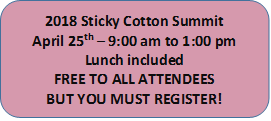
This is the last call to attend the 2018 CCGGA Sticky Cotton Summit. We have discussed this issue many times, and brought it to the forefront last year in our first ever Sticky Cotton Summit. We walked away from that meeting with several action items, and now it’s time to see where we are. The cotton industry in California can ill afford to be labeled with sticky cotton. Our Board of Directors has called for an update on where we are on those action items. This important meeting will be the 2018 CCGGA Sticky Cotton Summit and will be held on Wednesday, April 25th at the Wyndham Garden Fresno Airport Hotel in Fresno. Registration and Continental Breakfast will begin at 8:30 am. The actual program will begin at 9:00 am and will end with lunch. This event is FREE; however registration is REQUIRED in order to provide us with an accurate count for room and lunch needs. You may register online at https://2018stickycottonsummit.eventbrite.com or you can call our offices at (559) 252-0684.
Heat Illness Prevention Training Session
Sponsored by
Department of Industrial Relations,
Cal/OSHA Consultation & Agricultural Organizations
Date: Friday, April 13, 2018
Time: Spanish 10:00 a.m. to 12:00 p.m.
English 1:30 p.m. to 3:30 p.m.
Place: C.P.D.E.S. Portuguese Hall
172 W. Jefferson Avenue
Easton, CA 93706
NO COST TO ATTEND
Program intended for:
Contractors, Field Supervisors,Crew Leaders, Managers, Construction
RSVP NOT REQUIRED
Certificates will be given upon completion of the two-hour session
Transform Section 18 Moves to Federal EPA
The California Cotton Ginners and Growers submitted an application to California Department of Pesticide Regulation to reissue the Association’s 2017 Section 18 authorizing the use of Transform on cotton for Lygus. The application soared through DPR and is now in the hands of the federal Environmental Protection Agency. DPR specifically requested that this application be reviewed in an expedited manner. In addition, CCGGA is already underway with putting together another Section 18 for Transform for use on aphid. While we have additional time to put this application together, we are working as diligently as possible to get it as early as we can. If you have any questions, please contact us at our offices at (559) 252-0684.
Make Plans Now to Attend the 2018 Sticky Cotton Summit, April 25th
The cotton industry in California is faced with a critical issue, and that is the continued presence of sticky cotton. We have discussed this issue many times, and brought it to the forefront last year in our first ever Sticky Cotton Summit. We walked away from that meeting with several action items, and now it’s time to see where we are. The cotton industry in California can ill afford to be labeled with sticky cotton. Our Board of Directors has called for an update on where we are on those action items. This important meeting will be the 2018 CCGGA Sticky Cotton Summit and will be held on Wednesday, April 25th at the Wyndham Garden Fresno Airport Hotel in Fresno. Registration and Continental Breakfast will begin at 8:30 am. The actual program will begin at 9:00 am and will end with lunch. This event is FREE; however registration is REQUIRED in order to provide us with an accurate count for room and lunch needs. You may register online at https://2018stickycottonsummit.eventbrite.com or you can call our offices at (559) 252-0684.

ARB Approves Spending Plan for Agricultural Equipment
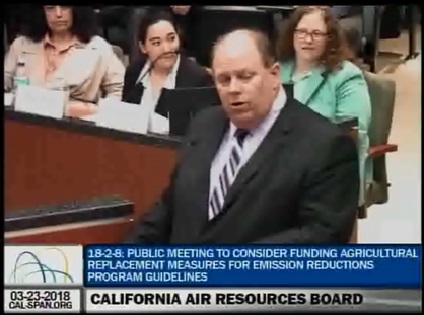
The culmination of tough legislation, and six months of negotiations resulted in the approval of $135 million for agricultural equipment in California. This momentous event occurred at the California Air Resources Board (CARB) hearing in Riverside this past week. This funding will replace ag tractors and harvesters, ag trucks and ag irrigation pump engines. This is critical because the California Air Resources Board is forced to consider mandatory tractor replacement regulations in the San Joaquin Valley, due to the imposition of incredibly restrictive federal ambient air quality standards. Without federal action to delay those standards, CARB is obligated to consider all potential measures, including a mandatory tractor replacement rule, such as those already being implemented on trucks and construction equipment. The Association pushed for this funding, as it is the only way agriculture can comply without being forced out of business. At the hearing, Association President/CEO Roger Isom stated “the problem with agriculture is that we have no way to pass along the cost.” The funding plan was approved unanimously and money should start flowing to the air districts in the late spring.
Association Announces Election Results and New Chairman
The California Cotton Ginners and Growers Association is pleased to announce that Tom Gaffney, of the J.G. Boswell Company has been named Chairman of the Association’s Board of Directors. Gaffney succeeds outgoing Chairman Phil Hansen, of Hansen Ranches. The Association would like to recognize Hansen for his outstanding service to the Association, especially during the critical time of merging the Ginners and Growers Associations into one organization. President/CEO Roger Isom stated “Phil was a true asset to the Association during this transition, and the cotton industry in California owes a debt of gratitude for his leadership and service during this time. During his time at the helm, Chairman Hansen led this Association in addressing critical issues like sticky cotton, the Association’s Section 18 for Transform, as well as the many regulatory and legislative issues we faced. He also served as the face of the California Cotton Industry during his tenure speaking at critical events in support of FFA and the construction of Temperance Flat Reservoir.” Also appointed were 1st Vice Chair, Bryan Bone of Buttonwillow; 2nd Vice Chair, Mike Davis of Dos Palos Coop; and Secretary/Treasurer Gary Martin of Firebaugh. Re-elected to the board were the following Ginners: Tom Gaffney, J.G. Boswell Company; Greg Gillard, Olam Cotton; Tom Pires, West Island Cotton Growers; and Mason Otten, Semi Tropic Cooperative Gin. The following Growers were re-elected: Kings County: Jim Razor, J.G. Boswell Company; and Phil Hansen, Hansen Ranches; and Southern California: Tim Cox. Newly elected to the Board of Directors was Kings County Grower Geoff Toledo of Hanford. Sam Carreiro, of Kings County was appointed as an Advisor to the board. All board member positions are three year terms, while officers serve in those positions for two years.
2018 Sticky Cotton Summit, April 25th
The cotton industry in California is faced with a critical issue, and that is the continued presence of sticky cotton. We have discussed this issue many times, and brought it to the forefront last year in our first ever Sticky Cotton Summit. We walked away from that meeting with several action items, and now it’s time to see where we are. The cotton industry in California can ill afford to be labeled with sticky cotton. Our Board of Directors has called for an update on where we are on those action items. This important meeting will be the 2018 CCGGA Sticky Cotton Summit and will be held on Wednesday, April 25th at the Wyndham Garden Fresno Airport Hotel in Fresno. Registration and Continental Breakfast will begin at 8:30 am. The actual program will begin at 9:00 am and will end with lunch. This event is FREE however registration is REQUIRED in order to provide us with an accurate count for room and lunch needs. You may register online at https://2018stickycottonsummit.eventbrite.com or you can call our offices at (559) 252-0684.
In addition, we are soliciting sponsorship from our Associate Members to help defray the costs of this meeting. Your support will be duly recognized in print in the meeting program and during the meeting. You may download the Sponsorship Form below. Please consider helping by choosing a level of sponsorship from the levels listed and faxing the form back to our offices promptly at (559) 252-0551 to allow for proper advance planning and recognition.
Draft Agenda
Online Registration
Sponsorship Flier
Western Cotton Shippers Association 2018 Annual Convention
REMINDER:
Join the WCSA in Monterey, CA for the 2018 Annual Convention, April 9-11, 2018 at the Monterey Plaza Hotel.
Please register soon with the hotel as March 15, 2018 is the cut-off date! Also, if you would like to play in the Golf Tournament there are still a few spots remaining. Click here for more information.
Forklift Train-the-Trainer Workshops 2018
The California Cotton Ginners and Growers Association in partnership with other Ag Organizations are now conducting the Forklift Train-the-Trainer Workshops. The first workshop began in Reedley to a great start with already 70 participants trained! These workshops are for Owners, Farmers, Managers Supervisors and those who are responsible to conduct training on forklifts. The training will review what is needed for the trainer to cover with their forklift operators at their facility. Be sure to visit our website www.ccgga.org for registration. If you have any questions, please contact our office at (559) 252-0684.
