The California Cotton Ginners and Growers Associations (CCGGA) submitted a letter to Department of Interior Secretary Sally Jewell this week urging the Department to reconsider the proposal by the National Marine Fisheries Service (NMFS) to limit Shasta releases to 8,000 cfs for temperature protection for salmonids. Doing so would cost the Central Valley Project (CVP) over 400,000 ac-ft of water, most of which had already been factored into this year’s water plans. The elimination of this water will have far reaching impacts to all water users. To add to the mess, the Fish and Wildlife Service (FWS) is requesting 300,000 ac-ft to be released later this summer for Delta smelt protection, meaning even more water could be lost from an already devastated valley.
NEWS & ISSUES
CCGGA Opposes Wild and Scenic Designation for San Joaquin River
The California Cotton Ginners and Growers Associations (CCGGA) has weighed in on the Bureau of Land Management’s (BLM) proposed designation of a 7.5 mile stretch of the San Joaquin River above Millerton Lake as “wild and scenic”. Such a designation would eliminate any possibility of the construction of Temperance Flat Dam and Reservoir. CCGGA wrote a letter this week to Department of Interior Secretary Sally Jewell opposing the proposed listing as not meeting the criteria for “wild and scenic”, which requires the river to be “free flowing”. The proposed area falls between Kerckhoff Dam and Kerchoff Powerhouse which has the water running through tunnels thereby largely bypassing the area. As such, it could not possibly meet the very basic criteria of “free flowing” and CCGGA urged the Secretary to not list the San Joaquin River as “wild and scenic.”
Cotton Ginning Cost Share Program
On June 6, 2016, the U.S. Department of Agriculture (USDA) launched the Cotton Ginning Cost Share (CGCS) program, providing cost share assistance payments to cotton producers to expand and maintain the domestic marketing of cotton. Through the Cotton Ginning Cost Share program, eligible producers can receive a one-time cost share payment, which is based on a producer’s
2015 cotton acres reported to FSA multiplied by 40 percent of the average ginning cost for each production region. The regional payment rates are
$47.44 for the Southeast, $56.26 for the Mid-South, $36.97 for the Southwest and $97.41 for the West. The average assistance to cotton producers from the program is estimated to be about $4,200 per farm or $8,100 per producer on average. For comparison, the 2014 Cotton Transition Assistance Program
(CTAP) provided about $2,600 per farm or $5,200 per producer on average.
Since 2011, cotton fiber markets have experienced dramatic changes. As a result of poor U.S. market conditions for cotton and, in part, as a result of a large amount of excess stocks of cotton held in China, cotton producers are facing economic uncertainty that has led to many producers having lost equity and having been forced to liquidate equipment and land to satisfy loans. The ginning of cotton is necessary prior to marketing the lint for fiber or the seed for oil or feed. While the Cotton Ginning Cost Share program makes payments to cotton producers for anticipated cotton ginning costs, the benefits of the program will be felt by the broader marketing chain associated with cotton and cottonseed, including cotton gins, cooperatives, marketers and cottonseed crushers and the rural communities that depend on them.
Signup for the program will begin June 20 and run through Aug. 5, 2016 at your local FSA office. Payments will be processed as applications are received and are expected to begin in July.
For more information, contact Kent Politsch:
Kent.Politsch@wdc.usda.gov; 202-720-7163.
Ag Overtime Legislation is Defeated!
As a result of an ag group effort by all in agriculture, including the Association, the effort to reduce the trigger for overtime pay in agriculture was officially defeated on a vote of 38 to 35! Assembly Bill 2757 (Gonzalez) would have enacted the Phase-In Overtime for Agricultural Workers Act of 2016, by phasing in a reduction in the trigger for overtime pay for “agricultural workers” as follows:
- July 1, 2019 – trigger would be 9 ½ hours per day or 55 hours per week
- January 1, 2020 – trigger would be 9 hours per day or 50 hours per week
- January 1, 2021 – trigger would be 8 ½ hours per day or 45 hours per week
- January 1, 2022 – trigger would be 8 hours per day or 40 hours per week
The bill was defeated in large part thanks to the “NO” votes by several key urban legislators including Assemblymembers Ken Cooley, Jim Cooper and Bill Quirk, and by those that did not vote including Assemblymembers Jacqui Irwin, Richard Bloom and Adrin Nazarian. Disappointingly, Assemblyman Rudy Salas of Bakersfield voted for the bill. Thanks to all in agriculture who worked so hard to oppose this important legislation.
Hazard Communication Deadline Approaching
The last deadline of the phase-in period in the revised Hazard Communication Standard is June 1, 2016.
Are you in compliance? Your Hazard Communication Program must be updated, provide employee training on identifying chemical physical or health hazards, safety data sheets and container labels (primary and secondary).
Please visit the Industry Issues page for Hazard Communication Compliance Safety Guide or contact Elda Brueggemann or Priscilla Rodriguez for assistance.
San Joaquin Valley Groundwater Briefing Wednesday, June 1
The California Department of Water Resources and Water Education Foundation in cooperation with the Center for Irrigation Technology will host a FREE one-day briefing on Wednesday, June 1 discussing how San Joaquin Valley groundwater conditions have responded to the multi-year drought and actions being taken towards sustainable groundwater management. This briefing is open to any interested parties including media, elected officials, legislative aides, water district managers and board members, state and federal agency officials, city and county government officials, farmers, environmentalists, attorneys, consultants, engineers, business executives and public interest groups.
Topics to be discussed include:
- Hydrologic conditions and drought status
- San Joaquin Valley groundwater conditions and status of SGMA implementation
- Monitoring valley land subsidence with remote sensing
- Beginning SGMA implementation – the local perspective
- Private residential wells and drought
The event will be held at the Alice Peters Auditorium (PB 191) in the University Business Center at Fresno State. Check-in/registration begins at 9:30 a.m. Complimentary coffee will be served. The program runs from 10 a.m. to noon and from 1:30 to 3 p.m. Lunch is on your own.
Event Flyer->june_1_fresno_flyer
Event Agenda->draft_june_1_agenda
East San Joaquin Petition Workshop Held
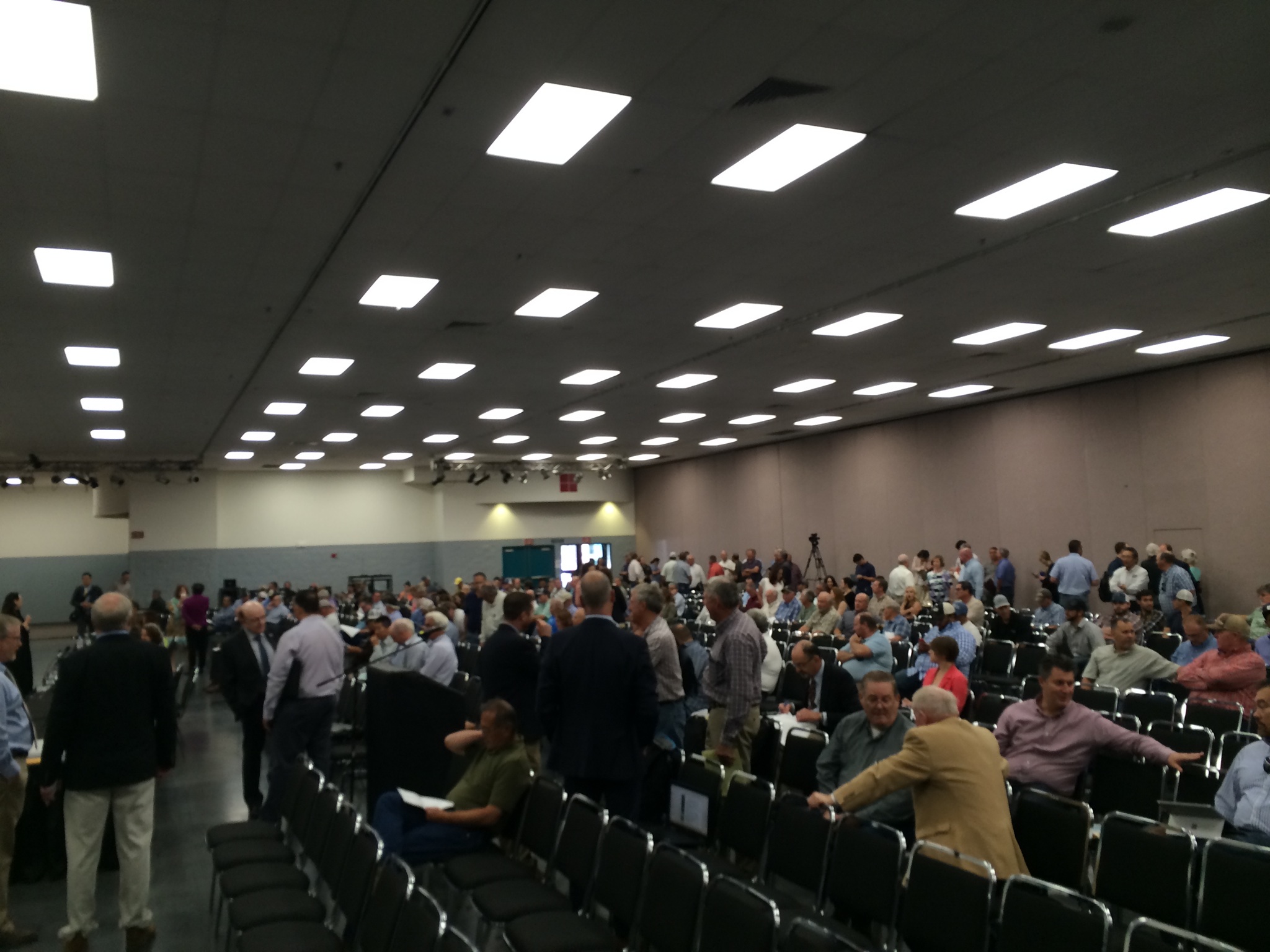
On May 17th, State Water Resources Control Board members traveled down to Fresno for a workshop on the proposed changes to the Waste Discharge Requirements in the East San Joaquin Water Quality Coalition. The workshop had to change locations due to the amount of grower involvement that was being encouraged by coalitions, commodity groups, and other interested stakeholders. Over 300 interested stakeholders attended the workshop, with many taking the opportunity to comment on the effects the changes to the current order will have throughout the state. State Water Board staff heard from coalition groups, as well as a panel of technical experts who participated in the Expert Panel report development, and finally a panel comprised of experts on the Southern San Joaquin Valley Water Quality Coalition which is leading the way on a Management Practices Effectiveness Program (MPEP).
CCGGA’s President/CEO Roger Isom provided public comment on the effectiveness of grower participation in various other programs, such as the CMP rules for PM10 as well as the Ag ICE program for diesel pump engines. Isom also discussed the importance of grower participation on rule and program development, such as the East San Joaquin petition. The Association’s Director of Technical Services, Chris McGlothlin, also provided comments on a few key issues. McGlothlin touched on the concern over the Regional Board’s capacity to handle the new responsibilities that the proposed changes would incur, the fear of bio-attacks against landowners if private information is made public, as well as asking the Board to trust the efforts being made on addressing water quality issues within the Central Valley. State Water Board Chairwoman, Felicia Marcus, commended attendees and commenters at this workshop for providing a valuable perspective on the effects the ag industry will face if the proposed rules are implemented.
Association Co-Hosts Meeting With Assemblyman Jim Patterson
The California Cotton Ginners and Growers Associations (CCGGA) hosted a meeting with Assemblyman Jim Patterson of the 23rd Assembly District at the Association offices in Fresno today. Key issues discussed included the biomass facility closure issue, water, labor issues and the State Water Board’s effort to completely redo the Irrigated Lands Program. Assemblyman Patterson is Vice Chairman on Labor and Employment Committee, Vice Chairman on the Utilities and Commerce Committee and sits on the Budget Subcommittes #3 and #6, one of which oversees the budget for the State Water Resources Control Board. Participating in the meeting were the Western Agricultural Processors Association (WAPA), California Citrus Mutual, California Fresh Fruit Association and the South Valley Water Association.
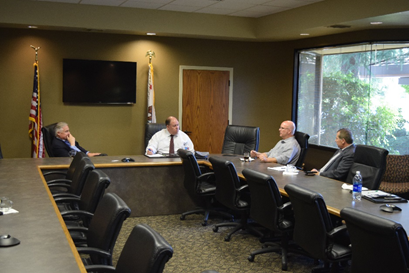
Talking water issues with Assemblyman Jim Patterson
OSHA Updates Recordkeeping Rule on Electronic Submittal
The Federal Occupational Safety and Health Administration recently updated its recordkeeping rule. The rule expands the list of severe work-related injuries that all employers must report to OSHA. Under the new reporting requirements establishments with 20 – 249 employees must electronically submit information only from the OSHA Form 300A Summary of Work-Related Injuries and Illnesses. For those employer’s with 250 employees or more, must electronically submit to OSHA injury and illness information from OSHA Forms 300, 300A, and 301 forms.
Submission of this data electronically will enable the public to access this data. In addition, it will also assist employers to review their own performance and compare against industry and to enhance their own safety programs and procedures.
The Federal changes will be effective August 10, 2016 and data submission will begin in 2017. Along with the electronic submission of injury and illness date, employers are still required to complete the accident report and investigation, and record injuries and illnesses on the OSHA Log 300 and Summary 300A forms.
The Cal/OSHA Standards Board will have to adopt requirements that are identical to the Federal requirements within 6 months after publication of OSHA final rule. WAPA will be monitoring the rulemaking advisory committee meetings and any proposed regulations regarding this change for our members.
CCGGA Co-Hosts United States Senator Roger Wicker
Today, the Association co-hosted United States Senator Roger Wicker, of Mississippi, for a breakfast meeting at the Association offices in Fresno. Issues discussed included water, immigration, trade, pesticides (in particular neonics), crop insurance and other regulatory matters. Senator Wicker sits on the Armed Services, the Budget, the Commerce, Science and Transportation, the Environment and Public Works, and the Rules Committee. Most importantly for our interests, the Senate Environment and Public Works Committee will be involved in any federal legislation involving water supply or attempts to address the Endangered Species Act (ESA). Also participating in the meeting were Western Agricultural Processors Associations, California Citrus Mutual, California Fresh Fruit Association, Committee for the Advancement of Cotton, Nisei Farmers League, and several individual farmers and ranchers from throughout the valley.
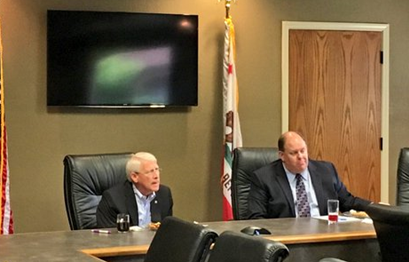
United States Senator Roger Wicker fields questions alongside CCGGA President/CEO Roger Isom