The California Cotton Ginners and Growers Association (CCGGA) submitted formal comments to the California Department of Pesticide Regulation (CDPR) opposing the proposed regulations that would mandate a quarter mile buffer zone restricting numerous applications from 6 a.m.-6 p.m. including air blast, aerial and sprinkler chemigation around school sites and registered child daycare facilities. CCGGA has been actively engaged in opposing this proposal because of the lack of science that is the foundation for this regulation. CCGGA staff and several growers gathered on Wednesday, Nov. 16 to publicly testify in opposition to the proposed regulations. These public comments were supported on Friday when CCGGA submitted written comments to CDPR staff. With no science or incidents to cite the cause of creating this proposal, CCGGA has been adamant that the current laws put forth but the US Environmental Protection Agency, CDPR and the County Agricultural Commissioners office provide an abundance of protection to human health. Additionally, CCGGA cited several issues including concerns with the two-tier notification system, lack of flexibility for time sensitive applications and concern with distribution conducted by schools regarding application information. Should CDPR choose to change the regulation in a major way, there will be a reopening of the comment period. We look forward to bringing you an update when we know more.
NEWS & ISSUES
Joe Vierra Passes Away
It is with a very heavy heart that we report on the passing of long time Gin Manager Joe Vierra on December 7th. Joe was Gin Manager at Stratford Growers from the mid-1980’s until he retired in 2000, and was President of the Ginners Board in 1992. In 1998, Joe was recognized as the Ginner of the Year for his service to the industry. As we understand it the services will be private. If we receive any more details we will be sure to pass them along.
Fresno State – Jordan College Career Fair

Partner with us to Grow Your Team!
The Jordan College Advising & Career Development Center is your source for finding great new talent through internships and for your entry level career positions. For Spring 2017 we have a number of events and other opportunities that will allow you to connect with potential interns and staff members.
Register for the Harvesting the Leaders of Tomorrow
Internship & Career Fair

Thursday, February 2nd . 10:30 am to 3:00 pm
Fresno State’s Satellite Student Union
Connect with Fresno State students seeking internships and careers in the Agriculture and Food Industry. Registration includes 6′ table and two chairs and lunch for two representatives. There is a $20 registration fee for each additional representative.
Registration Fees:
- $55 for Government, Non-Profits and Small Business (less than 25 employees).
- $100 for For-Profits.
Enhance your visibility at the Career Fair by becoming an Event Sponsor.
To Register to Attend or Sponsor the Event:
Please visit Jordan Connect by Thursday, January 26th, at http://www.fresnostate.edu/jcast/student-success/login/index.html. After logging in, click the “Career Events” menu and select “Search”. Then enter “Harvesting” in the the “Career Event Name” field.
Questions about registration or sponsorship? Please contact Mary Willis at mwillis@csufresno.edu or 559.278.4207.
More Spring 2017 Career Fairs
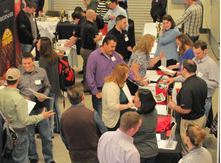
Expand your reach by attending these upcoming career fairs.
- February 8, 2017 – The Viticulture and Enology Career Fair
Hosted by the Fresno State Viticulture & Enology Department
- March 15, 2017 – Recruit Down the 99 and Beyond Career & Internship Expo
Hosted by the Fresno State Career Development Center
Recruit Now for Spring Interns

If you are looking for interns for the Spring 2017 semester, please submit your internship description to Mary Willis, the Coordinator of Internships & Professional Experiences for the Jordan College, by December 23rd. You can email your internship description directly to her at mwillis@csufresno.edu or post your internship on Jordan Connect by clicking HERE.
Don’t have an internship program? If you would like to learn more about the benefits of having an internship program and how to get started, please contact Mary Willis at mwillis@csufresno.edu or by calling 559.278.4207.
Invest in the Future: Become an Agribusiness Mentor

The Agribusiness Program at Fresno State is seeking mentors to provide wisdom and career guidance to students entering the Ag and Food Industry. Serving as a mentor can be as simple as being available for an occasional informational interview to committing to meet with a student for a total fo 8-hours over the course of a semester. To learn more about the Agribusiness Mentoring program, please contact Mary Willis at mwillis@csufresno.edu or by calling 559.278.4207.
2nd PM2.5 Workshop in One Week
The San Joaquin Valley Air Pollution Control District (SJVAPCD) a workshop this week on the PM2.5 SIP in Fresno. This follows right on the heels of the California Air Resources Board’s (CARB) workshop less than a week ago. Again, agriculture is one of the sources listed as a target for further controls. The meeting began with the SJVAPCD indicating that farming operations make up 23% of the PM2.5 emissions on an annual basis, and 18% during the critical winter months. As a result, the SJVAPCD identified the following control measures on agricultural operations for consideration:
- Evaluate further practices that minimize dust from wind erosion and soil disturbances (could include tree nut harvesting)
- Evaluate all feasible opportunities for additional reductions from Conservation Management Practices (CMPs)
- Assess economic feasibility of lowering NOx emission limits for ag irrigation pump engines
- Avoid relaxing prohibition on ag burning
- Increase funding for incentives to replace ag tractors, pump engines and trucks
The Association’s President/CEO Roger Isom was one of only two agricultural representatives to testify at the hearing. Isom raised questions on the emission inventory highlighting research that has been conducted in recent years demonstrating that PM2.5 emissions from agricultural operations was insignificant, and this is demonstrated in the information provided by CARB and the SJVAPCD in their own presentations where the monitor used to monitor air quality where measuring less than 2% geological material (dust)! Isom then made the following points on behalf of agriculture:
- We oppose any new CMP requirements that cannot be demonstrated through peer reviewed research that significant PM2.5 emissions reductions are achievable, and if so, they are demonstrated to be cost effective.
- We oppose the proposed Healthy Soils Initiative as an approach until such time as the state can streamline the bureaucracy to an acceptable level and avoid composting operations having to get 4 separate permits from 4 different agencies.
- We oppose any new regulations on ag irrigation pump engines, since many of these engines were just upgraded to Tier 3 or Tier 4 under the existing regulations.
- We support incentive funding and support for pyrolysis and gasification technology advancement, and commit to working with the SJVAPCD and CARB on this matter.
- We wholeheartedly support the use of incentives and commit to assisting the SJVAPCD in securing additional funds to incentivize the replacement of ag equipment
Workshops will continue for the next few months, as the plans moves forward towards adoption in the fall.
Association Merger Approved!
On January 1, 2017, after a unanimous vote from members of both Associations, the California Cotton Ginners Association and the California Cotton Growers Association will become one organization! The Western Cotton Growers Association was founded in 1949 as a cotton organization representing the interests of Arizona, California, and New Mexico cotton growers. One of the important issues that brought these growers together was government cotton allotments. By the mid 1950′s, with cotton allotments no longer being the central issue, each of the three states went their separate ways and formed their own state grower associations. Since that time, the Western Cotton Growers Association, the name retained by the California organization, worked on issues involving the California cotton growers. In 1971, a few ginners began meeting. They were concerned over a series of regulations being imposed by State and Federal agencies. What they envisioned was an organization that would represent a united front, and in 1973 the needs led to the formation of the California Cotton Ginners Association. In 1990, the Western Cotton Growers Association and the California Cotton Ginners Association agreed to share offices, staff and costs of running both organizations. This agreement has facilitated better use of the dues collected from the members of both associations by avoiding duplication of costs. Furthermore, the Ginner – Grower Associations’ Agreement has greatly enhanced and strengthened the legislative advocacy link in Sacramento as well as Washington. To further identify the members as California Cotton Growers, in 1991 the Western Cotton Growers changed its name to the California Cotton Growers Association. For the past 25 years these Associations have shared staff and offices, but kept separate accounting, Boards of Directors and meetings. With the approved merger there will now be one Board of Directors made up of 12 growers and 12 ginners. At the December joint board meeting the following board members and officers were appointed from the existing boards:
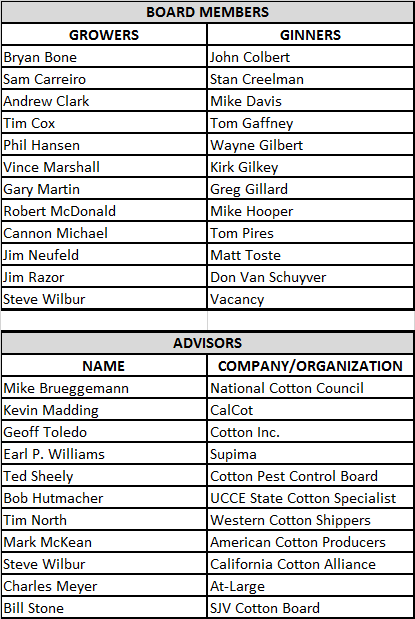
The new officers for the Association were appointed as follows:
Officers
Chairman – Phil Hansen
1st Vice Chairman – Mike Davis
2nd Vice Chairman – Bryan Bone
Secretary/Treasurer – Tom Gaffney
Officially, this new organization will be called the California Cotton Ginners and Growers Association.
FOR IMMEDIATE RELEASE “Not Perfect But It Will Help”

FOR IMMEDIATE RELEASE December 6, 2016
“Not Perfect But It Will Help”
The words above uttered by U. S. Senator Feinstein, accurately sums up our feelings regarding the California drought legislation introduced yesterday and attached to the Water Resources Development Act. Our collective email accounts were inundated with announcements and summaries yesterday and over last night we collectively read the pertinent language addressing California’s drought and aging infrastructure needs.
The litany of positives is significant and contains both short term and long term solutions to California needs. The crescendo of concern expressed by those opposing would have us living in an undeveloped California, foregoing ingenuity and the forward thinking that once helped turn California into a leading producer of food and fiber. The bill removes subjective intuition that has never been held accountable as a pathway to achieve a goal. Science that is vetted will create solutions for fish, families and farming.
Funds are authorized that begins a process to create more water efficiencies and create more water for a state seeking environmental and community relief. We commend Senator Feinstein and Congressman McCarthy for their tireless efforts to achieve a viable compromise on an important issue. Our thanks to Congressmen Valadao, Nunes, Calvert, Costa, and Garamendi for expressing their support and helping lead Congress to the goal line.
The Senator is correct, “this bill isn’t perfect but I do believe it will help California.” That’s something that hasn’t been done in a generation relative to water infrastructure and use.
###

| Pdf Version |
Air Resources Board Conducts Workshop on PM2.5 SIP – Ag called on to do more!
Yesterday, the California Air Resources Board (ARB) held a workshop in Fresno on the PM2.5 State Implementation Plan (SIP) for the San Joaquin Valley Air Pollution Control District (SJVAPCD). And as we warned a few weeks ago, agriculture is being called on to do more. Agriculture is being looked at for additional emission reductions from the following categories:
- Ag Tractor Rule – replace ag tractors and harvesters (particularly almond harvesting equipment) for both NOx and PM2.5 reductions
- More stringent engine standards for agricultural pump engines (beyond tier 4 and cleaner natural gas engines)
- A new low-NOx standard for heavy-duty diesel trucks (beyond ARB’s current Truck Rule)
- Alternatives for ag burning
- Additional Conservation Management Practices (CMPs)
- Additional restrictions under Regulation VIII for fugitive dust
The Association was the only agricultural group in attendance, represented by President/CEO Roger A. Isom and Director of Technical Services Christopher McGlothlin. Isom also testified at the meeting reporting that incentives are absolutely critical and necessary for the agricultural community due to their inability to pass along the additional costs. Isom further commented that USDA NRCS already had a program to incentivize the low emission nut harvesting equipment and that the Association is working to develop a similar program with the Air District. In addition, the Association also pointed to significant research performed recently to more accurately determine PM2.5 emissions from agricultural operations and that data showed that PM2.5 emissions from almond harvesting equipment, cotton gins and other operations are insignificant. Additional workshops and meetings will occur in January and February.
State Proposes Aggressive Water Conservation Plan
This week, the California Department of Water Resources (DWR), California Department of Food and Agriculture (CDFA), the State Water Resources Control Board (SWRCB), the Public Utilities Commission (PUC) and the California Energy Commission (CEC) released a draft plan for achieving permanent conservation measures for water consumption in California in line with the Executive Order the Governor issued is May of 2016. Several key water conservation efforts included in the plan include:
- Permanent bans on wasteful practices, such as hosing driveways and excessively watering lawns.
- Technical assistance and financial incentives for water suppliers to implement leak prevention, detection, and repair programs.
- Collecting information about innovative water conservation and water loss detection and control technologies.
- Requiring agricultural water suppliers to quantify water use in their service areas and describe measures to increase water use efficiency.
- Full compliance with water use targets for urban water suppliers by 2025.
- Planning and preparing for continued and future drought and water shortages.
The draft plan concerning agricultural water is outside of the scope of the Executive Order, so will require statutory authority. It is anticipated that the administration the administration has already drafted language that will either be run through the process or as a budget trailer bill. The SWRCB has been overseeing much of the implementation of the Executive Order, so it is likely the expanded statutory authority would be given to the Board as well. For agricultural water suppliers, requirements will include:
- Develop an annual water budget for the agricultural water service area;
- Identify agricultural water management objectives and implementation plans;
- Quantify measures to increase water use efficiency; and
- Develop an adequate drought plan for periods of limited supply.
The proposal would expand existing requirements to require agricultural water suppliers providing water to over 10,000 irrigated acres of land to prepare, adopt, and submit plans by April 1, 2021, and every five years thereafter. Agricultural water suppliers would also be required to submit an annual report to DWR by April 1 of each year that documents water budget inflow and outflow components in the water budget for the preceding water year. The draft plan can be found here: http://www.water.ca.gov/wateruseefficiency/conservation/docs/EO_B-37-16_Report.pdf
Comments on the plan will be received through December 19.
Assemblyman Low Visits Cotton Gin
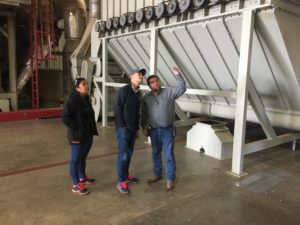
This past week, the California Cotton Ginners and Growers Associations (CCGGA) brought Assemblyman Evan Low (28th Assembly District) to Dos Palos Coop, a cotton gin near Dos Palos. The visit was part of a tour by the Agricultural Presidents’ Council (APC). Gin Manager Mike Davis was the site host where Assemblyman Low saw first-hand how upland and pima cotton are ginned. Assemblyman Low saw both a saw gin and a roller gin. Many topics were discussed including increased automation due to the impact of the increase in minimum wage and the overwhelming regulatory pressures faced by industry. Assemblyman Low represents the 28th Assembly District, located in the Bay Area and representing such cities such as Campbell, Cupertino, Los Gatos, Monte Soreno, San Jose and Saratoga. The tour is part of the Association’s continuing effort to inform and educate urban legislators on the challenges of operating and doing business in California. Other sites visited included an almond processor, dairy processor and a tomato processing plant. Representing CCGGA on the tour was President/CEO Roger Isom.
New I-9 Form Released by Feds
The U.S. Citizenship and Immigration Services (“USCIS”) has released the latest revision to the Form I-9, Employment Eligibility Verification. Beginning January 22, 2017, employers must begin using the revised Form I-9 for new employees. The new form is intended to make it easier complete electronically. It does not does not require any additional information be provided by the employee or employer. You can continue to use the old form until January 21, 2017. The latest version can be downloaded at the USCIS’s website, available here: https://www.uscis.gov/i-9.