NEWS & ISSUES

CA’s Healthy Workplaces, Healthy Families Act of 2014 (PSL)

Saqui

tpo picture- saqui

CA’s Healthy Workplaces, Healthy Families Act of 2014 (PSL)

  • PSL Applies to All CA Employers, Regardless of Size
  • Your Current PTO Plan Does NOT = Compliance!
  • New Employment Posters and Notice Requirements Went Into Effect on 1/1/15

NOW YOU NEED TO GET READY FOR JULY 1, 2015!

This law has lots of complicated angles…up to and including employee relations!

Attend TPO’s PSL Compliance Briefings to learn more about:

  • – Eligibility
  • – Accrual, Carryover, and Use
  • – Rates of Pay
  • – Impact on Current Paid Time-Off Policies
  • – Coordination with Other Laws
  • – New Paycheck Reporting Requirements
  • – Penalties for Non-compliance
  • – Assessing the Financial Impacts
  • – and more…

We will build on the information covered in the TPO Annual Conference and provide a checklist to follow so that you are confident and ready for implementation on July 1!

Now it is time to update your Employee Handbook. Contact TPO for assistance!

There is No Charge for TPO Members to Send One Person – Others Pay $35

TWO SCHEDULED OPTIONS:
TPO Monterey: April 15th, May 14th, June 17th from 9:00am – 10:30am

Webinar: April 22, May 19th, June 24th from 9:00am – 10:3am

Additional Scheduled Briefing Dates… Go to http://www.tpohr.com/training-calendar/ to register, or contact Amber at 831.647.7292 or ambera@tpohr.com

THE BOTTOM LINE:
The law requires either one hour of sick leave for every 30 hours worked or three days of sick leave per year.

THIS IS A GAME CHANGER!

Drought Takes Its Toll on California Cotton Acres

The fourth consecutive year of drought is leaving a lasting impression on the California cotton industry.  A fourth consecutive year of drought coupled with depressed prices, is leading California cotton growers to plant less acres in 2015.  Based on a survey conducted in early March, the California Cotton Ginners and Growers Associations are currently estimating cotton plantings in 2015 to be at 135,000 acres of pima and 35,000 acres of upland for a total of 170,000 acres.  Now, this is preliminary and a lot can happen between now and when things are actually planted, but based on the survey this is our best estimate.  If it play out, it will be represent at 12% decrease in pima acreage and a 38% decrease in upland acreage in California as compared to 2014.  With a zero allocation in surface water and a dwindling supply of groundwater2015 looks to be a rough year for all of agriculture.

CE Credits Available on Pesticide Breakout Session – 25th Annual CA Cotton Growers Association Meeting

We have been approved to have 1.5 hours of CE Credits for the Pesticide Breakout Session, so mark your calendars for the California Cotton Growers Associations (CCGA) 25th Annual Meeting to be held at the Visalia Convention Center on March 6, 2015.   This year’s Annual Meeting will begin 9 am with concurrent sessions on Pest & Products Chaired by Pete Goodell, Varieties – Trials & New Releases Chaired by Bob Hutmacher, and Water – Issues and Irrigation Efficiency Chaired by Dan Munk. Please RSVP to Shana via email at shana@ccgga.org or call (559) 252-0684.  We hope to see you there!

2015 Growers Annual Meeting Agenda

CA Cotton Growers 25th Annual Meeting Flyer, Registration Form & Preliminary Agenda

CA Cotton Growers Associate Member – Annual Mtg Sponsorship/Exhibitor Flyer

CCGGA Hosts Legislators at “Kitchen Dinner” Event in Sacramento

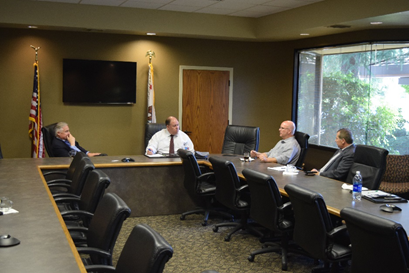
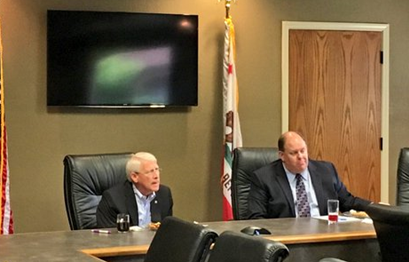
The California Cotton Ginners and Growers Associations hosted Assemblyman Freddie Rodriguez, Assemblyman Bill Dodd, Assemblyman James Gallegher, Assemblyman Marc Levine and Senator Anthony Cannella as part of the Annual Agricultural Presidents Council (APC) “Kitchen Dinner” Event in Sacramento this past month.  This event is a special “invitation only” event held at the “Kitchen Restaurant” in Sacramento for select members legislators and sponsored by members of the APC.  The legislators have a sit down dinner with the hosting organizations in essentially a one-on-one format for the evening.  Co-hosted by the agricultural organizations that make up the APC, this year’s event attracted 25 legislators.  Agricultural organizations co-hosting the event were the Western Agricultural Processors Associations, California Citrus Mutual, California Fresh Fruit Association, California Rice Commission, California Strawberry Commission, Western Plant Health Association, Far West Equipment Dealers Association, and California Agricultural Aircraft Association.  The events provide the Association and its leadership an opportunity to meet new legislators, as well as veteran ones, and educate them on the critical issues facing our industry.  Attending on behalf of WAPA included Growers Chairman Steve Wilbur, Ginners Chairman Greg Gillard, and Association President/CEO Roger Isom and Director of Technical Services Christopher McGlothlin.  Each and every legislator received a special California Agriculture gift bag, which included a mini cotton bale and cotton handkerchief.

PMA/ILWU Announce Tentative Contract

With mounting pressure from the White House, the Pacific Maritime Association (PMA) and International Longshore and Warehouse Union (ILWU) reached a tentative contract late Friday night ending a several month marathon that cost the ag industry millions of dollars in lost contracts, delays, excess charges and resulted in mounting job losses for agricultural workers.  With involvement from the US Secretary of Labor Tom Perez and Federal Mediation and Conciliation Service Deputy Director Scot Beckenbaugh, the two sides reached a long overdue agreement.  With over 50 ships at anchor on the West Coast, it is anticipated that it could take up to 3 months for the ports to “catch back up!”  Port activity was resuming to a more normal capacity this week.

CalOSHA Approves Changes to Heat Illness Regulations

Despite extreme opposition from agricultural groups and other employer groups, the Cal/OSHA Standards Board approved significant revisions to the state’s heat illness prevention standard.  The Board voted to approve the changes on a 5 to 1 vote.

The new revisions include the following major changes:

  •   – The procedures now kick in at 80 degrees, instead of the current 85
  •   – Shade must now cover 100% of those employees working during recovery or rest periods, and onsite meal periods, instead of the current 25%.
  •   – High-heat procedures now include a mandatory 10 minute cool-down period every two hours. 


That means that employers must revise their heat illness programs and train employees on an accelerated schedule, with barely two months before the changes become enforceable. Normally, these changes would go into effect on July 1st, but Cal/OSHA is asking the Office of Administrative Law (OAL) to move these up to as early as April 1st.  Training must be provided and the Association will be working with its members to assist in this effort, and to make sure their Heat Illness Plan are updated.

25TH ANNUAL CALIFORNIA COTTON GROWERS ASSOCIATION MEETING

Mark your calendars for the California Cotton Growers Associations (CCGA) 25th Annual Meeting to be held at the Visalia Convention Center on March 6, 2015.   This year’s Annual Meeting will begin 9 am with concurrent sessions on Pest & Products Chaired by Pete Goodall, Varieties – Trials & New Releases Chaired by Bob Hutmacher, and Water – Issues and Irrigation Efficiency Chaired by Dan Munk. Please RSVP to Shana at (559) 252-0684.  We hope to see you there!

2015 Growers Annual Meeting Agenda

CA Cotton Growers 25th Annual Meeting Flyer, Registration Form & Preliminary Agenda

CA Cotton Growers Associate Member – Annual Mtg Sponsorship/Exhibitor Flyer

President Obama Gets Involved in Port Issue

After almost nine months of negotiations with little results President Obama has ordered Labor Secretary Tom Perez on Saturday to renew talks between shipping companies and the International Longshore and Warehouse Union.  The slowdown at the West Coast ports has cost the cotton industry millions in cancelled contracts and delayed shipments.  In addition, the cotton industry has paid hundreds of thousands of dollars in additional and extraordinary container fees, chassis fees, storage fees and congestion management fees.  The slowdowns have become progressively worse, culminating in a major shutdown this past weekend.  The involvement by the administration is seen as the only way to bring this dispute to an end, as both sides have refused to budge.  “The negotiations over the functioning of the West Coast ports have been taking place for months with the administration urging the parties to resolve their differences,” White House spokesman Eric Schultz said Saturday. “Out of concern for the economic consequences of further delay, the president has directed his Secretary of Labor Tom Perez to travel to California to meet with the parties to urge them to resolve their dispute quickly at the bargaining table.”  Many cotton merchants have resorted to shipping products out of Houston or East Coast ports.  The California Cotton Ginners and Growers Associations (CCGGA) have been heavily involved in this issue, updating Senator Feinstein and Governor Brown on a daily basis, including participating in periodic conference calls with these offices to update their representatives on the devastating impact of this dispute on the tree nut industry.  CCGGA President Roger Isom said “These delays cannot continue and we urge the Administration to move swiftly and decisively in bringing this dispute to a resolution.”

Secretary Vilsack Designates 55 California Counties as Primary Natural Disaster Areas

On February 4th, USDA Secretary Thomas J. Vilsack designated 55 California counties as primary natural disaster areas due to a recent drought.  According to the U.S. Drought Monitor (see http://droughtmonitor.unl.edu/), these counties suffered from a drought intensity value during the growing season of: (1) D2 (Drought-Severe) for 8 or more consecutive weeks; or (2) D3 (Drought-Extreme) or D4 (Drought-Exceptional).  In accordance with section 321(a) of the Consolidated Farm and Rural Development Act, Del Norte, Imperial, and San Francisco Counties in California, are named as contiguous disaster counties. A Secretarial disaster designation makes farm operators in primary counties and those counties contiguous to such primary counties eligible to be considered for certain assistance from the Farm Service Agency (FSA), provided eligibility requirements are met. This assistance includes FSA emergency loans. Farmers in eligible counties have 8 months from the date of a Secretarial disaster declaration to apply for emergency loans. FSA considers each emergency loan application on its own merits, taking into account the extent of production losses on the farm, and the security and repayment ability of the operator. Local FSA offices can provide affected farmers with further information.