Last week, the U.S. Environmental Protection Agency (EPA) rolled back Biden-era emission vehicle emissions standards for light and medium-duty automakers. The proposal is providing manufacturers a 2-year delay in technology implementation, and allows for automakers to continue to manufacture Tier 3 controlled equipment. The Agency estimates that this pause in regulatory requirements will save consumers $1.7 billion dollars in associated cost of new technology in vehicles. In the press release, EPA highlights this rule as a failed attempt to push industry towards electric vehicles (EV’s) and the current “…low consumer appetite for EV’s”. This is considered Phase 1 of EPA’s actions against the Tier 4 Vehicle Standards, with Phase 2 including further potential revisions to the rule including further implementation deadline adjustments, phase-in schedules and testing procedure changes. Stay tuned for more updates.
NEWS & ISSUES
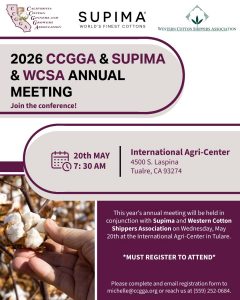
2026 CCGGA, SUPIMA, & WCSA Annual Meeting – Tomorrow, May 20th
California Cotton Ginners and Growers Association’s 2026 Annual Meeting, held in conjunction with Supima and Western Cotton Shippers Association is happening tomorrow, May 20th at the International Agri-Center in Tulare, California. Registration and Continental Breakfast will begin at 7:30 am. The program will begin with Breakout Sessions at 8:30 am. Please find the registration form and agenda here. Complete and submit the form as soon as possible to allow the Association to make sure we can appropriately plan for the meeting. You can email the form to Michelle Franco at michelle@ccgga.org or fax it to our offices promptly at (559) 252-0551.
State Water Project Water Allocation Increased to 45%
The Department of Water Resources (DWR) announced an increase to the State Water Project (SWP) allocation for 2026. The allocation is now 45 percent of requested supplies, up from the previous allocation of 30 percent announced on January 29. The allocation establishes how much water the State plans to deliver to the 29 public water agencies served by the SWP, which provides water to 27 million Californians and 750,000 acres of farmland. In the spring, SWP allocations are based on current hydrological conditions, existing reservoir storage, and remaining snowpack. While California saw record heat in March and early snowmelt, consistent rainstorms in April provided critical runoff through the system that allowed DWR to capture more water and meet environmental regulations without using stored water. Currently, the SWP’s largest reservoir, Lake Oroville, is at 99 percent of capacity. Statewide, reservoirs are 117 percent of average for this time of year. The challenge remains that California’s snowpack, the state’s frozen reservoir, is essentially gone. As of today, the statewide snowpack is just 12 percent of average. The snowpack peaked in mid-February and has since melted off. “California’s reservoirs are full, but most snowpack melted off weeks ago. We must use this stored water carefully because there’s no backfill until next season,” said DWR Director Karla Nemeth.
Cotton & Coffee is Tomorrow, May 19, at 7:30 a.m. CT
Cotton & Coffee is Tomorrow – Tuesday, May 19, at 7:30 a.m. Central.
This year marks the 20th anniversary of Cotton Incorporated’s Blue Jeans Go Green™ denim recycling program. This initiative has transformed well-loved cotton denim into new opportunities while promoting cotton’s circularity. Over two decades, the program has partnered with brands, retailers, and communities to divert millions of pairs of jeans from landfills. Join us on May 19th for Cotton & Coffee as we look back at the program’s impact and celebrate this milestone year.
Join Zoom Meeting here.
Meeting ID: 841 9671 7414
Passcode: Cotton1
Passcode: Cotton1

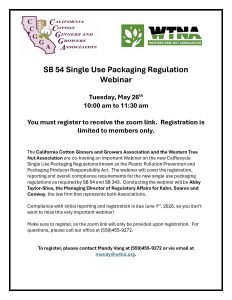
Single Use Packaging Regulations Final – Attend This Important Webinar
CalRecycle has finalized their single use packaging regulations now and compliance with initial reporting and registration with the Circular Action Alliance is due June 1st! Are you ready for this? Is your facility subject to the regulation? If so, is all of your plastic and cardboard subject, or only portions? What do I have to report? Are there any exemptions. Get the answers to these questions and many more by attending the Association’s SB 54 Single Use Packaging Compliance Webinar on Tuesday, May 26th at 10:00 am. Participation is limited to members only, and you must register to get the zoom link for the meeting. See attached flyer for details.
Nitrogen Pollution Bill Held Up in Committee
AB 2447 (Bauer-Kahan), otherwise referred to as the Nitrogen Pollution Reduction Act, was held in suspense in the Assembly’s Appropriations Committee today. The bill would have eliminated the current reporting structure growers utilize with their respective water quality coalitions, additionally it would have required individual farm information be reported directly to the State Water Board (Water Board), given increased fee authority to the Water Board, as well as set restrictive caps on the amount of fertilizer growers could use per acre per year. The bill was authored in response to the ongoing Irrigated Lands Regulatory Program – Expert Panel meetings, where hard limits on fertilizer use was being considered but was ultimately left off of the recommendations from the committee. As expected, the proposed legislation was supported by the Natural Resources Defense Council (NRDC), and pushed by a supportive author in Bay Area representative Assemblywoman Rebecca Bauer-Kahan (D-16).
The bill was opposed by a broad range of industries, and the Association highlighted our opposition of the bill to the various legislators last week during the Association’s Lobby Days trip to Sacramento. While the bill is not completely dead yet, this is a significant victory for the moment. Stay tuned for more updates.
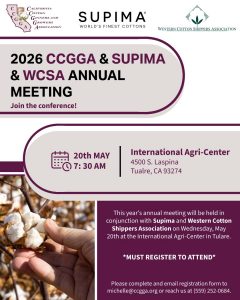
Next Week: 2026 CCGGA, SUPIMA, & WCSA Annual Meeting
You’re invited to come join the California Cotton Ginners and Growers Association’s 2026 Annual Meeting, held in conjunction with Supima and Western Cotton Shippers Association on Wednesday, May 20th at the International Agri-Center in Tulare, California. Registration and Continental Breakfast will begin at 7:30 am. The program will begin with Breakout Sessions at 8:30 am. Please find the registration form and agenda here. Complete and submit the form as soon as possible to allow the Association to make sure we can appropriately plan for the meeting. You can email the form to Michelle Franco at michelle@ccgga.org or fax it to our offices promptly at (559) 252-0551.
There is also an opportunity to sponsor the event. All sponsorships go toward offsetting the costs, which helps us deliver our message to the industry. If you’d like to sponsor, you may do so by clicking the sponsorship link below.
The cost of the event is free, but we encourage you to consider making a donation of at least $50 to the CCGGA Federal PAC or CCGGA State PAC to help protect California cotton at the state and federal levels. The CCGGA Federal PAC can only accept personal checks. Any corporate contributions must be made to the CCGGA State PAC.
Association Leadership Takes the Fight to Sacramento This Week
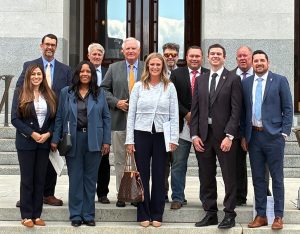
This week the Association leadership and staff from the California Cotton Ginners and Growers Association (CCGGA) and the Western Tree Nut Association (WTNA) spent two days in Sacramento addressing critical regulatory and legislative matters. At the Capitol, the group met with Assemblyman Juan Alanis, Senator Shannon Grove, Assemblyman David Tangipa, Assemblywoman Alexandra Macedo, Assemblywoman Cecilia Aguiar-Curry, Assemblywoman Diane Papan, Assemblyman Juan Carrillo, Assemblywoman Heather Hadwick, Assemblywoman Stephanie Nguyen, Assemblywoman Esmeralda Soria, Senator Christopher Cabaldon, Senator Jerry McNerney, Assemblywoman Rhodesia Ransom, Senator Susan Rubio Assemblywoman Blanca Rubio, Assemblyman John Harabedian, and the staffs of Assemblywoman Lori Wilson, Speaker Robert Rivas, Senator Melissa Hurtado, and Assemblyman Heath Flora. The group focused on opposing AB 1603 (Schulz) which would ban pesticides containing PFAS, AB 2447 (Bauer-Kahan) which would scrap the current Irrigated Lands Regulatory Program (ILRP) for a state enforced program that would be grower specific with stricter regulations and higher fees, AB 1777 (Garcia) that give the state authority to establish a statewide Indirect Source Rule (ISR) that would indirectly mandate electric trucks at all warehouses including ag processing facilities including cotton gins, nut hullers and processors, AB 2646 (Krell) a bill that would increase minimum wages for farmworkers, and incentive funding requests for ag burning alternatives and the FARMER tractor replacement program. The group also met with the California Department of Pesticide Regulation (CDPR), the California Air Resources Board (CARB) and the California Department of Food and Agriculture (CDFA). With CDPR the group discussed sulfoxaflor, paraquat, plinazolin, new endangered species act (ESA) requirements on labels, and proposed regulations on anticoagulants and treated seeds, and sustainable pest management (SPM). Representing CDPR was Director Karen Morrison and Chief Deputy Director Leia Bailey. The CARB meeting focused on proposed Tier 5 regulations and the NOX shortfall discussions. Chief Deputy Director Christopher Gumpler and Chief of the Mobile Source Control Division Michelle Buffington represented CARB at this meeting. Finally, the group met with CDFA Secretary Karen Ross and discussed ag burn alternatives funding, rats, cottonseed bug, cotton jassid, and efforts to expand the navel orangeworm sterile insect technology program. Representing the Association was Roger A. Isom, President/CEO; Priscilla Rodriguez, Assistant Vice President; and Christopher McGlothlin, Assistant Vice President of Technical Services.
Association hosts Critical Meeting with CARB
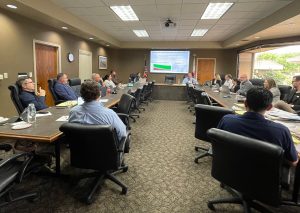
As a follow-up to a critical meeting earlier this year, the Association hosted the California Air Resources Board (CARB), San Joaquin Valley Air Pollution Control District (SJVAPCD) and several agricultural organizations to discuss CARB activities to address what is being called the “NOx shortfall”. The NOx shortfall is the gap in emission reductions needed by CARB and the SJVAPCD due to CARB’s withdrawal of needed waivers to mandate electric trucks and electric forklifts. While the removal of the waivers is considered great news by industry, the Clean Air Act mandates and timelines are still in place, and the regulatory agencies must find other control measures to make up the NOx shortfall. One of the measures being floated is a new California only mandate to create and implement a new “Tier 5” emissions standard. The Association and other groups immediately pushed back on a “California only” emission standard citing the added imbalance to an already very unfair economic disadvantage for California businesses. In addition to the NOx shortfall discussions, additional discussions were held to discuss recent enhancements to the emissions inventory by CARB including updates to almond harvesting with low dust harvesters, conservation management plans, and updated crop calendars and commodity acreages. Attending the meeting were 10 representatives from CARB including Michelle Buffington, Chief of the Mobile Source Control Division, Matthew Lakin, Chief of the Air Quality Planning and Science Division; and Ariel Fideldy, Branch Chief for Air Quality Planning. Five representatives from the SJVAPCD attended including Sheraz Gill, Deputy Air Pollution Control Officer; Todd DeYoung, Director of Strategies and Incentives; Tim Franquist, Director of Air Quality Planning and Jon Klassen, Director of Air Quality Science. Representing the Association was Roger A. Isom, President/CEO; Priscilla Rodriguez, Assistant Vice President; and Christopher McGlothlin, Assistant Vice President of Technical Services.
Packaging Regulations Now Final – Registration Due by June 1st
CalRecycle has announced approval of regulations governing plastic waste. Taking effect on May 1, 2026, these rules implement California’s packaging producer responsibility law, requiring producers to reduce single-use plastic by 25% and ensure all packaging is recyclable or compostable. These changes shift the burden of rising trash costs, pollution, and harmful plastics away from taxpayers and local governments to producers of single-use products. “We’re taking action to stop producers from using excessive amounts of plastic packaging that pollutes our communities” CalRecycle Director Zoe Heller said.
Producers, led by a nonprofit producer responsibility organization, Circular Action Alliance, have until 2032 to meet statewide targets for:
- 25% less plastic, with nearly half of that achieved by eliminating plastic and shifting to reuse or refill systems
- 100% recyclable or compostable packaging and plastic food service ware, with 65% of plastic packaging and food service ware actually recycled
Registration & Preliminary Data Submission Requirements
- Producers must register by June 1, 2026.
- Producers must submit supply data for the 2023 calendar year when applying to become a participant in the PRO. This includes the following “supply data”, by covered material category:
- Total weight of material sold, distributed, or imported in/into the state
- Total number of plastic components sold, distributed, or imported
- Producers must also submit annual supply and source reduction reports for the 2025 calendar year by May 31, 2026.
CAA’s guidance document for data reporting and a preparation workbook is available here. The Association will be sending out guidance this week specifically to our members, so be on the lookout for those materials this week.