The California Department of Water Resources (DWR) has released the latest Semi-Annual Groundwater Conditions report, and the data show that California achieved 4.1 million acre-feet of managed groundwater recharge during Water Year 2023. The report also details an increase in groundwater storage of 8.7 million acre-feet. This is the first year since 2019 that there has been a reported increase in groundwater storage. A significant reduction in groundwater pumping in 2023 also led to favorable groundwater conditions, including a decrease in land subsidence, or sinking of the land. Some areas that had previously experienced subsidence actually saw a rebound (uplift) in ground surface elevation from reduced pumping in the deeper aquifers and refilling of groundwater storage. This latest report includes, for the first time, groundwater sustainability plan Annual Report data reported by local groundwater sustainability agencies (GSAs) across 99 groundwater basins which make up over 90 percent of the groundwater use in the State. Paul Gosselin, DWR Deputy Director of Sustainable Water Management stated, “The impressive recharge numbers in 2023 are the result of hard work by the local agencies combined with dedicated efforts from the state, but we must do more to be prepared to capture and store water when the wet years come.” During the 2023 Water Year, more than 1.2 million acre-feet of groundwater recharge was permitted by state agencies, more than 400,000 acre-feet of flood water was recharged using the Governor’s Executive Orders, and millions more acre-feet of managed and naturally occurring recharge was achieved.
NEWS & ISSUES
Association Leadership Ascends Upon the Capitol
Leadership and Staff from the California Cotton Ginners and Growers Association (CCGGA) and the Western Agricultural Processors Association (WAPA) spent two days in Sacramento last week to address critical concerns on legislation and regulations. The Associations met with Senator Toni Atkins, Assemblyman Greg Wallis, Assemblyman James Gallagher, Assemblywoman Cecilia Aguiar-Curry, Assemblywoman Blanca Rubio, Assemblyman Eduardo Garcia, Assemblyman Heath Flora, Senator Richard Roth, Assemblywoman Jasmeet Bains, Assemblywoman Esmeralda Soria, and Assemblyman Juan Alanis. The group also met with staff from Senator Josh Becker, Senator Anna Caballero, Senator Lena Gonzalez, Senator Angelique Ashby, Assemblyman Josh Hoover, Senator Shannon Grove, Senator Roger Niello, Assemblyman Josh Lowenthal and Assemblywoman Lori Wilson. Several issues were discussed included AB 1963, the bill to ban paraquat; AB 2522, the bill to severely limit FGARs, Ag Burning, Sulfoxaflor (Transform) for lygus control on cotton, CDPR’s budget increase request, ZEV truck and forklift rules, electricity rates and infrastructure deficiencies, SWRCB fees, and FARMER funding. If those 18 meetings were not enough the second day was spent on regulatory issues meeting with the Governor’s Office, California Air Resources Board (CARB), California Department of Pesticide Regulation (CDPR) and the California Department of Food and Agriculture CDFA). Topics covered included pesticide bans and CDPR’s budget requests, ZEV truck and forklift regulations, electricity rates and infrastructure, and invasive pests such as cottonseed bug, carpophilus beetle, and fruit flies. The group also met with Assembly candidates David Tangipa and Ali Macedo. The Association Staff including President/CEO Roger Isom, Assistant Vice President Priscilla Rodrigues, and Director of Technical Services Christopher McGlothlin were also present and participating.

Association Hosts Senator Deb Fischer from Nebraska
This past week, the Western Agricultural Processors Association, the California Cotton Ginners and Growers Association and the American Pistachio Growers co-hosted an event for United States Senator Deb Fischer from Nebraska. Senator Fischer sits on the Agriculture and Appropriations Committees, as well as Nutrition and Forestry, Commerce, Science and Transportation and the Armed Services Committees. She is also a ranking member on the Rules and Administration Committee. Also attending the event were individuals from the Nisei Farmers League, California Citrus Mutual, California Blueberry Association, Olive Growers Council of California, National Cotton Council as well as several individual farmers and growers.

Association Testifies at Critical PM2.5 Workshop
The San Joaquin Valley Air Pollution Control District held a workshop Monday to present their “revised Plan for the 2012 Annual PM2.5 Standard”. The plan contains air pollution control measures and has been revised to address EPA’s concerns. Originally slated to be in attainment for the 2012 standard by 2025, the new plan proposes 2030 to achieve the standard. To date the District has made huge strides in reducing PM2.5 concentrations and only 5 monitoring stations remain in the valley showing levels about the 12 ug/m3 standard for PM2.5. Unfortunately, to be in attainment, all stations must show levels below 12 ug/m3. The proposed plan focuses on residential wood burning, open areas and mobile source control measures. The California Air Resources Board (CARB) and the SJVAPCD are also looking at additional measures to ensure attainment including looking at additional Conservation Management Practices (CMPs), low dust nut harvesting equipment and the FARMER program, which is the incentive program that helps farmers purchase cleaner burning tractors and harvesters. Association President/CEO Roger Isom testified at the hearing urging the district to base all regulatory decisions on science-based measurements, and to continue to fund and utilize existing incentive programs like FARMER that have provided effective proven emission reductions while assisting farmers.
Bureau Increases Water Allocations – Slightly
The Bureau of Reclamation announced another increase in the Central Valley Project 2024 water supply allocation for south-of-Delta contractors and those in the Friant Division. While all north-of-Delta CVP contractors are currently at 100% of their supplies, south-of-Delta agricultural contractors are being increased from 35% to 40%. Last week, on April 18, the Friant Division Class 1 allocation was increased from 95% to 100% and the Class 2 allocation increased from 0% to 5%. “Hydrologic conditions have improved enough that we are able to provide this gradual increase,” said California-Great Basin Regional Director Karl Stock. “We realize that our contractors were hoping to see a greater amount of water, and we understand how critical irrigation is to California agriculture and the surrounding communities. However, continued uncertainty in long-term hydrology and regulatory constraints necessitate Reclamation’s approach with available water supplies.”
According to the Bureau, as the water year progresses, changes in hydrology, actions that impact operations, and opportunities to deliver additional water will influence future allocations. In response, Association President/CEO Roger Isom commented “While we appreciate any increase in the allocation, in many ways this is too little, too late. Planting decisions are done. Given the current reservoir conditions throughout the state as well as the snowpack, we are disappointed with the minimal allocation. The regulatory restrictions in the delta are truly hurting the valley and every single person that lives here. Less water means less farming, which means less jobs.”
Survey on Biocontrol and Microbial Control Options for Pest Management
The Association has been asked to survey growers to evaluate the knowledge and use of biocontrol and microbial control options for pest management in California. The survey is anonymous and is being conducted by Dr. Surendra Dara, an extension entomologist and professor from Oregon State University. The data will be used along with similar information from the Pacific Northwest to prepare a report to develop research and education strategies moving forward. We encourage all growers to participate in this anonymous survey found here:
https://oregonstate.qualtrics.com/jfe/form/SV_2t6szOEbmryTpNs
EPA Publishes Update on Herbicide Strategy Progress
The U.S. Environmental Protection Agency (EPA) is releasing an update to its draft Herbicide Strategy, which is part of the Agency’s plan to improve how it meets its Endangered Species Act (ESA) obligations. The revised draft strategy is in response to comments received on the initial draft. The draft strategy, which EPA released for public comments in July 2023, describes whether, how much, and where mitigations may be needed to protect listed species from agricultural uses of conventional herbicides. The goal is for EPA to use the strategy to proactively determine mitigations for registration and registration review actions for herbicides even before EPA, the U.S. Fish and Wildlife Service (FWS), and the National Marine Fisheries Service (NMFS) formally complete the lengthy ESA determination on whether an herbicide has effects on a listed species. EPA received extensive comments on the draft strategy, who identified concerns with specific aspects of the draft strategy and suggested revisions. EPA plans to make a number of improvements to the draft based on this feedback, with the primary changes falling into three categories.
- Making the strategy easier to understand. Many commenters noted the complexity of the strategy to determine the amount of mitigation a label requires for a particular pesticide—up to nine points of mitigation. In response, EPA is simplifying its approach, such as by using four tiers—none, low, medium, high—to describe the amount of mitigation that may be needed for each herbicide. EPA also plans to create educational materials that concisely explain the four-tier mitigation approach.
- Increasing flexibility for growers to implement the mitigation measures in the strategy. EPA expects to expand its mitigation measures, especially for specialty crops such as cherries and mint, to include new measures such as erosion barriers, reservoir tillage, and soil carbon amendments. EPA is also working with the U.S. Department of Agriculture (USDA) and other organizations to identify other measures to add to the mitigation menu that can reduce pesticide runoff and erosion.
- Reducing the amount of mitigation that may be needed when growers have already adopted voluntary practices to reduce pesticide runoff or where runoff potential is lower due to geography. For example, in areas of the country with flat lands or minimal precipitation where runoff potential is low, growers may need less or no additional measures to use agricultural herbicides, compared to what is currently in the draft strategy. EPA is also considering whether growers could meet any necessary mitigation requirements if they participate in agricultural conservation programs or work with qualified experts to design and implement mitigation measures.
EPA is also working on other changes to the Herbicide Strategy and how it is implemented. For many listed species, the maps used in the draft strategy for determining where mitigation measures would apply are often too broad, covering areas not needed to conserve the species. EPA is working with FWS and others to develop a process for refining maps for hundreds of species. Through this work, EPA expects that the land area subject to the pesticide restrictions under the final strategy could shrink for many species. The Agency expects to publish the final strategy in August 2024.
Bureau Increases Federal Water Allocation
This past week the Bureau of Reclamation announced an increase in Central Valley Project 2024 water supply allocations. After below average precipitation in January, Reclamation announced an initial water supply allocation for the CVP on Feb. 21. Mid to late February storms have since improved hydrological conditions particularly for Northern California, allowing for a more robust water supply allocation. “Thanks to the improved hydrology, we are pleased to announce a bump in water supply allocations for the Central Valley Project,” said California-Great Basin Regional Director Karl Stock. “While the series of storms in Northern California improved the water supply outlook, a number of factors, particularly anticipated regulatory constraints throughout the spring, continue to limit the water supply allocation for south-of-Delta agriculture.” In recognition of recent efforts to develop a south-of-Delta drought plan, Reclamation is reserving approximately 83,000 acre-feet of water currently in San Luis Reservoir that will contribute to a drought reserve pool and is not considered as a volume of water available for this year’s water supply allocations. Additionally, approximately 185,000 acre-feet of rescheduled water from the 2023 water year, also stored in San Luis Reservoir, is not included in the 2024 water supply allocation. Based on current hydrology and forecasting, Reclamation is announcing the following increases to CVP water supply allocations:
North-of-Delta Contractors
- Irrigation water service and repayment contractors north-of-Delta are increased to 100% from 75% of their contract total.
South-of-Delta Contractors
- Irrigation water service and repayment contractors south-of-Delta, including Cross Valley Contractors, are increased to 35% from 15% of their contract total.
- M&I water service and repayment contractors south-of-Delta are increased to 75% of historical use or public health and safety, whichever is greater, up from 65% of historical use.
Friant Division Contractors
- Friant Division contractors’ water supply is delivered from Millerton Reservoir on the upper San Joaquin River and categorized by Class 1 and Class 2. The first 800,000 acre-feet of available water supply is considered Class 1; Class 2 is considered the next amount of available water supply up to 1.4 million acre-feet. Class 1 is increased to 65% from 60%; Class 2 remains at 0%.
As the water year progresses, changes in hydrology, actions that impact operations, and opportunities to deliver additional water will influence future allocations.
Cal/OSHA Adopts Indoor Heat Illness Standard – Will it Stick?
This week the Cal/OSHA Standards Board approved the “Indoor Heat Illness” Standard. However, they did so in defiance of direction from the Department of Finance who notified the Standards Board Wednesday that the regulation would not be approved due to significant costs to its own states agencies, supposedly the state prison system. After notifying the public at its hearing in San Diego, activists ran wild chanting and protesting and eventually shutting the hear down. Later, the Standards Board reconvened and adopted the standard anyway, allegedly as a sign of protest the last-minute direction from the state. The Association has actively been engaged in opposition to the proposed standard stating it would cost millions to retrofit ag buildings, such as cotton gins, nut hullers and processors and farm shops. The Association even made a standalone presentation to the Standards Board last June on the matter. Unfortunately, those concerns went largely unnoticed until the State’s own agencies determined how costly compliance would be. So now we wait to see what the state will do. The Department of Finance must approve the regulation for it to go into effect, so we are in uncharted territory here. Stay tuned to hear the latest.
Association Addresses Senate Ag Committee on Energy Issues
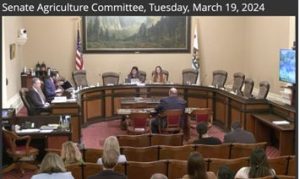
This week, Association President/CEO Roger A. Isom spoke to the Senate Ag Committee as a panelist at a committee hearing entitled “Navigating Threats to California Agriculture – Continuing the Discussion.” Speaking on behalf of not only the California Cotton Ginners and Growers Association (CCGGA) and the Western Agriculture Processors Association (WAPA), but also the Ag Energy Consumers Association of which he chairs the board, Isom was one of five panelists that addressed everything from SGMA and water to energy, land use and pesticides. Isom focused on the impacts of the State’s efforts to address climate change and how the shortage of electric infrastructure, skyrocketing electric rates and the high cost of new electric equipment will make California agriculture even more non-competitive than it is today. Isom opened his comments by stating “California is headed for a train wreck. Agriculture in California is doing these things to address climate change and the state is not ready. We don’t have the infrastructure; we already pay the highest electric rates in the country, and we cannot pass along the cost to pay for the new infrastructure or the new equipment.” Senate Ag Committee Chair Melissa Hurtado thanked Isom for his comments and thought the hearing was important for the legislature to hear the concerns. Will the legislature do anything to step in and change things. Only time will tell. But one thing is for sure. Electric rates are getting a lot of attention by the legislature, and we are only beginning to feel the pain. Maybe this will be our opportunity to reign this runaway freight train in.