The California Department of Pesticide Regulation (DPR) announced new requirements on the way 1,3-D (aka Telone) is managed and used in California. Taking effect January 1, 2017 the annual limit for a township (six mile by six mile area used to monitor pesticide activity) will be changed to 136,000 pounds. This is a drastic decrease given some current township limits are as high as 180,500 pounds per year. To give a better indication of the impact this reduction will have, growers will only be able to treat about 410 acres in a township a year. Additionally, DPR announced that it will no longer allow the use of the “banking” system, which allowed for annual carryover of unused allocations of 1,3-D from one year to the next. Furthermore, growers will no longer be allowed to use 1-3,D during the month of December, citing that the weather conditions tend to make air concentrations higher. These changes poses serious hurdles for growers to overcome, if a township meets the new threshold growers who need to use 1,3-D will have little to no options for nematode control.
Author Archives: ccgga
State Water Board Drops Hammer on Central Valley
Last week, 27 growers throughout the Kaweah, Tule and Kings River Watershed and Water Quality Coalitions were issued letters from the State Water Board’s (SWB) Office of Enforcement. These letters identified each specific grower as a primary contributor to nitrate contamination within the aquifers in their areas. The letters also “recommend” that identified growers participate in a preliminary settlement hearing as a means of avoiding the hard handed regulatory enforcement that the growers would face otherwise. We have updated you previously on similar actions taken by the Office of Enforcement, specifically in the Salinas Valley where 17 growers were served identical letters due to their usage of nitrogen fertilizers and soil amendments to help produce the region’s crops.
The State Water Board is requiring that these growers provide temporary clean drinking water to the communities as well as begin the process of finding a long term source of clean and reliable drinking water for communities. The cost of long term sources for clean drinking water can be very costly, and so one avenue that the SWB is exploring is the development of a fertilizer tax. Fertilizer taxes have long been a target by the Governor’s office, with multiple attempts failing to pass in the legislature. The SWB is justifying the extortion of cited growers solely on studies that claim irrigated agriculture is the sole proprietor of nitrogen contamination within drinking water sources. The Association is monitoring this and is in discussions with some of the affected parties. Stay tuned.
New Overtime Provisions Signed by Governor
The Governor has now signed AB 1066 (Gonzales). AB 1066, known as the Phase-In Overtime for Agricultural Workers Act of 2016, will make significant changes to the IWC’s Wage Order 14 covering all employees subject to the Wage Order 14. Here are the important details.
Key Impacts & Changes –
- Changes overtime triggers from 10 hours per day and 60 hours per week in a phased-in approach.
- Removes exemption for irrigators, as irrigators are now subject to the new overtime provisions
- Removes exemption for drivers, as regulated by the Federal DOT or CHP are now subject to the overtime provisions
- Agricultural workers under Wage Order 14 were previously exempt from the mandatory 7th day off. Under this Act, agricultural workers must provide one day’s rest every seven days.
- However, there is a provision that the one-day-of-rest requirement may be met by accumulating days of rest when the nature of the employment reasonably requires that the employee work seven or more consecutive days, provided that in each calendar month the employee receives days of rest equivalent to one day’s rest in seven.
Timeline –
The Act becomes effective on January 1, 2017, as per the following schedule:
Employers with more than 25 employees:
- January 1, 2019: Overtime must be paid for work in excess of 9 ½ hours per workday or in excess of 55 hours per week.
- January 1, 2020: Overtime must be paid for work in excess of 9 hours per workday or in excess of 50 hours per week.
- January 1, 2021: Overtime must be paid for work in excess of 8 ½ hours per workday or in excess or 45 hours per week.
- January 1, 2022: Overtime must be paid for work in excess of 8 hours per workday or in excess of 40 hours per week. Any work in excess of 12 hours in one day must be compensated at the rate of no less than twice the employee’s regular rate of pay.
Employers with 25 or fewer employees:
- January 1, 2022: Overtime must be paid for work in excess of 9 ½ hours per workday or in excess of 55 hours per week.
- January 1, 2023: Overtime must be paid for work done over 9 hours per workday or in excess of 50 hours per week.
- January 1, 2024: Overtime must be paid for work in excess of 8 ½ hours per workday or in excess or 45 hours per week.
- January 1, 2025: Overtime must be paid for work in excess of 8 hours per workday or in excess of 40 hours per week. Any work in excess of 12 hours in one day must be compensated at the rate of no less than twice the employee’s regular rate of pay.
A full legal summary will be posted on our website.
Governor Signs Ag Overtime Bill
Ignoring the pleas of real farmworkers and the agricultural industry, Governor Edmund G. Brown Jr. today signed AB 1066, the ag overtime legislation. This means that California will have the most stringent trigger of any state in the country for overtime for farmworkers, with 45 states having no overtime protection at all. The Governor signed this bill, supposedly to bring “equality to all workers”, yet taxi cab drivers, commercial fishermen, car salesmen, student nurses, computer programmers, and carnival workers all work without any overtime provisions whatsoever. The Governor signed this ag overtime bill in the same year that minimum wage legislation was also passed that will take California to the highest minimum wage as well as legislation forcing California to adopt additional greenhouse gas regulations for businesses in California. California is the only state in the country subject to such regulations. Today’s signing occurred despite numerous requests by the agricultural industry to meet with the Governor to discuss our concerns. The message is clear. California simply doesn’t care. These provisions will be phased in over the next few years ending with the overtime provisions to be triggered at 8 hours per day and 40 hours per week.
Association Testifies in Support of More Incentive Funds for Air Quality
Association President/CEO Roger Isom testified before the Governing Board of the San Joaquin Valley Air Pollution Control District in support of a collaborative effort to bring additional incentive funds to California for businesses throughout the state. Incentive funds have been used by farmers and agricultural processing facilities for the past several years to replace irrigation pump engines, tractors, loaders, harvesters and trucks. But there isn’t enough money to meet all of the needs that have been identified. The use of incentive monies has proven to be the most successful and cost effective means to reduce air pollution emissions and improve air quality in the history of the Clean Air Act. Isom testified “nowhere has this been more evident than with the use of incentives to replace, repower or retrofit farm equipment. In 2008, the California Air Resources Board set in motion a plan to regulate farm equipment beginning on January 1, 2014 and achieve to 5 to 10 tons of NOx emissions reductions by December 31, 2017. Through the use of incentive monies, the State of California has already reduced farm equipment emissions by more than 10 tons as of today on a voluntary basis, thereby proving incentive programs work. Our organizations wholeheartedly support the incentive program approach and commit our resources to assisting the District and the State in the search for more incentive funds!”
Final Mapped California Cotton Acreage
The Pink Bollworm Program under the California Department of Food and Agriculture has released their final mapped numbers for 2016. While the drought is not over, for the first time in six years, cotton acreage has increased. Final acreage numbers for California put Pima at 152,630 acres and upland at 66,353 acres for a total of 218,713 acres statewide.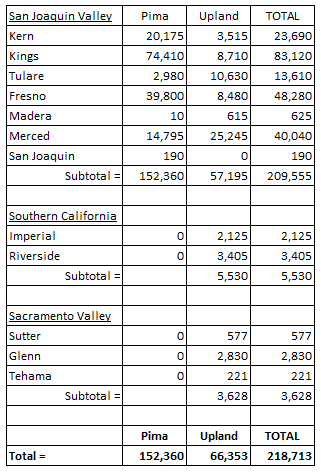
This represents a 31% increase in Pima acreage and a 44% increase in upland acreage as compared to 2015. This represents a 35% increase in overall cotton acreage for 2016.
*click on the graph to enlarge
CCGGA Keeps Up Pressure on FDA
Despite the fact the rules are final and the odds are against it, the California Cotton Ginners and Growers Associations are still battling on the issue of applicability and how it applies to cotton gins under the Preventive Controls Rules for Animal Food. As the rules stand now most cotton gins will be exempt from the Animal Food rule; however, some will be subject to the confusing rules. Confusing, because the rules state that cotton gins are specifically exempt from the Good Manufacturing Practices (GMPs) required by the rule, but must comply with the risk assessment and supplier control provisions of the rule. Applicability is based on ownership and in recent correspondence from FDA to CCGGA, FDA stated “We have acknowledged that the safety of animal food (e.g., cotton seed) from ginning on farm and off farm would not be different based on where the activities take place. We have also acknowledged that cotton ginning facilities are likely to determine through their hazard analysis that there are no hazards requiring a preventive control and that therefore they are not required to establish preventive controls and associated management components”. With these statements in mind, CCGGA has engaged Congress to assist in the effort to put all cotton gins under the same provisions, meaning exemption from the Animal Food Rule. CCGGA is working closely with the National Cotton Ginners Association and National Cotton Council on this issue. An important announcement related to this could be made soon, so stay tuned!
CARB Releases Final Sustainable Freight Plan
In response to an Executive Order issued last year by Governor Brown, state agency leaders released the California Sustainable Freight Action Plan, a comprehensive document that serves as a blueprint for transforming the state’s multi-billion dollar freight transport system. This new plan affects every facet of transportation in the state from rail, trucks and forklifts to fuel, transportation refrigeration units (TRUs) and ships. From the Association’s perspective the plan has improved in that it now recognizes and relies heavily upon incentives to help fund many of the new technologies that companies will be implementing. “We listened to stakeholders, incorporated changes, and we will continue to consult with them as we put the Plan into action” said California Air Resources Board Chair Mary D. Nichols. While it has improved, major impacts still remain or are yet to be fleshed out. Developed in response to Governor Brown’s Executive Order B-32-15, which calls for a single integrated action plan for California, the Action Plan was prepared by the California State Transportation Agency, California Environmental Protection Agency, California Natural Resources Agency, California Air Resources Board, California Department of Transportation, California Energy Commission and the Governor’s Office of Business and Economic Development, with broad stakeholder input. The Executive Order directs the state agencies to pursue a shared vision to “improve freight efficiency, transition to zero-emission technologies and increase the competitiveness of California’s freight system.” The Action Plan includes a long term-2050 vision and guiding principles for California’s future freight transport system along with these targets for 2030:
- Improve freight system efficiency 25 percent by 2030
- Deploy over 100,000 zero-emission vehicles/equipment and maximize near-zero by 2020
- Foster future economic growth within the freight and goods movement industry.
The plan also identifies opportunities to leverage State freight transport system investments, pinpoints actions to initiate over the next five years to meet goals, and lists possible pilot projects to achieve concrete progress in the near term. Some of the areas where our members will be impacted include:
- Zero emission technologies, such as electric forklifts
- Lower emission trucks (beyond the current ARB Truck Rule)
- Transportation Refrigeration Units (TRUs)
- Freight Hubs (could include our operations where trucks come and go)
Over the next several months, the Association will be heavily involved in this issue as we work to push for incentives and voluntary approaches to this broad regulatory effort. Next steps for state agencies will include continued work with federal, state, industry, labor, regional, local and environmental and community-based partners to refine and prioritize the strategies and actions outlined in the Action Plan. The state agencies will also create collaborative stakeholder working groups on competitiveness, system efficiency, workforce developments, and regulatory and permitting process improvements. Regular California Freight Advisory Committee meetings will continue, and by July 2017, the state agencies will establish work plans for chosen pilot projects.
Association Pushes Back on 1 Mile Buffer Zone
The California Cotton Ginners and Growers Associations (CCGGA) participated in a meeting of agricultural organizations the California Department of Pesticide Regulation (CDPR) opposing the idea of a one mile buffer zone one pesticide and fumigation applications being pushed by pesticide activist groups including the United Farm Workers (UFW) and the Pesticide Action Network of North America (PANNA). The concept of a one mile buffer zone on all pesticide and fumigation applications has been raised in recent months by the activists in the CDPR Initiative to address “Pesticides Use Near Schools”. The UFW and PANNA have submitted several form letters and postcards. To combat that effort, CCGGA along with the Western Agricultural Processors Association, the Nisei Farmers League, California Fresh Fruit Association, California Citrus Mutual, California Agricultural Aircraft Association, and the Western Plant Health Association met with CDPR Director Brian Leahy to express our frustration with the effort and call for CDPR to continue to use sound science when making regulatory decisions on buffer zones. CCGGA President/CEO Roger Isom presented Director Leahy with over 500 agricultural industry letters from actual California farmers, processors and allied industry calling for CDPR to make policy decisions based on science. If you haven’t sent in a letter, we strongly encourage you to do so. The time is now for your voice to be heard!
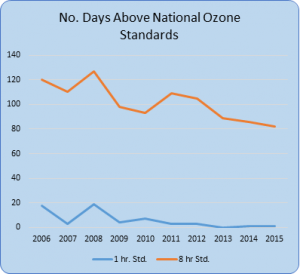
Some Good News – EPA Finds that San Joaquin Valley Meets 1 Hr. Ozone Standard!
The Environmental Protection Agency (EPA) has determined that the San Joaquin Valley nonattainment area “has attained the 1-hour ozone National Ambient Air Quality Standard”. This determination is based on sufficient, quality-assured, and certified data for the 2012-2014 period. Ozone data collected in 2015 shows continued attainment of the standard in the San Joaquin Valley. EPA noted that preliminary data for 2015 was consistent with continued attainment in the San Joaquin Valley. The Valley covers approximately 23,000 square miles and includes all of Fresno, Kings, Madera, Merced, San Joaquin, Stanislaus, and Tulare counties, as well as the western half of Kern County. EPA agrees with reports and associated analyses, submitted by the California Air Resources Board (CARB) and the San Joaquin Valley Air Pollution Control District (“District”), and finds the Valley has attained the 1-hour ozone standard. While this is great news, unfortunately it does not in any way change the air quality regulations related to ozone. That is because EPA has adopted an 8 hour ozone standard that is much lower and much more difficult to achieve. Nonetheless, as trucks, tractors and off-road equipment are being replaced ozone measurements have dropped considerably in the last ten years as air quality has drastically improved!