NEWS & ISSUES

Irrigated Lands Regulatory Program Update

The State Water Resources Control Board (SWB) has begun conducting outreach and educational meetings between interested stakeholders, as well as the overall public, on their recently proposed order.  The East San Joaquin WDR Proposed Order is a draft regulation that will essentially eliminate all of the work being done through the Irrigated Lands Regulatory Program.  The changes made to the Irrigated Lands Regulatory Program through this Draft Order include the re-designation of all areas within California as Highly Vulnerable to groundwater threats, the power to collect and organize Farm Evaluation Plans and Nitrogen Management Plans no longer sits with the Coalitions and that same information will be submitted directly to the Regional Water Quality Control Board (RWB), as well as require wells that supply drinking water to communities to be monitored continuously.  These changes directly affect the functionality of the Irrigated Lands Regulatory Program, and also add a significant burden to the Regional Water Board to collect and store all of the data.

Pursuant to the release of the draft Proposed Order, watershed coalitions have begun meeting with SWB representatives in an effort to find some ways to push back.  WAPA also took the opportunity to voice concerns over recent actions by meeting with Pamela Creedon, Executive Officer for the Regional Water Quality Control Board.  Creedon voiced as much concern over the proposed changes and the adjustments that her department will need to make in order to satisfy their burden in receiving this information.  The Association then took the time to meet with Felicia Marcus, Chair of the State Water Board.  Marcus took a more defensive stance of the proposed order, stating that she felt confident the Board would be able to handle the changes the proposed order creates.  The Association has also found opportunities to participate in Coalition led meetings, which focus primarily on the areas of the proposed order that can be challenged and possibly thrown out.  Comment letters for the ESJ Proposed Order are due by May 18th. A public workshop will be held at the San Joaquin Valley Air Pollution Control District on May 17th, if you would like to participate or attend the public workshop, feel free to contact the Association’s Director of Technical Services, Chris McGlothlin.
Association Meets with ARB on Proposed Forklift and TRU Regulations

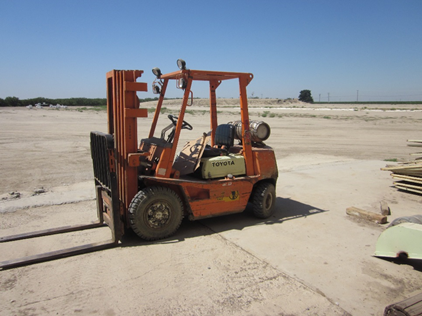
Association President/CEO Roger Isom and Director of Regulatory Affairs Jodi Raley attended a meeting with the California Air Resources Board today on the proposed next versions of the Large Spark Ignited (LSI) Regulation, which regulates forklifts and floor sweepers/scrubbers, and the Transportation Refrigeration Unit (TRU) Regulation. The first steps in this process is to “survey” the industry, and the Association reviewed and commented on the proposed survey and how it would be carried out for cotton gins. Following this meeting, the Association will be conducting a survey for the industry that will be used to help formulate the rule. This was conducted in the original forklift rulemaking and one of the reasons the ag provisions of the forklift rule where much more lenient than the general business requirements. It is this level of involvement in the process that will hopefully provide the best outcome possible given the state’s air quality issues.

forklift 1

Kings County Sheriff’s Office BOL Kubota RTV 900

Please click here to view.

Thank you,
CRCPTF

For General Questions regarding the CRCPTF and Membership please contact the following members:
President – Chad Parker  caparker@tehamaso.org
Vice President – Kristie Dougan  kdougan@SBCSD.ORG
Secretary – Neil Bailey neil.bailey@sonoma-county.org
Treasurer – Robert Winn winnr@kernsheriff.com

For BOLO distribution – Bo Houngviengkham  agcrimes@fresnosheriff.org

Recent Changes to CRCPTF Crime Alerts

CRCPTF has recently changed the format of its news alerts in order to provide you information more efficiently and to add new features. If you have any comments or questions, please feel free to send them to CRCPTF.

Association Supports Agricultural Equipment Trade-Up Program

Association President/CEO Roger Isom testified this week at the San Joaquin Valley Air Pollution Control District Governing Board Meeting in support of the Air District’s proposed “Trade-Up Program”.  The new program would be funded by $500,000 in Cap & Trade Funds from the California Air Resources Board (CARB).  The money would be used to purchase new agricultural equipment (tractors and harvesters) to replace existing Tier 2 and Tier 3 agricultural equipment.  Then, rather than crushing the Tier 2/3 equipment, it would be provided free of charge to growers to replace existing Tier 0 equipment that might not otherwise be replaced due to financial constraints or limited use.  The Tier 2/3 tractors will be inspected and the Air District will spend up to an additional $5,000 to repair this equipment for use.  A big focus will be on harvesting equipment which tends to have a low use.   The new pilot program will go into effect later this summer, and the Association is already lining up growers and equipment for the pilot program.  If it is successful, it could lead to a more permanent program.

California Cotton Acreage on the Rebound

The drought is not over, but for the first time in six years, cotton acreage will increase in California according to preliminary survey conducted by the California Cotton Ginners and Growers Associations this past month.  The Association is currently estimating approximately 145,000 acres of pima and 61,000 acres of upland statewide.   Now, this is preliminary and a lot can happen between now and when things are actually planted, but based on the survey this is our best estimate.  If it plays out, it will represent a 19% increase in pima acreage and a 24% increase in upland acreage in California as compared to 2015.

2016 CA Cotton Ginners Association Annual Meeting – Monterey

We are gearing up for the 2016 Annual California Cotton Ginners Association meeting in Monterey on Wednesday, June 1st through Friday, June 3rd at the Monterey Marriott.  There will be a welcome reception on Wednesday night for the early arrivals.  On Thursday we will be having our golf tournament and for non-golfers it will be an open day, with a reception dinner, and annual award presentations on Thursday evening.  The Board of Directors will hold their regularly scheduled board meeting on Friday morning followed by the Ginners Annual Meeting featuring guest speakers covering the “hot topic” issues in the industry.

2016 Ginner Registration

2016 Associate Registration

Update on CA’s mandatory Paid Sick Leave (PSL)

Following is TPO’s recap of CA’s mandatory Paid Sick Leave (PSL) with yellow highlights representing areas of change with the 7/13/15 “clean-up” law.

Employers who revised/created their policies to comply with PSL prior to 7/1/15  may choose to make further revisions in light of the “PSL clean-up” law, though revisions are not required and some employers may choose to not further revise their policies.

The Department of Industrial Relation’s (DIR’s) website was updated in October 2015 to reflect the 7/13/15 law (http://www.dir.ca.gov/DLSE/Paid_Sick_Leave.htm).

3 4 16 – TPO’s PSL Recap CoBranded (002)

WHEEL PATH RECOVERY

L. M. Carter and J. H. Chesson

OBJECTIVES: To determine the degradation of wheel paths (roads) over time with normal tillage. To determine number of years of normal tillage and cropping to return soil to original or comparable state.

PROCEDURE: The paths to be studies were created in 1984 and used for conduct of system studies with the wide tractive research vehicle (WTRV) until 1989. In 1990 the guidance wire was removed and the paths only were subsoiled on 15 inch centers to a depth of about 18 inches. The entire field was then disk harrowed twice with all traffic east to west to prevent movement of path soil into plot areas. The field was then bedded, preirrigated, and planted to black-eye beans which were allowed to grow until late July. The field was then irrigated to wet the soil to beyond 3 feet and penetrometer measurements made in plot and path areas.

RESULTS: The penetrometer data was analyzed for difference in means and differences in data distribution by treatments. When an accumulative distribution of data by treatments was plotted it was apparent that more variability existed among path data than

in plot data. Using an univariate analysis it can be shown that the standard deviation for the path areas was between 1.38 and 1.43 MPa compared to the treatment areas with 0.64 MPa or 2.14 times greater. Using F-tests the probability that these are not the same exceeds 99.9%. The data could be from normal distributions but the data is skewed with less than expected low values. The path data could be fitted as a uniform distribution. The standard farmer approach to removing compaction (subsoiling) is not sufficient to remove the compaction within the fractured consolidates. There was no difference in the mean penetration resistance among paths and plots in the zone between the surface and 20 em. This may be explained by the disk tillage which probably extended to 20 em. At depths below 20 em the mean penetration resistance for the paths was 15 to 18 MPa compared to 7 MPa for the plot areas which represents a very large difference and could easily explain the poor growth of beans.

Deep tillage with subsoilers will not remove compaction of road-ways within 1 year. Perhaps the bad news is that variability among zones within the tilled path zones is much greater than old plot area and no tillage machinery is available to directly influence this variability.

FUTURE PLANS: The field has been mapped to locate the old path areas. After normal tillage operations in 1991 and a crop, another series of penetrometer reading will be made. These data will be compared to the 1990 data to access any improvement in soil variability or penetrability.

SUMMARY OF UNIVARIATE STATISTICS FOR PATH AND PLOT AREAS PENETROMETER DATA IN MPa

STATISTIC PATH AREA
POOR GROWTH
PATH AREA
W/ NO GROWTH
PLOT AREAS
mean 2.29 2.44 1. 26
S.D. 1.38 1.43 0.64
variance 1.922 2.054 0.407
cv 60.7 58.7 50.6
W:NORMAL 0.93 0.93 0.93
Skewness 0.57 0.51 0.99
Kurtosis -0.41 -0.43 2.61
Mean: top zone 5.6 6.2 5.0
Mean: till zone 15.5 17.5 6.9
Mean: deep zone 15.5 15.4 8.3

For PDF Copy, Click Here.

Louie Colombini Named “National Cotton Ginner of the Year”!

IMG_0994

Louie Colombini, Westside Farmers Co-op Gin was named the winner of the 2015 Horace Hayden National Cotton Ginner of the Year by the National Cotton Ginners Association, this month at the National Cotton Council Annual Meeting in Dallas, Texas.  Louie is one of the most active Ginners in California Cotton Ginners Association.  He is a past Chairman of this Association in 2000-2001, Ginner of the Year recipient in 2002, and longtime and current board member.  Currently, Louie sits on the Association’s Joint Steering, Safety, and Energy Committees.  Additionally, Louie has served as a board member for the San Joaquin Valley Cotton Board.  Finally, on the national level, Louie has been a longtime Ginner delegate to the National Cotton Council.   Louie is a member of, and serve as a Eucharistic Minister for the St. Phillip’s Catholic Church.  He is a past Grand Knight of the Knights of Columbus.  Louie was also involved in the Boy Scouts for 15 years.  Louie has been a significant contributor to the California cotton ginning industry for many years, and is a shining example of the leadership within our industry.    Congratulations to Louie Colombini!