NEWS & ISSUES

Hazard Communication Deadline Approaching

The last deadline of the phase-in period in the revised Hazard Communication Standard is June 1, 2016.

Are you in compliance?  Your Hazard Communication Program must be updated, provide employee training on identifying chemical physical or health hazards, safety data sheets and container labels (primary and secondary).

Please visit the Industry Issues page for Hazard Communication Compliance Safety Guide or contact Elda Brueggemann or Priscilla Rodriguez for assistance.

San Joaquin Valley Groundwater Briefing Wednesday, June 1

The California Department of Water Resources and Water Education Foundation in cooperation with the Center for Irrigation Technology will host a FREE one-day briefing on Wednesday, June 1 discussing how San Joaquin Valley groundwater conditions have responded to the multi-year drought and actions being taken towards sustainable groundwater management. This briefing is open to any interested parties including media, elected officials, legislative aides, water district managers and board members, state and federal agency officials, city and county govern­ment officials, farmers, environmentalists, attorneys, consultants, engineers, business executives and public interest groups.

Topics to be discussed include:

  • Hydrologic conditions and drought status
  • San Joaquin Valley groundwater conditions and status of SGMA implementation
  • Monitoring valley land subsidence with remote sensing
  • Beginning SGMA implementation – the local perspective
  • Private residential wells and drought

Full agenda here.

The event will be held at the Alice Peters Auditorium (PB 191) in the University Business Center at Fresno State. Check-in/registration begins at 9:30 a.m. Complimentary coffee will be served. The program runs from 10 a.m. to noon and from 1:30 to 3 p.m. Lunch is on your own.

Event Flyer->june_1_fresno_flyer

Event Agenda->draft_june_1_agenda

East San Joaquin Petition Workshop Held

Roger Testifying
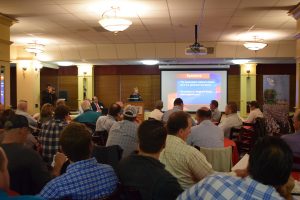
On May 17th, State Water Resources Control Board members traveled down to Fresno for a workshop on the proposed changes to the Waste Discharge Requirements in the East San Joaquin Water Quality Coalition.  The workshop had to change locations due to the amount of grower involvement that was being encouraged by coalitions, commodity groups, and other interested stakeholders.  Over 300 interested stakeholders attended the workshop, with many taking the opportunity to comment on the effects the changes to the current order will have throughout the state.  State Water Board staff heard from coalition groups, as well as a panel of technical experts who participated in the Expert Panel report development, and finally a panel comprised of experts on the Southern San Joaquin Valley Water Quality Coalition which is leading the way on a Management Practices Effectiveness Program (MPEP).

Roger Testifying
CCGGA’s President/CEO Roger Isom provided public comment on the effectiveness of grower participation in various other programs, such as the CMP rules for PM10 as well as the Ag ICE program for diesel pump engines.  Isom also discussed the importance of grower participation on rule and program development, such as the East San Joaquin petition.  The Association’s Director of Technical Services, Chris McGlothlin, also provided comments on a few key issues.  McGlothlin touched on the concern over the Regional Board’s capacity to handle the new responsibilities that the proposed changes would incur, the fear of bio-attacks against landowners if private information is made public, as well as asking the Board to trust the efforts being made on addressing water quality issues within the Central Valley.  State Water Board Chairwoman, Felicia Marcus, commended attendees and commenters at this workshop for providing a valuable perspective on the effects the ag industry will face if the proposed rules are implemented.

Association Co-Hosts Meeting With Assemblyman Jim Patterson

The California Cotton Ginners and Growers Associations (CCGGA) hosted a meeting with Assemblyman Jim Patterson of the 23rd Assembly District at the Association offices in Fresno today.  Key issues discussed included the biomass facility closure issue, water, labor issues and the State Water Board’s effort to completely redo the Irrigated Lands Program.  Assemblyman Patterson is Vice Chairman on Labor and Employment Committee, Vice Chairman on the Utilities and Commerce Committee and sits on the Budget Subcommittes #3 and #6, one of which oversees the budget for the State Water Resources Control Board.  Participating in the meeting were the Western Agricultural Processors Association (WAPA), California Citrus Mutual, California Fresh Fruit Association and the South Valley Water Association.

Talking water issues with Assemblyman Jim Patterson

Talking water issues with Assemblyman Jim Patterson


OSHA Updates Recordkeeping Rule on Electronic Submittal

The Federal Occupational Safety and Health Administration recently updated its recordkeeping rule. The rule expands the list of severe work-related injuries that all employers must report to OSHA. Under the new reporting requirements establishments with 20 – 249 employees must electronically submit information only from the OSHA Form 300A Summary of Work-Related Injuries and Illnesses. For those employer’s with 250 employees or more, must electronically submit to OSHA injury and illness information from OSHA Forms 300, 300A, and 301 forms.

Submission of this data electronically will enable the public to access this data.  In addition, it will also assist employers to review their own performance and compare against industry and to enhance their own safety programs and procedures.

The Federal changes will be effective August 10, 2016 and data submission will begin in 2017.  Along with the electronic submission of injury and illness date, employers are still required to complete the accident report and investigation, and record injuries and illnesses on the OSHA Log 300 and Summary 300A forms.

The Cal/OSHA Standards Board will have to adopt requirements that are identical to the Federal requirements within 6 months after publication of OSHA final rule.  WAPA will be monitoring the rulemaking advisory committee meetings and any proposed regulations regarding this change for our members.

CCGGA Co-Hosts United States Senator Roger Wicker

Today, the Association co-hosted United States Senator Roger Wicker, of Mississippi, for a breakfast meeting at the Association offices in Fresno.  Issues discussed included water, immigration, trade, pesticides (in particular neonics), crop insurance and other regulatory matters.  Senator Wicker sits on the Armed Services, the Budget, the Commerce, Science and Transportation, the Environment and Public Works, and the Rules Committee.  Most importantly for our interests, the Senate Environment and Public Works Committee will be involved in any federal legislation involving water supply or attempts to address the Endangered Species Act (ESA).  Also participating in the meeting were Western Agricultural Processors Associations, California Citrus Mutual, California Fresh Fruit Association, Committee for the Advancement of Cotton, Nisei Farmers League, and several individual farmers and ranchers from throughout the valley.

United States Senator Roger Wicker fields questions alongside CCGGA President/CEO Roger Isom

United States Senator Roger Wicker fields questions alongside CCGGA President/CEO Roger Isom

2030 Target Scoping Plan Workshop Held in Fresno

Earlier this week, representatives from the California Air Resources Board (CARB), Cal EPA, and California Department of Food and Agriculture (CDFA) met in Fresno with local stakeholders to discuss the implementation of the 2030 Target Scoping Plan.  The meeting was held at the San Joaquin Valley Air Pollution Control District, and was organized to address the Scoping Plan as it pertains to the agricultural sector.  The 2030 Scoping Plan is part of the Governor’s plan to reduce Greenhouse Gas Emissions to 40% below 1990 levels by 2030, the plan also calls for a 50% reduction in petroleum usage, as well as a call to increase the state’s renewable portfolio by 50% by 2030.

The primary focus within the ag sector includes rangeland management and productive farmland.  The emphasis on rangeland and farmland management is for the purpose of carbon sequestration, and CARB wants to encourage sequestration as much as possible.  The Air Resources Board also presented Climate Smart Ag Practices with management practices such as manure, water and nitrogen management; renewable energy installation and utilization; as well as land conservation, to name a few.  Similar to the Short Lived Climate Pollutant workshop, CARB is encouraging growers to develop their own composting practices to help with California’s Healthy Soils Initiative.  Incentive funding was also a topic of conversation, both on the tractor trade up funding as well as finding funding methods to help encourage the rebirth of biomass and cogeneration plants.  With the floor open for public comment, the Association’s Director of Technical Services, Chris McGlothlin made a couple of remarks.  McGlothlin pointed out that in order for a farm to be able to compost legally, four separate permits are required from four different government agencies.  McGlothlin stressed the importance of incentive dollars to the Central Valley, stating that emissions reductions have exceeded expectations thanks to the amount of money being utilized in the Valley.  There will be more workshops in the future, so stay tuned for more updates.

Air Resources Board Releases SLCP Proposed Strategy

Earlier this month, California Air Resources Board released a Proposed Strategy to address Short-Lived Climate Pollutants.  This proposed strategy aims to reduce emissions for pollutants that do have a shorter lifespan in the atmosphere, but have the potential to heat that atmosphere exponentially higher than what CO2 can.  Some of the mitigation measures presented in the package by ARB include diversion of material from landfills, incentive investment in smaller communities, and a focus on the development of technology that could lower SLCP emissions.  There are 3 major SLCP’s that are the focus of ARB in this proposed order.  Black Carbon is the particulate matter generated by the burning of fuels, Methane is also a major contributor to SLCP’s, and fluorinated gases are considered one of the heaviest polluters in the SLCP inventory.  Black Carbon is also represented in the Ag industry through the use of combustible on-road and off-road equipment.  Methane is a major focus for the dairy industry, whereas fluorinated gases are a major concern for commodity groups throughout the state that utilize refrigeration transportation to ship and store their products.

The Association has been engaged with California Air Resources Board throughout their drafting process.  The Association has taken the opportunity to comment on the Proposed Strategy on several occasions, through written submissions as well as testimony during workshops.  One of the key points that the Association has lobbied for is the continued inflow of incentive funding to help replace older equipment, to newer and cleaner technologies.  Incentive money dedicated to the Central Valley has already helped exceed expected emissions reductions tremendously.  Incentive funding also goes towards replacing older refrigeration systems (fluorinated gas systems) and replacing them with newer, lower emitting systems.  The Association has also pointed out that reductions efforts could be greater if biomass and co-generation plants remained operational.  The lack of facilities have left growers with few answers on how to deal with removed orchards and vineyards, and one of the only solutions is to allow temporary burning of the material. Another point made by the Association focused on the overregulation of permitting on site composting operations.  In order to compost on one’s own property, an applicant is required to obtain 4 separate permits from 4 different government agencies.  The Association hopes to achieve a more streamlined approach to applying for a composting permit and contributing to the State of California’s Healthy Soils Initiative.  Stay tuned for more updates.

Irrigated Lands Regulatory Program Update

The State Water Resources Control Board (SWB) has begun conducting outreach and educational meetings between interested stakeholders, as well as the overall public, on their recently proposed order.  The East San Joaquin WDR Proposed Order is a draft regulation that will essentially eliminate all of the work being done through the Irrigated Lands Regulatory Program.  The changes made to the Irrigated Lands Regulatory Program through this Draft Order include the re-designation of all areas within California as Highly Vulnerable to groundwater threats, the power to collect and organize Farm Evaluation Plans and Nitrogen Management Plans no longer sits with the Coalitions and that same information will be submitted directly to the Regional Water Quality Control Board (RWB), as well as require wells that supply drinking water to communities to be monitored continuously.  These changes directly affect the functionality of the Irrigated Lands Regulatory Program, and also add a significant burden to the Regional Water Board to collect and store all of the data.

Pursuant to the release of the draft Proposed Order, watershed coalitions have begun meeting with SWB representatives in an effort to find some ways to push back.  WAPA also took the opportunity to voice concerns over recent actions by meeting with Pamela Creedon, Executive Officer for the Regional Water Quality Control Board.  Creedon voiced as much concern over the proposed changes and the adjustments that her department will need to make in order to satisfy their burden in receiving this information.  The Association then took the time to meet with Felicia Marcus, Chair of the State Water Board.  Marcus took a more defensive stance of the proposed order, stating that she felt confident the Board would be able to handle the changes the proposed order creates.  The Association has also found opportunities to participate in Coalition led meetings, which focus primarily on the areas of the proposed order that can be challenged and possibly thrown out.  Comment letters for the ESJ Proposed Order are due by May 18th. A public workshop will be held at the San Joaquin Valley Air Pollution Control District on May 17th, if you would like to participate or attend the public workshop, feel free to contact the Association’s Director of Technical Services, Chris McGlothlin.

Association Meets with ARB on Proposed Forklift and TRU Regulations

Association President/CEO Roger Isom and Director of Regulatory Affairs Jodi Raley attended a meeting with the California Air Resources Board today on the proposed next versions of the Large Spark Ignited (LSI) Regulation, which regulates forklifts and floor sweepers/scrubbers, and the Transportation Refrigeration Unit (TRU) Regulation. The first steps in this process is to “survey” the industry, and the Association reviewed and commented on the proposed survey and how it would be carried out for cotton gins. Following this meeting, the Association will be conducting a survey for the industry that will be used to help formulate the rule. This was conducted in the original forklift rulemaking and one of the reasons the ag provisions of the forklift rule where much more lenient than the general business requirements. It is this level of involvement in the process that will hopefully provide the best outcome possible given the state’s air quality issues.

forklift 1