The California Water Commission convened in Sacramento to listen to the technical presentations of applicants for the Water Storage Investment Program (WSIP). Director of Regulatory Affairs Jodi Raley attended the meeting to show support for both Sites Reservoir and the Temperance Flat Reservoir Project. Raley had the opportunity to provide comments of support for the Temperance Flat Reservoir. Raley stated that after the devastating effects the drought had on valley agriculture and jobs that the Temperance Flat project was necessary for the long term survival of the industry in the state. Additionally, Raley cited that water will become an increasingly precious resource as farmers begin to feel the pressure of achieving the goals of the Sustainable Groundwater Management Act. The Association supports and has provided letters of support for both Sites Reservoir and Temperance Flat Reservoir and will continue to take advantage of opportunities to engage on the matter to ensure the dams get built!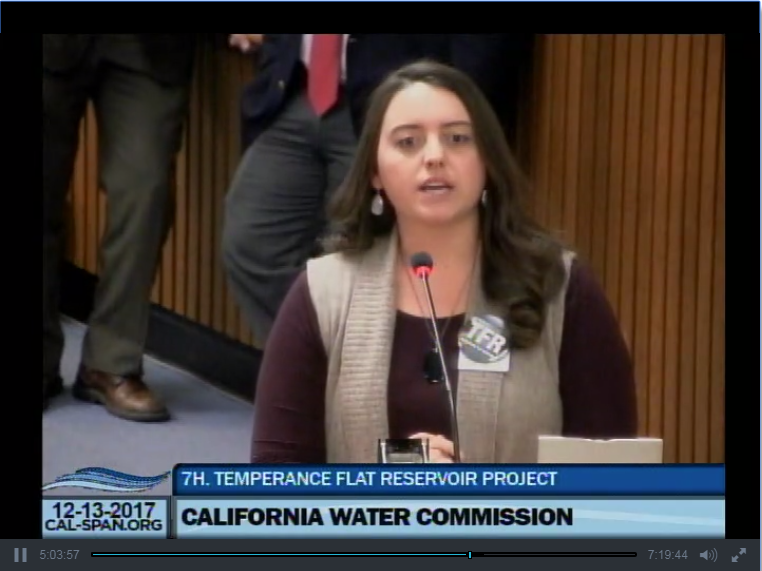
NEWS & ISSUES
Latest News – IC-DISC Restored in Senate Bill
Late Friday night, the Senate capped a frenetic few days with the adoption of a “wraparound” amendment to H.R. 1, the Tax Cuts and Jobs Act. These amendments were drawn to the manager’s amendment which incorporated a range of individual members’ amendments that had been prepared for the bill, along with new language negotiated throughout the day. Many of these amendments are technical, clarifying or making minor revisions to non-notable provisions. However, there were some important revisions that were made as a result of intense negotiations. Included in those amendments was restoring the IC-DISC tax incentive. The California Cotton Ginners and Growers Association (CCGGA) was heavily involved in this effort working closely with a tax coalition focused on IC-DISC, and was on the phone daily last week with Washington, DC and New York, NY. We also want to recognize our members and Associate members who took the time to write letters and make calls to legislators throughout last week. It was the specific examples of the impact of potentially losing IC-DISC that changed the tide for us. The bill now heads to Conference Committee, where the Association will still be closely monitoring the situation to protect IC DISC.
Latest News – Supporting Temperance Flat Dam
The San Joaquin Valley Water Infrastructure Authority is seeking the attendance of Temperance Flat Dam supporters at the next California Water Commission meeting on Wednesday, December 13. During this meeting Valley water leaders will be making a formal presentation on the project to commission members and how critical the 1.3 million acre-foot reservoir is to valley agriculture and residents. This is possibly the only chance to show the California Water Commission, the strong regional support there is for the project. Transportation and provisions will be provided to all participants as this will be an all day trip. If you are interested in participating in this effort please contact your County Farm Bureau for information on bus transportation.
Latest News – Chlorpyrifos to Be Listed Under Prop 65
The Developmental and Reproductive Toxicity Identification Committee (DARTIC) made a decision to list chlorpyrifos under Proposition 65 as a developmental toxicant. California Cotton Ginners and Growers Association submitted comments in opposition to the product’s potential listing, stating that any additional actions that could potentially limit the use of the product are unacceptable. This latest action while not favorable, will not affect the availability or use of chlorpyrifos containing products for the time being.
Latest News – East San Joaquin Revised Order Draft Released, Workshop Dates Set
Last month, the State Water Board released a second draft of their Proposed East San Joaquin Order. This Order aims to strengthen groundwater quality protection by leveraging stronger monitoring and field level requirements on growers and coalitions, and the Order is precedential in that it can be applicable to all Coalitions throughout the State. The recently released draft has several key changes to various requirements set forth in the order, primarily the inclusion of more stringent surface water monitoring throughout the state. This newly added requirement will undoubtedly result in higher fees to stakeholders due to the newly incurred cost at the Coalition level for this kind of monitoring. Other changes include the elimination of township level data aggregation, this provision is being replaced by individual operation data being submitted to the Regional Board with only the name of the operation being withheld by the Coalitions. Another major change is that growers in Low Vulnerability areas must have their Nitrogen & Irrigation Management Plans signed off on by a CCA or other certified source. This was not a requirement in the previous draft, although the State Water Board was trying to designate the entire State as being in High Vulnerability to groundwater quality.
The State Water Board will be hosting 2 workshops on this specific topic within the month of November, as well as holding a specific workshop in front of the entire Board during the month of December. A workshop will be held in Fresno on November 27th, and an additional workshop will be held in Redding on November 30th. We will be developing talking points to distribute amongst the membership, and we encourage you to participate in the Board Hearing as well as the workshop that is closest to you. We would also encourage you to submit written comments to the Board, as these will be reviewed and considered for the final draft to be released this next year. For more information on the proposed workshops, please visit the link below.
Latest News – Senate Tax Bill Proposes to Eliminate IC-DISC: Could Cost Cotton Industry Millions
Unlike the House Tax Reform Legislation, HR 1, passed this past week, the Senate Finance Committee similarly passed its version of the tax reform legislation, which unfortunately contains specific language that repeals the IC-DISC provisions. The IC-DISC tax savings are achieved from a reduced 20% U.S. capital gains tax rate on at least half of the income derived from qualifying products, in lieu of the normal Federal tax rate which can be almost 40%. IC‐DISC stands for “Interest Charge – Domestic International Sales Corporation,” a tax incentive which was introduced by Congress in its current form in 1984. It was designed to provide a U.S. tax incentive to stimulate U.S. export activities. The IC‐DISC is relatively unknown and often overlooked because other alternative tax incentives were more often used until the last remaining alternative was eliminated in 2006. This is a critical tool for the tree nut industry, which exports the majority of its product. The California Cotton Ginners and Growers Association (CCGGA) is actively working against these provisions, through our Senate and House Representatives, and in conjunction with a national coalition working to preserve IC-DISC.
Association Testifies at Yet Another PM2.5 Workshop
Association President/CEO Roger Isom provided testimony at today’s Public Advisory Workgroup (PAW) meeting on the PM2.5 State Implementation Plant (SIP) at the San Joaquin Valley Air Pollution Control District (SJVAPCD). The 12th such workshop, which does include the four Air Resources Board (ARB) and SJVAPCD Board Briefings, was held to provide an update on the development of the SIP which will be considered and voted on by the SJVAPCD Governing Board in March of 2018 and by the ARB Board in April of 2018. The Association has been present and testified at every single one. Isom’s comments focused on the SJVAPCD’s proposal to electrify more ag pump engines, use incentive funds in “hot spots” areas for tractor and harvesters, as well as looking at new Conservation Management Practices (CMPs). Isom also commented on the ARB’s proposal to have a tractor rule that would put forth a date by which tractors would have to be replaced with Tier 4 engines. “Incentive funds are the only way agriculture can address a tractor replacement regulation. We cannot pass along the cost, like other industries”. With regards to the electrification issue, Isom commented that there needs to be a meeting of the agencies, including the California Public Utilities Commission (CPUC) as the utilities are proposing to change their rates which would have a direct negative impact on further electrification. Stay tuned as this issue continues to move towards Board adoption.
Latest News-CDPR Finalized Pesticide Use around Schools
CDPR Finalized Pesticide Use around Schools
The California Department of Pesticide Regulations has adopted the official regulations regarding the use of agricultural pesticides near schools and licensed child day-care facilities. The regulations will take effect on January 1, 2018. The new rule prohibits most applications within a quarter mile around schools and day care facilities from 6 a.m. to 6 p.m. Additionally, the regulations require growers within the quarter mile radius to provide an annual notification no later than April 30 of pesticides they expect to be used between July 1 of the current year through June 30 of the next year. Pesticides that require use but are not included on the annual notification must provide notification at least 48 hours prior to their use. Fumigants may not be applied within 36 hours of the school and/or daycare facility are open.
Below is a breakdown of distance and application restrictions.
Prohibited applications within a quarter mile:
- Aircraft
- Airblast sprayer or other ground application equipment that delivers spray into an air stream created by fan
- Sprinkler chemigation
- Dust or Powder, unless injected into the soil
- Fumigant, includes fumigation of stockpiles in orchards but excludes fumigation on huller/processor sites.
Prohibited applications within 25 feet:
- Ground rig sprayer
- Field soil injection equipment
- Drip or flood chemigation
No distance restriction:
- Application made within closed space (exception of fumigant)
- Bait stations
- Dust or powder injection into soil
- Application of granule, flake or pellet (exception of fumigant or aircraft application)
- Backpack sprayer (exception if it incorporates airblast or is used to apply dust/powder)
- Hand pump sprayer (exception if used to apply dust, powder or fumigant)
Latest News – Don Cameron, Awarded 2017 Agriculturalist of the Year
Don Cameron, longtime cotton industry advocate and friend, was awarded Fresno Chamber of Commerce’s Agriculturalist of the Year award. Cameron who farms more than 7,500 acres has proven to be an industry leader through innovative farming practices as well as through his high level of involvement in the industry. Cameron, who once served as California Cotton Growers Association Chairman from 2007-2008, has participated on numerous committees and boards. He currently serves on the California State Board of Food and Agriculture and is currently the chairman for the California Cotton Alliance and serves on the Western Growers Board of Directors. He has had critical involvement with the Sustainable Ground Water Management Act formation, in the Kings Sub-basin. President/CEO Roger Isom said, “There is no one more deserving than Don. If you look at what a grower needs to be successful in California in 2017, it’s Don Cameron.” California Cotton Ginners and Growers Association congratulates Don Cameron on a well-deserved award! To watch Don Cameron receive the award watch the link below.
CCGGA Tours SoCal Ag with Urban Legislators
The California Cotton Ginners and Growers Association joined a large group of urban southern California legislators last Friday to tour the agricultural industry in the 44th (Irwin) and the 37th (Limon) legislative districts. Assemblywoman Irwin, Assemblywoman Limon, Speaker Rendon, Assemblyman Bloom, Assemblywoman Burke, Assemblyman Jones-Sawyer, Assemblywoman Rubio as well as several staffers were among the participants in the day long tour. The group visited Houwelling’s Tomatoes, a Driscoll’s farm site and Limoneira packing house. The Association was represented by Director of Technical Services Chris McGlothlin and Director of Regulatory Affairs Jodi Raley. This was an incredibly unique opportunity to discuss agricultural issues with several members who are primarily in urban Los Angeles areas. Issues discussed included labor, the increasing cost of staying in business in California, and the increasing regulatory burden agencies are rolling out. The Association finds great value in these opportunities to expose our lawmakers to the agricultural industry with the result of them emerging with a greater understanding and appreciation of agriculture!
