The U.S. Department of Agriculture is offering a new option to schedule appointments online with their local Farm Service Agency (FSA) office. Following a successful pilot program, FSA is now using a digital appointment platform across the agency to allow producers to make farm program or farm loan appointments online at their convenience. “Farmers and ranchers work around the clock and should be able to schedule appointments with their local offices at their convenience,” said FSA Administrator Bill Beam. Producers can schedule appointments through FSA’s digital platform, Microsoft Bookings, using a mobile device, tablet, laptop or desktop computer. To assist producers in finding their local FSA office to make an appointment, each county office contact page has a unique link for producers to make an appointment online and shows contact information for the local FSA office and the farm loan team. Appointments may be in-person or virtual with the local FSA office depending on producer preference. Producers can conveniently schedule appointments for a variety of services with both farm program and farm loan staff. For more information, producers can contact their local FSA office.
NEWS & ISSUES
Science Prevails in Latest Atrazine Assessment
A decades-long effort by grower organizations to ensure science-based regulation of atrazine reached an important milestone this month as the U.S. Fish and Wildlife Service reconfirmed atrazine and simazine do not pose a risk to the continued existence of threatened and/or endangered species. The decision follows years of advocacy by the Triazine Network, a coalition formed in 1995 to represent agriculture in regulatory actions involving atrazine and other triazine herbicides. Through the network, the California Cotton Ginners and Growers Association and Western Tree Nut Association haves worked to ensure growers’ voices are heard throughout the regulatory process. “For more than 30 years, farmers have been asking regulators to utilize sound science and consider how these decisions affect real operations,” Association President/CEO Roger A. Isom said. “Growers from across the country stepped up, helping ensure regulators had a complete picture of what atrazine means to American agriculture. That made all the difference.” This last major regulatory hurdle stems from lawsuits and court orders requiring EPA to evaluate pesticide impacts on threatened and endangered species under the Endangered Species Act. As part of that process, EPA requested a biological opinion from the U.S. Fish and Wildlife Service. The Service ultimately concluded atrazine and simazine can continue to be used without jeopardizing protected species. While this decision represents an important milestone, the work is not finished. Activist groups continue to use litigation and public-fear campaigns to challenge important crop-protection tools. The Triazine Network remains engaged to ensure future decisions involving atrazine and simazine are grounded in the best available science. Continued grower involvement will be critical as EPA works to finalize the reregistration process for this key crop protection tool.
US Supreme Court Hands Down Favorable Ruling in Durnell vs. Monsanto Case
This past week, the U.S. Supreme Court voted 7-2 affirming that the Federal Insecticide, Fungicide, and Rodenticide Act (FIFRA) expressly preempts state-law-based failure-to-warn claims when the U.S. Environmental Protection Agency (EPA) has made a definitive determination on product safety. It is believed this decision will bring “containment” to the ongoing Roundup litigation. For years, US EPA has repeatedly determined that glyphosate is not likely to be carcinogenic. In fact, many leading independent regulatory bodies worldwide, including the European Food Safety Author have come to the same conclusion. Association President/CEO Roger A. Isom stated, “Once and for all the Supreme Court has brought an end to the meritless litigation and made a decision that gives farmers certainty that regulatory decisions on pesticide labels will be based on sound and proven science.” In the Durnell case, EPA would have had to include a cancer warning on Roundup’s label despite clear science showing otherwise. This ruling ends the uncertainty surrounding glyphosate, and gives farmers protection against states making conflicting, and misleading label requirements contrary to FIFRA.
2026 American Pima Grade Standards Guide Box Review and Standards Matching
Visalia, CA Classing Office
9:00am
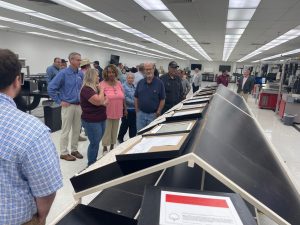
Please join us to review, comment, and approve the six guide boxes of the 2026 American Pima Grade Standards. Once approved, the guide boxes will be used as the reference to match all the 2026 American Pima Grade Standards. The guide box review and the standards matching will both take place the morning of July 22nd.
Industry participation is key to this process, and we hope you all can come and be a part of this important annual event.
For additional information please contact:
Ryan Phillips, Assistant Area Director
E-mail: ryan.phillips@usda.gov
Visalia Classing Office
7100 West Sunnyview Avenue
Visalia, CA 93291
Phone: (559) 651-3015
or
David Rowland, Director
E-mail: David.Rowland@usda.gov
Standardization and Engineering Division
3275 Appling Road
Memphis, TN 38133
Phone: (901) 384-3030
State Increase Potential Funding for Sites Reservoir Project
The California Water Commission committed $268.9 million in conditional supplemental funding to the Sites Reservoir Project earlier this week to offset inflation and for additional public benefits. These funds, administered through the Commission’s Water Storage Investment Program (WSIP), were made available from Proposition 1 (2014) and Proposition 4 (2024) and are an investment in the public benefits offered by the Sites Project. The project is a 1.5 million acre-foot off-stream surface storage reservoir located in the Sacramento Valley west of the town of Maxwell. Once construction is complete, the reservoir will provide the following public benefits:
- Capture and store flood flows from the Sacramento River to reduce potential flood damage in the Maxwell area.
- Provide new opportunities for recreation for an anticipated 187,000 visitors annually.
- Deliver water to wildlife refuges, including the Sacramento National Wildlife Refuge Complex, Upper Butte Basin Wildlife Area, and San Luis National Wildlife Refuge.
- Deliver up to 200,000-acre feet of captured water to create a new water supply for use during emergency-declared droughts.
With this additional funding, the Sites Project is eligible for a total of $1.363 billion in WSIP funding. To receive funding from the Commission, the project must first meet certain voter-mandated requirements, including securing financing, obtaining permits, completing environmental review, and contracting with the State agencies that are overseeing the administration of the public benefits. “The Sites Project proponents have shown consistent progress in making this reservoir come to fruition. We look forward to seeing them complete the statutory requirements so they can come before us for final funding,” said Commission Chair Fern Steiner. “The California Water Plan calls for a statewide goal of nine million acre-feet of additional water, water conservation, or water storage capacity by 2040. This project will go a long way toward meeting that goal.”
CDPR Proposes to Increase Penalties for Violations
The California Department of Pesticide Regulation (DPR) is proposing changes to the state’s Enforcement Response Regulations. According to DPR. the proposal would increase fines for violations that could harm people’s health, hold repeat violators accountable, and support consistency in enforcement across the state. These regulations address actions taken by County Agricultural Commissioners (CACs) in their pesticide use enforcement programs. DPR’ oversees and guides CACs who conduct on-the-ground compliance, inspections, investigations and enforcement actions across all 58 California counties. Key elements of the proposal include:
- Increasing fines for incidents impacting human health. Changing how pesticide violations are categorized, creating a higher category and associated fines for violations that pose hazards to human health.
- Holding violators accountable. Adjusting penalty levels, including changes to minimum civil penalties for the most serious violations and increasing penalties for repeat violators. This includes required documentation and consideration of compliance history when determining penalties.
- Supporting consistent enforcement statewide. Clarifying definitions, timelines, and documentation requirements to support consistent enforcement decisions across counties. This also includes DPR oversight of CAC enforcement decision-making.
- Streamlining processes for enforcement coordination. Identifying areas for timely CAC coordination with District Attorneys and other prosecuting authorities to ensure that every available enforcement tool – including criminal prosecution, where appropriate – is used effectively.
- Increasing transparency into DPR enforcement actions. Adding a DPR annual enforcement report describing actions taken under the Department’s enforcement authority.
DPR is holding a 45-day public comment period through July 28, 2026, to collect input on the proposed regulations. Comments can be submitted online through DPR’s public comment portal, SmartComment(external link), or can be submitted via email to dpr26002@cdpr.ca.gov. DPR will hold three public hearings during the comment period to receive verbal comments. All hearings will be conducted virtually to ensure statewide accessibility. The agenda and pre-hearing presentation will be posted on DPR’s Meetings and Events webpage in advance of each hearing.
July 8, 2026
5:30 p.m. – Pre-hearing presentation
6:00 – 8:00 p.m. – Regulatory hearing and public comment
Register and join: Zoom (Virtual)(external link)
July 21, 2026
9:30 a.m. – Pre-hearing presentation
10:00 a.m. – 12:00 p.m. – Regulatory hearing and public comment
Register and join: Zoom (Virtual)(external link)
July 28, 2026
5:30 p.m. – Pre-hearing presentation
6:00 – 8:00 p.m. – Regulatory hearing and public comment
Register and join: Zoom (Virtual)(external link)
Association Meets with EPA Regional Administrator
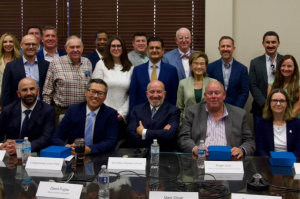
The California Cotton Ginners and Growers Association (CCGGA) and the Western Tree Nut Association (WTNA), along with the Nisei Farmers League and Fresno County Farm Bureau, met with Mike Martucci, EPA Regional Administrator for Region 2 and Interim Regional Administrator for Region IX, this week. The day began with a meeting at the San Joaquin Valley Air Pollution Control District in Bakersfield, and then a trip to Buttonwillow. The meeting included a tour of the Cauzza Growers Farm and equipment yard, followed by a meeting with local growers in the Buttonwillow area. Topics included air quality, pesticides and water. Also participating in the meetings were Anita Lee, EPA Region IX Director of the Air and Radiation Division, as well as Samir Sheikh and Shiraz Gill with the San Joaquin Valley Air Pollution Control District. Area growers included Association members Jake and Luc Cauzza, with Cauzza Growers; Bryan Bone, with Bone Farms, LLC; and Greg Actis, of the Elk Grove Farming Co and CCGGA Chair Adriane Carbonel of Farmers Coop Gin. The Association was represented by President/CEO Roger A. Isom and Assistant Vice President of Technical Services Christopher McGlothlin.
CCGGA Vice Chair Jake Cauzza talking about issues impacting their farm with EPA Regional Administrator Mike Martucci.
Trade Discussions in the Valley With Congressmen Fong and Smith
The Association was invited to attend and speak at two roundtable discussion with Congressman Vince Fong (CA- 20th) and Congressman Adrian Smith (NE-3rd) Chairman of the House Ways and Means Subcommittee on Trade. In the first meeting, which was focused on trade, Association President/CEO Roger A. Isom attended and spoke on behalf of the Association and focused his comments on the impact of not only tariffs, but the unfair cost of doing business in California. Isom discussed the impact of tariffs on almonds, walnuts and pistachios and having lost market share to Chile on walnuts going into India, and to Australia on almonds going into China. Isom highlighted the fact that 100% of the cotton, and more than 70% of tree nuts, grown in California are exported so tariffs have a significant impact. Isom also pointed to the significant input costs from water, labor, energy and environmental regulations as creating a significantly unfair playing field. He highlighted an example of having to purchase a new Tier 4 engine powered front end loader here for $360,000, while our counterparts in Australia can still purchase a Tier 0 engine powered loader for only $60,000. Isom stated “This is but one egregious example in the disparity in input costs between California and the rest of the country. Industry attendees at the meeting included almonds, pistachios, table grapes, potatoes, citrus, several county farm bureaus, the three major ports in California, railroad, and chemical companies.
In the second roundtable, which had a broader focus, representing the Association were Assistant Vice President Priscilla Rodriguez and Assistant Vice President of Technical Services Chris McGlothlin. Rodriguez reinforced the importance of international trade to California agriculture and discussed the need to maintain and expand export opportunities for the state’s cotton and tree nut industries. Rodriguez also spoke directly with Congressman Smith regarding the Buying American Cotton Act and encouraged his support of legislation that would provide incentives for the use of U.S.-grown cotton, helping strengthen domestic demand for American cotton producers. McGlothlin spoke on the finds of non-native pest species that could devastate the cotton industry in California, and encouraged federal agency readiness in the event those pests spread further.
Association Participates in Meeting With Senator Adam Schiff
This past week United States Senator Adam Schiff from California was in Hanford to meet with farmers and ag leaders to discuss critical issues affecting the agricultural industry. Representing the California Cotton Ginners and Growers Association (CCGGA) was Board Member and Past Chairman Kirk Gilkey of Cross Creek II Gin LLC and Gilkey Five. Gilkey used the opportunity to discuss the Sustainable Groundwater Management Act (SGMA) and the Buying American Cotton Act (BACA) which would provide tax incentives for using American grown cotton. More than 20 farmers, ranchers and ag leaders attended the meeting, which was hosted by the Kings County Farm Bureau.
USDA Announces Great American Cotton Plan
U.S. Secretary of Agriculture Brooke L. Rollins announced today the Great American Cotton Plan, a comprehensive USDA initiative to strengthen the cotton farm economy, restore domestic textile manufacturing, expand cotton trade opportunities, and increase demand for products made with American-grown cotton. “Since 1607, cotton has helped build and sustain rural America. Our farmers grow some of the highest-quality cotton in the world, but over the last several years America’s cotton growers have been crushed by rising costs, unfair foreign competition, and a flood of cheap synthetic products. In 2023, we lost our status as the world’s top cotton exporter to Brazil. This change starts today,” said Secretary Rollins. “The Trump Administration is committed to ensuring American cotton once again becomes the fiber of choice with the Great American Cotton Plan — a bold effort to restore profitability for cotton producers, strengthen rural economies, rebuild domestic textile manufacturing, and bring American cotton back into the products families use every day. Supporting natural fibers like cotton also aligns with the Make America Healthy Again agenda as Americans grow increasingly concerned about microplastics and synthetic materials in everyday products. Cotton is natural, breathable, biodegradable, and proudly grown by American farmers — not manufactured from petroleum-based plastics that can shed microplastics into our soil, water, and bodies.” The announcement comes as cotton producers face a fifth consecutive year of negative returns driven by rising input costs, trade distortions, and increasing competition from synthetic materials. As part of the plan, USDA will elevate the “Plant Not Plastic” initiative to encourage consumers to purchase products made with healthy natural American cotton fibers rather than synthetic plastic-based alternatives.
The Great American Cotton Plan addresses these challenges through four key pillars:
Promoting Domestic Cotton Consumption
- USDA and HHS are promoting the “Plant Not Plastic” initiative to encourage consumers to choose products made with American cotton
- USDA is ensuring the BioPreferred Program remains funded so biobased products, including cotton products, can continue using the BioPreferred label
- USDA is implementing increased marketing loan rates for upland and extra-long staple cotton authorized through the Working Families Tax Cuts Act
Providing Affordable Cotton by Increasing Domestic Demand and Production
- USDA is prioritizing cotton processors and manufacturers within Rural Development’s Business and Industry Guaranteed Loan Program to increase domestic production capacity
- The Economic Adjustment Assistance for Textile Mills program payment rate will increase from 3 cents to 5 cents per pound of cotton processed
- USDA will continue working with Congress to support the bipartisan Buying American Cotton Act
Improving Cotton Trade
- USDA is implementing the Administration’s Three-Point Trade Plan to expand export opportunities for U.S. cotton
- Cotton Council International participated in an Agribusiness Trade Mission to Indonesia for the first time in program history earlier this year
- USDA and USTR secured commitments from Indonesia and Bangladesh that will support future U.S. cotton purchases and textile production using American cotton
- USDA continues supporting cotton exports through the Market Access Program and COTTON USA™ licensing initiatives
Protecting Cotton Growers from Adverse Risk
- USDA Agricultural Research Service scientists are advancing research efforts to combat the spread of the cotton jassid pest
- Cotton producers now have expanded access to Supplemental Coverage Option insurance tools
- The Working Families Tax Cuts Act increased the seed cotton reference price for ARC and PLC programs by 14 percent beginning in fall 2026