NEWS & ISSUES

2025 Kearney Alfalfa, Forage and Field Crops Field Day – September 18, 2025

The annual Kearney Alfalfa, Forage and Field Crops Field Day is scheduled for Thursday, September 18, 2025. The field day takes place in its traditional location of the UC Kearney Agriculture Research and Extension Center at 9240 S. Riverbend Ave., Parlier, CA 93648.

This half-day meeting is free to attend thanks to generous sponsors from the
ag community. All are welcome to attend. Despite being free to attend, we strongly encourage all to pre-register so all can enjoy the lunch provided and so we may meet any accommodation necessary to attend and participate. Register your attendance by following this link and filling out the survey:
https://surveys.ucanr.edu/survey.cfm?surveynumber=46729

Sign-in starts at 7 AM, and it is critical for those seeking continuing
education units to sign in before the field day starts.
 We have applied for

continuing education units from CA DPR, CDFA INMP, and CCA. See the event
agenda for detailed times of presentations and more information about the
event below.

For inquiries or more information, contact Nick Clark – neclark@ucanr.edu.

Association Hosts Assemblywoman Soria

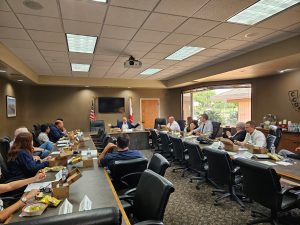
Yesterday, the Association hosted Assemblywoman Esmeralda Soria (D-27) at the office as the legislature is about to reconvene to finish the 2025 legislative session. The Association has made an all-out push to incorporate funding allocations specifically for tractor and equipment replacement related programs administered by the San Joaquin Valley Air District (SJVAPCD). Attendees included Association President/CEO Roger Isom, Assistant Vice President of Technical Services Chris McGlothlin, Air District Executive Director/APCO Samir Sheikh, Morgan Lambert – Deputy APCO of the Air District, Mark Montelongo – Director of Policy and Government Affairs for the District, as well as Manuel Cunha from the Nisei Farmers League. The Association also discussed the ongoing efforts to find solutions for rat infestation in the westside of the Valley.
 
It was announced late last month that the Air District would be pausing the application process of their FARMER program due to the already existing backlog of projects, and the limited funding that is currently allocated for 2025. The fight for additional FARMER funding has been looped into the ongoing Cap & Trade reauthorization discussion, and the Association has been working to keep the funding request in the forefront of the legislature’s mind. With only one month left in this year’s legislative session, it’s time to put the pedal to the metal. Stay tuned for updates.

Sites Reservoir Advances

This past week the Sites Project Authority (Authority) announced two major advancements that move the Sites Reservoir Project (Project) closer to construction. Significant contractor outreach progress and two key environmental permitting milestones indicate that the Authority’s goal of breaking ground on Sites Reservoir by the end of 2026 is within reach. The Authority is reviewing a short list of qualified applicants for the Construction Manager at Risk (CMAR) contract to construct the reservoir and roads portion of the Project. The CMAR procurement process began earlier this year, and the Authority is now requesting detailed proposals from the short list applicants and anticipates selecting a CMAR contractor later this year. “The CMAR selection process, which is done through a qualifications based competitive procurement, ensures we select the highest ranked team that will provide the best value for the Project and local community,” said Jerry Brown, Executive Director of the Sites Project Authority. “The first phase shortlisted from a group of premier internationally recognized contractors, while this second phase allows the Authority to dive deeper into each firm’s approach to efficiency, cost certainty, local community compatibility, and project management for a project of this magnitude.” 

Additionally, on Wednesday, the U.S. Fish & Wildlife Service (USFWS) issued the biological opinion for the construction of the Project, a key permit that analyzes potential impacts of the Project on federally listed endangered and threatened species. The biological opinion also addresses the Project’s construction effects on three species listed as candidates, should they become listed under the Federal Endangered Species Act. In addition, on July 7, the California Department of Fish and Wildlife (CDFW) issued the Master Streambed Alteration Agreement for the construction of the Project. This is a key permit required to modify local waterways in the construction site during Project construction. USFWS’s biological opinion and the CDFW Master Streambed Alteration Agreement represent two of a handful of key permitting milestones that further authorize the construction of the Project by state and federal resource agencies. In late 2024, the Project received two Incidental Take Permits (ITPs) from CDFW, authorizing the Authority to build and operate Sites Reservoir in compliance with California’s comprehensive endangered species laws. The ITPs ensure the Authority will fully mitigate any potential impacts to the state’s endangered and threatened species throughout construction and operation. Sites Reservoir will increase water supply throughout California and provide, for the first time, environmental benefits by storing water specifically to support native wildlife and their habitat during drought periods. The Project will provide an additional 1.5 million acre-feet of storage capacity, substantially improving the state’s water flexibility, reliability, and resiliency in drier years. 

SJV Air District Pauses Tractor Replacement Application Intake

Yesterday, the San Joaquin Valley Air Pollution Control District (Air District) sent notice to all stakeholders and equipment dealers that the application intake is being paused for the highly popular Ag Equipment Replacement Program on July 31st. Applications submitted prior to the deadline will be accepted and processed once funding is made available. The reasoning for the hold application submittals is a combination of the large backlog of existing equipment replacement applications currently at the Air District, paired with a lack of funding provided by the State of California to achieve meaningful and significant emission reductions. The Equipment Replacement Program is the most cost-effective program in achieving the state’s emission reduction goals. 
 
The Association has submitted a formal letter to state legislative leadership, as well as discussed the need for equipment replacement funding with every legislator that we have met with this legislative session. We have been hopeful that a multi-year commitment will be developed in order to try and secure the necessary funding to keep the program working efficiently. With prior year’s funding coming from the Cap & Trade Program, the legislature has signaled that there could be an opportunity to secure future year’s funding through Cap & Trade program reauthorization negotiations. Stay tuned for more updates!

Cotton Harvest Safety Training

The Association has partnered with Fresno County Farm Bureau to host a Cotton Harvest Safety Training on Tuesday, September 16, from 8:30-10:30 a.m. at the UC West Side Research and Extension Center located at 17353 W. Oakland Ave in Five Points. This training will be held concurrently in both English and Spanish.

The training will cover equipment safety (preparation and operation), electrical hazards, heat illness prevention and road safety. All information will be provided in English and Spanish. Certificates will be given upon completion. The training will be provided by Zenith Agribusiness Solutions.

There is no cost to attend, and check-in will begin at 8 a.m. RSVP for the upcoming training here.

CDFA Issues Advisory on Cotton Seed Bug Detections

The California Department of Food and Agriculture has issued an advisory that it has found cotton seed bug (CSB) at three different nurseries in San Diego County this month.  Six (6) adult CSB were found at a nursery in San Marcos, one (1) adult CSB was detected at a nursery in Vista and eight (8) more were found at a nursery in San Diego.  With all of the detections, all flowers and fruiting bodies (seed pods and/or seeds) will be removed from the plants on hold. Foliar treatment commences within the week along with reinspection in 30 days.  San Diego County is continuing survey efforts at the nursery and surrounding areas, as well as conducting trace back and trace forward activities to determine potential origin of the CSB and any potential shipments of host material.  CSB is a small (adults are ~4mm long), brownish-black, nondescript true bug. The primary food of adults and nymphs is seed of plants in the family Malvaceae, including Hibiscus, Malva, Abutilon, and (based on California detections) Lagunaria.  Agricultural hosts include cotton, okra, and kenaf. Lagunaria patersonia trees appear to be a potential preferred host, as the seeds are present on the tree for long time periods.  Damage to cotton seed is reported to impact oil quality and reduce seed germination up to 75 percent. CSBs cause staining of cotton lint when their bodies are crushed during harvesting and processing.  The Department has conducted a visual survey to look for CSB in nurseries since 2023. In 2024, the Department surveyed a total of 49 nurseries for CSB in Los Angeles, Santa Barbara, San Diego, Riverside, Orange and Ventura counties. The nurseries were chosen based on the likelihood that they would have Malvaceous plants present ideally with seed pods. No CSB were found during this or past Pest Detection and Emergency Projects nursery and ornamental surveys. Th  Department continues in 2025 in conducting a CSB survey in nurseries located in Orange, Los Angeles, Ventura, Santa Barbara, Riverside, Santa Clara and San Diego counties. At least 54 sites will be surveyed during the 2025 survey. Production nurseries that ship Malvaceous plants out of state will be prioritized. In addition to these nursery/ornamental surveys, the Department is continuing to partner with the United States Department of Agriculture to conduct survey in commercial cotton and okra and monitor the spread of this pest. No CSB has been found in production cotton or okra in California to date.

EPA Proposes Attainment for San Joaquin Valley for 1997 PM2.5 Standard

The Environmental Protection Agency (EPA) is proposing to determine that the San Joaquin Valley, California fine particulate matter (PM2.5) nonattainment area attained the 1997 annual PM2.5 national ambient air quality standards (NAAQS). This proposed determination is based on ambient air quality monitoring data from 2022 through 2024. This is a very significant milestone for the San Joaquin Valley in terms of air quality. Unfortunately, EPA has kept moving the goalposts and established additional ambient air quality standards, especially for PM2.5 and the San Joaquin Valley has been forced to keep adopting rules and regulations to meet these tougher standards. The standard for which this ruling is being proposed is 15 µg/m3. New PM2.5 standards have since been established including 12 µg/m3 in 2012 and 9 µg/m3 in 2024. To get to this status has been painful for the industry given all of the rules and regulations that have been adopted and implemented to get to this point.  According to the District, emissions of air pollutants from stationary sources has been reduced by over 93%. 

New Federal EPA Region IX Administrator Meets With Agriculture

Newly appointed Federal Environmental Protection Agency (EPA) Region IX Administrator Josh Cook came to the Valley this week to meet with agricultural groups to discuss critical air quality issues. Coordinated by the Nisei Farmers League and co-hosted by the California Cotton Ginners and Growers Association (CCGGA) and the Western Tree Nut Association (WTNA), Regional Administrator Cook and his staff joined State Farm Service Agency (FSA) Director Connie ConwayUSDA Natural Resource Conservation Service (NRCS) State Conservationist Carlos Suarez, San Joaquin Valley Air Pollution District APCO Samir Sheikh and his staff. Discussion centered on federal issues, including the future of any waivers for mobile equipment, outstanding State Implementation Plans (SIPs) for the San Joaquin Valley, and federal incentive programs such as the Diesel Emission Reduction Act (DERA) and the Targeted Air Shed Grants. The group also discussed the impact of the Sustainable Groundwater Management Act (SGMA) and how agriculture may have to address any fallowed lands. Joining the NFL, CCGGA and WTNA on the agricultural side was California Farm Bureau Federation, Fresno County Farm Bureau, California Citrus Mutual, California Fresh Fruit Association, Fresno Equipment Company, and the California Avocado Commission. The Association was represented by President/CEO Roger A. Isom.  The meeting was held at Fowler Packing.

USDA Announces Disaster Relief

U.S. Secretary of Agriculture Brooke L. Rollins has announced that agricultural producers who suffered eligible crop losses due to natural disasters in 2023 and 2024 can now apply for $16 billion in assistance through the Supplemental Disaster Relief Program (SDRP). The American Relief Act, 2025, provides disaster relief payments to producers who suffered revenue, quality or production losses to crops, trees, bushes, or vines due to qualifying disaster events in calendar years 2023 and 2024. The SDRP will be administered in two stages. Producers can receive payments in both stages, if applicable, and for one or both years, depending on losses.
 
Stage 1
Stage 1 will leverage existing Federal Crop Insurance or Noninsured Crop Disaster Assistance Program (NAP) data as the basis for calculating payments. This enrollment period is currently active. Crop, tree, and vine losses must be due to wildfires, hurricanes, floods, derechos, excessive heat, tornadoes, winter storms, freeze (including a polar vortex), smoke exposure, excessive moisture, qualifying drought, and related conditions occurring in calendar years 2023 and/or 2024. Drought losses must have occurred in a county rated by the U.S. Drought Monitor as having a D2 (severe drought) for eight consecutive weeks, D3 (extreme drought) or greater intensity level during the applicable calendar year. Eligible counties from California include: Alameda, Amador, Butte, Calaveras, Colusa, Contra Costa, El Dorado, Fresno, Glenn, Inyo, Kern, Kings, Lake, Lassen, Los Angeles, Madera, Mariposa, Mendocino, Merced, Modoc, Monterey, Napa, Nevada, Placer, Riverside, Sacramento, San Benito, San Bernardino, San Joaquin, San Luis Obispo, Santa Barbara, Santa Clara, Shasta, Siskiyou, Solano, Sonoma and Stanislaus Counties. 
 
Stay tuned for information on Stage 2.

Association Tours Cotton Seed Bug Research Lab

The Association was asked to meet with USDA Ag Research Service (ARS) and Animal and Plant Health Inspection Service (APHIS) representatives at their Beltsville, MD facility. CCGGA Assistant Vice President of Technical Services Chris McGlothlin, and National Cotton Council’s Vice President of Technical Services, Chad Brewer, attended the event on behalf of the cotton industry. There, USDA researchers made presentations on the work that is being done at the lab, identifying crucial pheromone research being conducted, working on potential control measures to keep the bugs out of commercial cotton production, as well as other related cotton seed bug research that is ongoing. Both Brewer and McGlothlin explained the importance of trap, lure and pheromone development to try and curb any further incursion of the Cotton Seed Bug to areas without cotton production. 
 
After the discussion, attendees were then led to the research lab, where ongoing pheromone research is being conducted. With only an area of 93 square feet for a containment lab, Dr. Aijun Zhang, Research Chemist with USDA-ARS and his research assistants Dr. Mohamed Ahmed, Dr. Saveer Ahmed, and Dr. Souvic Sarker, maintain a colony of Cotton Seed Bugs, and conduct testing on attractants that could be used in future lures. Squeezing into the room 4 at a time, researchers showed the various equipment and tests examples that individual bugs are subject to in order to test efficacy. Dr. Aijun is hopeful that a patented lure will be available by the end of July, and can be paired with traps in areas where Seed Bug has been detected to keep them out of commercial cotton fields. Stay tuned for more updates.