In a significant victory for agriculture, the Monterey County Superior Court decided in favor of California Department of Pesticide Regulation (DPR) and County Ag Commissioner’s authority to issue restricted material’s permits for fumigant use in Monterey County. Petitioners from 4 local teachers unions had challenged the existing authority for the government agencies to approve the use of restricted materials of chloropicrin and 1, 3-dichloropropene to fumigate fields intended to be planted in strawberries for applications proposed during the 2023 season.
The Court rejected Petitioners’ arguments. The administrative record could not be expanded beyond what was presented to both CAC and Director. The “post hoc rationalization” theory failed because CAC inspectors performed their evaluations before issuance, and written explanations are only required when review is requested. The claim that CACs have authority to stay permits was forfeited and contrary to the statute, which grants stay authority only to the Director. Finally, Petitioners’ “pattern and practice” claim could not stand once the core CEQA-based challenges failed.
This is a huge win for the industry, while also affirming DPR and the Ag Commissioner’s authority to issue restricted material permits.
NEWS & ISSUES
Association Hosts Texas Ag Leadership Group
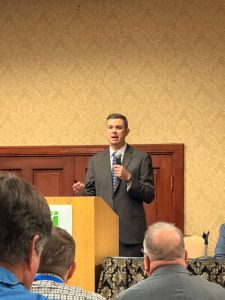
The Texas Agricultural Lifetime Leadership Cohort was in California this week, and the Association hosted the group for a very special dinner at the Association offices in Fresno. Speaking at the event was the Association’s Assistant Vice President Priscilla Rodriguez (CALF Class 50) and Assistant Vice President Christopher McGlothlin (CALF Class 52), who both shared their leadership journeys and experiences through the California Ag Leadership Program, as well as discussing the critical issues they are working on. In addition, special guest speakers also presented their experiences and issues including Don Cameron, of Terranova Ranches and current Chairman of the Board of the California Department of Food and Agriculture (CDFA), Daniel Hartwig, President of the California Fresh Fruit Association, and Mandy Critchley (CALF Class 37). Association President/CEO Roger A. Isom served as the host and emcee for the event.
CA Legislature Approves Composting Bill, Now It’s Up to the Governor
The California Legislature has unanimously approved Sen. Jerry McNerney’s SB 279, which is designed to benefit farmers and winegrape growers by allowing them to compost large amounts of green waste onsite. “California farmers and winegrape growers are facing a new challenge now that burning agricultural waste is no longer allowed and must ship their green waste to large composting facilities, often hundreds of miles away at great expense,” said Sen. McNerney, D-Pleasanton, who is a member of the Senate Agricultural Committee. “SB 279 will provide California farms and vineyards with a more affordable alternative that is also good for the environment — the ability to compost a modest amount of green waste onsite once every ten years.” SB 279 now goes to the governor’s desk for approval. SB 279 is sponsored by Californians Against Waste, California Association of Winegrape Growers, California Cotton Ginners and Growers Association, California Alliance for Community Composting, The Climate Center, and People Food & Land Foundation. “SB 279 is a significant tool that could help agriculture begin to answer the major dilemma it faces with the closure of so many biomass plants. It opens the door for many of our growers to get introduced to composting, which is especially critical in those times when you have to replace an entire orchard. For our smaller growers this may be the only solution, and we would welcome its passage at a time we so desperately need answers,” said Roger Isom, President and CEO of California Cotton Ginners and Growers Association. Currently, California has a shortage of composting facilities, making it even more challenging for farmers and winegrape growers to dispose of their green waste. According to a recent report from CalRecycle, the state needs 50 to 100 additional organic waste recycling facilities to meet current demand. SB 279 would enable:
- Farmers and winegrape growers to compost onsite when they have large amounts of agricultural waste, such as when they remove an old orchard or vineyard, and combine their compost with agriculture waste from offsite;
- Community composting, urban farms, and school farms to compost up to 200 cubic yards of green waste, and up to 500 cubic yards for publicly owned compost activities (they’re both currently capped at 100 cubic yards);
- Composting operations to sell or give away up to 5,000 cubic yards of compost a year (farms and vineyards are currently capped at 1,000 cubic yards).
Court Finds in Favor of Agriculture in Latest Ruling
In early 2024, the Association joined with other ag groups in filing an amici curiae in the Pacific Coast Federation of Fishermen’s Association, et al., v. Nickels, et al., case regarding the scope of the irrigated agriculture exemption in the Clean Water Act from NPDES permitting requirements. The lawsuit specifically targeted the Grasslands Bypass project jointly operated by the US Bureau of Reclamation, San Luis Delta-Mendota Water Authority and the Grassland Water District. Drainage water from the area enters the Grassland Bypass Channel and conveys the water into the San Luis Drain. It then travels through the drain to the Mud Slough.
We are happy to report we have received the Ninth Circuit’s opinion in this case, and it was a complete win for agriculture. The following is a summary of the Court’s Opinion provided by our legal counsel, Ms. Tess Denham of Kahn, Soares & Conway:
- The Court rejected PCFFA’s reading of the exemption for irrigation return flows as applying only to flows that are entirely from irrigated agriculture and that any commingling of return flows with pollutants from other sources would negate the exemption and require an NPDES permit.
- The Court found that PCFFA’s reading, as a practical matter, would render the exemption “a dead letter.”
- The Court upheld the district court’s conclusions and finding that the exemption applies to irrigation return flows that do not contain additional “point source discharges from activities unrelated to crop production.”
- The opinion contains important analysis of Congress’ intent with respect to the CWA and the inclusion of this exemption in the CWA. In short, the exemption “exempts” point source discharges from irrigated agriculture (e.g., discharge from the San Luis Drain to Mud Slough) if other “point source” discharges are not commingled. It does not mean that there can’t be other sources of pollutants from nonpoint sources commingled in the drain, and nonpoint source discharges are not regulated under the Clean Water Act.
- After establishing the scope of the irrigation return flow exemption, the Court then evaluated Plaintiff’s alleged sources of commingled pollutants. The Court found all these sources to be nonpoint sources thus the commingling of these sources did not negate the irrigation return flow exemption.
Holding of the Court: “We hold that the irrigated agricultural exemption applies when return flows do not contain additional point source discharges from activities unrelated to crop production.”
As a practical matter, this means that irrigation return flows discharged to waters of the United States through a point source are exempt from Clean Water Act NPDES permitting requirements if other non-ag point source discharges of pollutants are not commingled. Nonpoint sources such as groundwater seepage and road runoff continue to be exempt as nonpoint sources. However, if an agricultural drain accepts discharges/pollutants from another point source (e.g., wastewater effluent, municipal stormwater discharged through an outfall, industrial point source discharge), the exemption will not apply and an NPDES permit would be required for the commingled discharge. Accordingly, entities that manage and operate agricultural drains need be sure that other sources are not authorized to discharge to agricultural drains.
Participants in the filing of the amici curiae were Association of California Water Agencies, California Cotton Ginners and Growers Association, California Farm Bureau Federation, California Fresh Fruit Association, California Rice Commission, East San Joaquin Water Quality Coalition, East San Joaquin Water Quality Coalition, Family Farms Alliance, Kern River Watershed Coalition Authority, Kings River Conservation District, Kings River Water Quality Coalition, Western Tree Nut Association, Western Growers Association, and Westside Water Quality Coalition.
NCC Announces 2025 Farm Bill Information Meetings
The National Cotton Council (NCC), with support from the California Cotton Ginners and Growers Association, is conducting a series of information meetings across the Cotton Belt to provide cotton producers, industry firms, and agri-businesses with crucial information regarding the 2025 Farm Bill provisions passed in the One Big Beautiful Bill Act. These meetings are open to all interested parties and are designed to ensure the industry is well-informed about the new law’s impact. “Understanding the intricacies of the new farm program provisions is vital for the continued success and stability of the U.S. cotton industry,” said NCC Chairman Patrick Johnson. “We encourage all involved to attend one of these important meetings to gain valuable insights and ask questions.”
The meetings will cover key aspects of the new farm bill provisions, offering attendees an opportunity to learn directly from experts and engage in discussions about its implications for their operations. All times are local. The NCC looks forward to welcoming attendees and providing valuable information to help navigate the new farm program landscape.
Meeting Schedule for California:
- Dos Palos: September 8, 9:00 a.m. – DES Hall, 1357 Elgin (Hwy 33)
- Coalinga: September 8, 2:00 p.m. – Harris Ranch Inn & Restaurant, 24505 W Doris Ave
- Visalia: September 9, 9:00 a.m. – Wyndham Hotel, 9000 W Airport Dr.
Department of Pesticide Regulation Releases Annual Pesticide Use Report
The California Department of Pesticide Regulation (DPR) has released its latest Pesticide Use Report, showing continued reductions in pesticide use in California. In total, approximately 176 million pounds of pesticides were used in 2023, a decrease of about 3% compared to 2022 data and the third year of continued declines. Over the last 10 years, highly regulated categories of pesticides — including potential carcinogens, reproductive toxins, cholinesterase inhibitors, groundwater contaminants, toxic air contaminants, and fumigants — have shown declines in use of 22 to 81%. Conversely, use of lower-risk biopesticides has increased 46% since 2014. California’s pesticide-use reporting program began in 1990 and is considered the most comprehensive in the nation. The latest report highlights other important changes in pesticide use between 2022 and 2023:
- 4% increase in the use of biopesticides (considered safer than conventional pesticides)
- 9% decrease in the use of fumigant pesticides
- 6% decrease in the use of pesticides regulated as potential carcinogens
- 9% decrease in the use of pesticides regulated as toxic air contaminants
- 13% decrease in the use of pesticides regulated as potential reproductive toxins
- 34% decrease in the use of pesticides regulated as potential groundwater contaminants
DPR’s annual Pesticide Use Reports include data collected by the state’s 55 county agricultural commissioners, who receive reports from farmers, pesticide applicators and others required to report their usage.
NCC Announces 2025 Farm Bill Information Meetings
The National Cotton Council (NCC), with support from the California Cotton Ginners and Growers Association, is conducting a series of information meetings across the Cotton Belt to provide cotton producers, industry firms, and agri-businesses with crucial information regarding the 2025 Farm Bill provisions passed in the One Big Beautiful Bill Act. These meetings are open to all interested parties and are designed to ensure the industry is well-informed about the new law’s impact. “Understanding the intricacies of the new farm program provisions is vital for the continued success and stability of the U.S. cotton industry,” said NCC Chairman Patrick Johnson. “We encourage all involved to attend one of these important meetings to gain valuable insights and ask questions.”
The meetings will cover key aspects of the new farm bill provisions, offering attendees an opportunity to learn directly from experts and engage in discussions about its implications for their operations. All times are local. The NCC looks forward to welcoming attendees and providing valuable information to help navigate the new farm program landscape.
Meeting Schedule for California:
- Dos Palos: September 8, 9:00 a.m. – DES Hall, 1357 Elgin (Hwy 33)
- Coalinga: September 8, 2:00 p.m. – Harris Ranch Inn & Restaurant, 24505 W Doris Ave
- Visalia: September 9, 9:00 a.m. – Wyndham Hotel, 9000 W Airport Dr.
Association Keeps Industry Issues at the Forefront
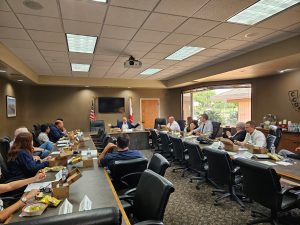
Both Congress and the State Legislature may have been on recess recently, but that didn’t stop the Association from making sure our issues remain front and center. On the Federal side, the Association held or attended meetings with Congressman Adam Gray, Congressman David Valadao, and Congressman Vince Fong. Issues discussed included water, federal agency staffing at USDA and its numerous agencies, air quality, and immigration. On the state side, the Association hosted or met with Senator Melissa Hurtado, Senator Monique Limon, Assemblyman Heath Flora, Assemblyman Jeff Gonzalez, Assemblywoman Dr. Darshana Patel and Assemblywoman Esmeralda Soria. Issues discussed included water, immigration, future year elections, and in meetings that were not fundraisers, we discussed the three bills currently sponsored or co-sponsored by the Association including AB 732 (Macedo) on abandoned orchards and vineyards, AB 1046 (Bains) on agricultural waste reporting, and SB 279 (McNerney) on composting, as well as the critical issue of Cap & Trade reauthorization and the needed inclusion of FARMER funding.
CDPR Identifies Potential Chemicals of Regulatory Concern
Over the past couple of years, the California Department of Pesticide Regulation (CDPR) has worked on its new effort to regulate pesticides under the auspices of an effort known as Sustainable Pest Management (SPM). According to CDPR, SPM is “a holistic, whole system approach to managing pests in agriculture and other managed ecosystems and urban and rural communities that builds on the concept of integrated pest management (IPM) with broader consideration of human health and social equity, environmental protections and economic vitality.” CDPR developed the SPM Roadmap to guide the agency for the next 20 years to achieve sustainable pest management. In the roadmap CDPR states as their number one goal “by 2050 California has eliminated the use of Priority Pesticides by transitioning to sustainable pest management practices”. What are “priority pesticides? According to the SPM Roadmap, “priority pesticides” are pesticide products, active ingredients, and groups of related products within the context of specific product uses or pest/location use combinations that have been deemed to be of greatest concern and warrant heightened attention, planning, and support to expedite their replacement and eventual elimination. Now CDPR has identified a list of pesticides of regulatory concern. We believe this to be the initial list of chemicals for SPM, as it meets their criteria presented in the SPM Roadmap. The Association has cross refenced with products used on cotton that we will have to fight to protect and keep available.
2025 Preliminary Mapped California Cotton Acreage
The Pink Bollworm Program under the California Department of Food and Agriculture has released their preliminary mapped numbers for 2025, including the Pima and Upland acreage splits. Final acreage numbers for California put Pima at 91,012 acres and Upland at 15,968 acres for a total of 106,968 acres statewide. This represents a 38% decrease in pima acreage and a 30% increase in California upland as compared to last year. Overall, California cotton acreage is down 33% compared to 2024 production.