Funeral services will be held tomorrow, Wednesday, December 30th at 1:30 pm at the Phipps Dale Funeral Home located at 420 West D Street in Lemoore. Graveside services will immediately follow at the Grangeville Cemetery located at 10428 14th Avenue in Armona. In lieu of flowers, remembrances can be sent to the American Cancer Society.
Author Archives: ccgga
Pacific Ginning Co. Gin Manager Ron Nimmo Passes Away
On December 26th, Pacific Ginning Co. Gin Manager Ron Nimmo passed away after a long battle with cancer. Ron was a board member and past Chairman of the California Cotton Ginners Association. Ron started his career with Producer’s Cotton Oil. He began as a night ginner at Pleasant Valley Gin in Coalinga. From there he moved to Tranquillity under Jack Lyons, also as the night ginner. He was then promoted to day ginner at Mesa Gin and then moved to Westhaven Gin, a gin that would have later significance. He then became a field electrician and later went into business for himself, opening an auto repair & electric shop. He returned to the cotton industry working as a ginner for Westhaven Cotton Company and Stone Land Company and eventually became the Gin Manager running the former Producers gin. His career was just getting started at this time. Over the last several years Ron has continued in his service as a Director of the California Cotton Ginners Association, and served on several committees even after he left Westhaven Gin to work in the Solar Industry and subsequently came back as a gin manager for County Line Gin. Ron later went to work for the Pacific Ginning Company where he has been ever since. Ron was Chairman of the California Cotton Ginners Association from 2011 to 2012, and received the Ginner of the Year Award from the California Cotton Ginners Association in 2011. Ron has been called an “innovator” and a “wonderful person and friend” by his colleagues. Truer words were never spoken. He will be sorely missed by this Association, his colleagues and the entire cotton industry in California.
Air District Receives Nearly $6 Million in Federal Grant Funding
The Valley Air District will augment its highly successful grant program with an additional nearly $6 million in U.S. Environmental Protection Agency (US EPA) funding to replace old agricultural tractors and dirty residential wood burning devices. “Grant funds such as these recognize the hard work and sacrifice being made by Valley farmers, businesses and residents to expedite emission reductions in the San Joaquin Valley,” stated Seyed Sadredin, Executive Director and Air Pollution Control Officer of the San Joaquin Valley Air Pollution Control District. “With these funds the EPA is acknowledging the unique challenges of the Valley and providing much needed financial assistance.” The nearly $6 million in funding being announced today is from two federal grant programs; the Targeted Air Shed Grant Program and the Diesel Emission Reduction Act (DERA) Grant Program. “With this financial assistance, EPA and San Joaquin Valley farmers are working together to improve air quality and promote the use of clean, cutting-edge tractors,” said Jared Blumenfeld, EPA’s Regional Administrator for the Pacific Southwest. An additional $2,483,607 of the Targeted Air Shed Grant Program funding will be spent on replacing approximately 187 agricultural tractors under the District’s very successful Tractor Replacement Program. This funding will reduce an estimated 699 tons of Nitrogen Oxides (NOx) emissions and 139 tons of PM emissions over the project lifetime of 10 years. The District also received an additional $1 million from the DERA program. The $1 million will fund the replacement of approximately 75 agricultural tractors and is estimated to reduce 169 tons of NOx emissions and 28 tons of PM emissions over the project lifetime of 10 years. The Association was also recognized for its contributions and assistance in the funding effort at a press conference at the San Joaquin Valley Air Pollution Control District today.
Assemblyman Quirk Visits the Valley
The Association hosted Assemblyman Bill Quirk on a tour of the farm of California Cotton Growers Association Director Cannon Michael of Bowles Farming and with California Cotton Ginners Association Director Mike Davis of Dos Palos Cooperative Gin. Assemblyman Quirk represents the 20th Assembly District which covers the communities of Hayward, Ashland, Castro Valley, Cherryland, Fairview, Fremont, Pleasanton, San Lorenzo, Sunsol and Union City. Assemblyman Quirk is a very active legislator as he is the Chairman of the Public Safety Committee, and also sits on the Agriculture, Appropriations, Revenue and Taxation Committees, as well as the Utilities and Commerce Committee. Accompanying the Assemblyman from the Association was President/CEO Roger Isom and Director of Technical Services Christopher McGlothlin. This is part of the ongoing effort of the Association to reach out to urban legislators to educate and inform them on the critical issues facing the cotton industry.
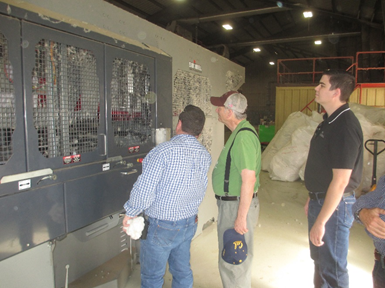
Assemblyman Mathis Tour Gin and Farm
The Association hosted a tour this past week for Assemblyman Devon Mathis of the 26th Assembly District. The Assemblyman represents Inyo County and large parts of Tulare and Kern Counties, including the cities of Bakersfield, Delano, Dinuba, Hanford, Lindsay, Tulare, Porterville and Visalia. On this trip, the Assemblyman visited a cotton field, and cotton gin with Association Board Member Stan Creelman, of Mid Valley Cotton Growers, and met with Growers Association Chairman Steve Wilbur at his cotton field southwest of Tulare. Water and regulatory impacts were among the topics covered and the Assembly even had an opportunity to ride in the cotton picker. Assemblyman Mathis is the Vice chairman of the Veterans Affairs Committee and also sits on the Agriculture, Aging and Long Term Care, and Water, Parks and Wildlife Committees. Accompanying the Assemblyman on the tour were the Association’s President/CEO Roger Isom.
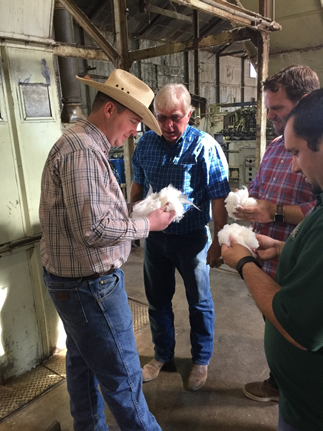
Gin Manager Stan Creelman discussing cotton quality with Assemblyman Mathis
Sixth Circuit Issues Stay on Federal Water Regulation Rule
Today, a federal appeals court issued a nationwide stay blocking the new Environmental Protection Agency regulation that seeks to expand the amount of water and wetlands under federal protection, known as “Water of the United States” or WOTUS. The Cincinnati-based U.S. Circuit Court of Appeals for the Sixth Circuit, in a split ruling, said it was prudent to block the regulation while litigation continued over whether the Obama administration’s effort was legal. “A stay temporarily silences the whirlwind of confusion that springs from uncertainty about the requirements of the new rule and whether they will survive legal testing,” the court said. Previously, a federal judge in August blocked the rule in 13 states that had challenged it in a federal court in North Dakota, saying those states were likely to succeed in their lawsuit against the regulation. In coordination with the U.S. Army Corps of Engineers, the EPA in May issued the rule, which is estimated to put about 3% more waterways throughout the U.S. under new federal jurisdiction, which would require a federal permit to pollute those waters and could restrict access altogether. Major waterways, like most rivers and lakes, are already under protection of the Clean Water Act and aren’t affected by the rule. The EPA has said the rule is necessary to clarify which waters should fall under the protection of the federal Clean Water Act of 1972 after two Supreme Court rulings, in 2001 and 2006, called into question whether and to what extent 60% of U.S. waterways, especially streams and wetlands, should fall under federal jurisdiction.
EPA Tightens Ozone Standard
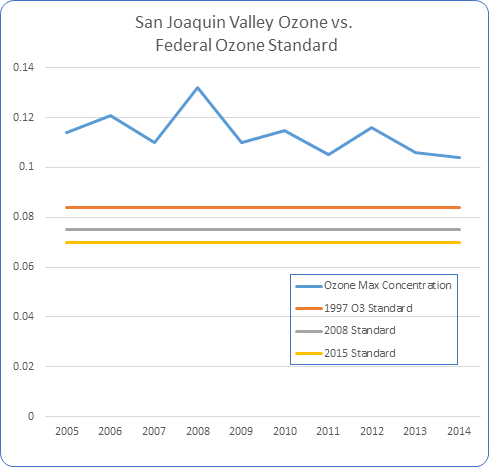
Citing “extensive scientific evidence on effects that ground-level ozone pollution, or smog, has on public health and welfare” the U.S. Environmental Protection Agency (EPA) has strengthened the National Ambient Air Quality Standards (NAAQS) for ground-level ozone to 70 parts per billion (ppb) down from 75 ppb! What does this mean for California? Good question. Much of the state has not even written the plan on trying to meet the 75 ppb, because the current requirements are for the 84 ppb standard adopted under the Clinton Administration. To put it in perspective, the San Joaquin Valley just had their cleanest summer on record for ozone, and still exceeded the 84 ppb standard on 75 days. In fact, substantial progress has been made in reducing ground-level ozone. Nationally, from 1980 to 2014, average ozone levels have fallen 33 percent, and the San Joaquin Valley has reduced the number of exceedances of the 84 ppb standard by 54% just since 1996! Depending on the severity of their ozone problem, areas would have until between 2020 and 2037 to meet the standards. In the San Joaquin Valley it will be 2037, and many doubt that this standard is achievable in the San Joaquin Valley, including EPA who stated the technology does not yet exist for the San Joaquin Valley to get into attainment! To take it one step further, the San Joaquin Valley has indicated that this new standard could not be met, even if you took every car, truck and tractor off the road! Nonetheless, EPA has adopted a new standard, and failure to meet the standard will result in penalties on businesses. What that means is that the current truck rule and the potential tractor rule will not be enough to get into attainment and businesses in the San Joaquin Valley will pay penalties as a result…
Cotton Harvest Safety Seminar
Wednesday, September 23, 2015
8:00 am- 12:00 pm
Kings & Tulare County Farm Bureaus, UCCE and State Fund will host their annual fall harvest safety training event for cotton and other fall harvesting crops.
Location: Kings County Fairgrounds, 801 10th Ave, Hanford, CA 93230
All farming operations with fall harvests approaching are encouraged to attend, with registration beginning at 7:30 am. This annual safety training will cover topics employers are required to offer: farm equipment safety, road safety, and chemical safety. Training sessions are offered in Spanish and English, certificates of completion are provided to all participants, and complimentary lunch is served afterwards.
For reservations, call Tulare County UCCE office at 559-684-3300.
Deadline to register is Monday, September 21.
Thank you to California Cotton Ginners and Growers, State Compensation Insurance Fund, California Highway Patrol, Kings and Tulare County Farm Bureaus, and University of California Cooperative Extension Service for your support and continued involvement in this harvest day, that now dates back more than 40 years!
Download fill-able registration form
Cotton Harvest Safety Training
Cotton Harvest Safety Training set for Sept. 17
Fresno County Farm Bureau (FCFB), California Cotton Ginners and Growers Associations (CCGGA), California Highway Patrol (CHP), Proteus Inc. and State Compensation Insurance Fund will host the annual Cotton Harvest Safety Training on Thursday, Sept. 17, at the West Side Research and Extension Center, 17353 W. Oakland Ave., Five Points.
The free program will begin with registration at 7:30 a.m. and conclude with lunch at noon.
Registration forms are available online at www.fcfb.org.
For more information, or to register, contact FCFB at 559-237-0263 or info@fcfb.org
FDA Submits Preventive Controls Rules
Today the U.S. Food and Drug Administration has released the Preventive Controls For Human Food Rule and Preventive Controls for Animal Food Rule as under the Food Safety Modernization Act (FSMA). The FDA has stated they will share updates as soon as the final rules are available, saying “documents submitted to the Federal Register can publish several days after they are submitted, with larger documents taking longer to process and display”. The Association will provide more information as it becomes available.