The Cal/OSHA Standards Board has requested that staff restart the dormant advisory committee studying whether and how to revise Cal/OSHA’s regulations on autonomous agricultural vehicles. In a recent email to the Association, CalOSHA Standards Board Executive Officer Millie Robinette stated that the Advisory Committee will meet again on December 1st. The committee has met several times, but little has come from it. Questions from within agency staff and outright opposition from labor have stymied any progress on developing a regulation. In response to the message from Robinette, Association President/CEO Roger A. Isom stated, “I have zero faith in the Advisory Committee process on this issue. We will proceed as planned with the hopes this information will be useful somewhere down the road.” Isom was referring to an autonomous tractor safety study being developed by the Association in conjunction with UC Riverside and California State University – Fresno. It is the Association’s hope that tractor demonstration studies conducted by the two universities can prove today’s autonomous technology is perfectly safe and protective of all employees and innocent bystanders. Given where technology is today, it is hard to believe the State of California is the one standing in the way of progress.
NEWS & ISSUES
USDA Announces More Money for Regenerative Practices
The U.S. Department of Agriculture (USDA) announced increased financial assistance for the Regenerative Pilot Program from $700 million to $1 billion in fiscal year 2027, providing more producers with the opportunity to adopt conservation systems that improve soil health, water quality, and long-term farm resilience. Producers can now apply for assistance with regenerative practices. “Last fiscal year, NRCS obligated more than 5,100 contracts for more than $851 million to implement whole-farm conservation practices for regenerative agriculture. Through this program, farmers and ranchers continue to make improvements to soil health, water management and natural vitality, and provide consumers with American-grown whole foods,” said NRCS Chief Colton L. Buckley.
In fiscal year 2027, the Regenerative Agriculture Pilot continues to focus on whole-farm planning that addresses major soil and water resource concerns— to maximize the ecological potential of working lands—under a single conservation framework. USDA is dedicating $650 million through the Environmental Quality Incentives Program (EQIP) and $350 million through the Conservation Stewardship Program (CSP) to fund this second year of regenerative agriculture projects. Producers can bundle multiple regenerative practices into one application, streamlining the process and increasing flexibility for operations. Farmers and ranchers interested in regenerative agriculture are encouraged to apply through their local NRCS Service Center by their state’s ranking dates for fiscal year 2027 funding consideration. Applications for both EQIP and CSP can be submitted under the single regenerative application process. For more information, visit nrcs.usda.gov.
Restrictive Federal PM2.5 Standard Not Going Away
Earlier this year, a Federal Appeals Court ruled that the Federal 9 ug/m3 PM2.5 ambient air quality standard will stand. As a result, EPA is now warning many states that they could have areas that are in “nonattainment” with EPA’s tightened federal limit for fine particulate matter (PM2.5) that will require tough emissions controls. This notice comes at the same time as the agency appeals a lower court order that required final designations by Feb. 6 and challenges the standard itself. On Oct. 2 EPA announced that it had sent letters to all 50 states informing them of initial monitoring and other data that indicate whether areas within their jurisdictions could be in nonattainment with the national ambient air quality standards (NAAQS) for PM2.5. States have 120 days to respond. According to a one report only 14 states including, Connecticut, Mississippi, Nebraska, Nevada, New York, North Carolina, North Dakota, Rhode Island, South Dakota, Tennessee, Vermont, Washington and the District of Columbia were found to have no data showing exceedances and were slated to be found in attainment with the standard. The agency’s actions are required by the U.S. District Court for the Northern District of California, which set Feb. 6 as the deadline for EPA to complete the area designations rulemaking. We understand that EPA is appealing the ruling and recently pressed the U.S. Court of Appeals for the 9th Circuit to accelerate briefing in the agency’s challenge. Meanwhile, several states and industry groups are asking the Supreme Court to reverse the appellate court ruling that upheld the original standard. This is a very restrictive standard that is nearing background levels, which is why so many states are going to have nonattainment areas.
CalOSHA Releases New Draft of Workplace Violence Regulation
A December 31st statutory deadline is coming in to view for the Cal/OSHA Standards Board to adopt a new standard on workplace violence prevention in general industry, as mandated by 2024’s SB 553. Now the Division of Occupational Safety and Health (DOSH) has released their latest language on the proposed regulation. Another advisory meeting to discuss the proposed language will be held on October 27th. However, it is unclear if the standard can be adopted by the end of the year to meet the deadline. The standard will require California employers to create a workplace violence prevention plan; identify and evaluate workplace violence hazards; adopt engineering controls such as access controls, weapons detectors, separating “high-risk persons,” video monitoring and alarms; institute work practice controls such as appropriate staffing; establish effective procedures for post-incident response and investigation; maintain a violent incident log; and provide training and recordkeeping.
The latest draft has several changes from a July version, the most significant of which include:
- The definition of “designated representative” has been revised to reference the definition of “written authorization” from the Injury and Illness Prevention Program standard.
- In the definition of “work practice controls,” the example of appropriate staffing levels has been revised to say they should be based on the “identification and evaluation of workplace violence hazards.”
- A section of the rule that referred to “reporting violent incidents and threats without fear of reprisal”, the comment about instances where a direct supervisor has not adequately addressed a report has been stricken. It was replaced with references to another section of the rule that covers effective procedures for accepting, evaluating, and responding to reports of WPV.
- In the prevention plan section regarding soliciting information involved in an incident, the “cause of the incident” has been struck and substituted with “conditions and factors that contributed to the incident.”
The Association is currently reviewing the proposed changes and will be making comments.
USDA Announces Record Payments of $13.8 Billion for 2025 ARC/PLC Programs
U.S. Secretary of Agriculture Brooke L. Rollins announced this week that the Farm Service Agency’s Agriculture Risk Coverage (ARC) and Price Loss Coverage (PLC) will generate approximately $13.8 billion in gross payments to eligible agricultural producers for the 2025 crop year; the largest annual payout by far since these key safety net programs were established in the 2014 Farm Bill. The 2025 crop year stands alone in the history of ARC and PLC since Congress created the programs as key components of the commodity safety net in the Agricultural Act of 2014. The Working Families Tax Cuts Act (WFTCA) strengthens ARC and PLC beginning with the 2025 crop year, including higher statutory reference prices and improvements to the effective reference price calculation. Additionally, for the 2025 crop year only, producers will automatically receive the higher payment rate of either ARC or PLC, regardless of their program election. The WFTCA also increases the ARC and PLC payment limit from $125,000 to $155,000, starting with the 2025 crop year with annual adjustments based on inflation. The payment limit for the 2025 crop year is $160,000. The following 16 crops triggered a PLC payment for the 2025 crop year: Chickpeas (small and large), canola, corn, dry peas, flaxseed, grain sorghum, lentils, peanuts, rice (long grain, medium grain, japonica), safflower, seed cotton, soybeans, and wheat. ARC-County (ARC-CO) payments are based on county-level revenue and therefore trigger at the county level. FSA will issue payments to eligible producers as calculations are completed.
As a reminder, the ARC and PLC election and enrollment period for the 2026 crop year is now open. ARC and PLC protect producers from substantial declines in crop prices or revenues. Producers annually elect and enroll for ARC or PLC coverage for eligible commodities. PLC provides income support when the effective price for a covered commodity falls below its effective reference price. ARC provides income support when actual crop revenue falls below a guaranteed level. Depending on the coverage elected, ARC protection is based on either county-level revenue or the revenue of an individual farm. Producers with questions about their ARC-CO or PLC enrollment or payments should contact their local FSA county office.
Recharge in Action: A Farmer Field Day – November 17th
As groundwater pumping rules change under the Sustainable Groundwater Management Act (SGMA), growers are looking for practical ways to strengthen water reliability and prepare for an uncertain water future. Join the California Water Institute in partnership with Sustainable Conservation on November 17 at the Fresno State campus for Recharge in Action: A Farmer Field Day, focused on real-world groundwater recharge solutions for Central Valley farms. Attendees will see recharge in action and learn about approaches including recharge basins, injection wells, subsurface recharge, and on-farm recharge. The field day will also highlight available incentives, technical resources, and the multiple benefits groundwater recharge can provide—including supporting groundwater supplies, soil health, habitat, and floodwater management.
Designed for growers, whether you own or lease property, the event will provide practical insights, farmer-to-farmer learning, and actionable next steps for incorporating recharge into farm operations. For more details on registration, view the flyer below or call (559) 278-7001 to register.

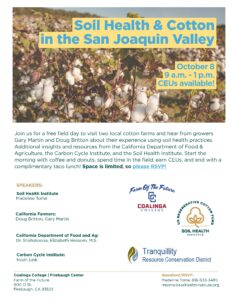
Soil Health & Cotton in San Joaquin Valley – October 8th
You’re invited to join the Soil Health & Cotton in the San Joaquin Valley event, hosted by the Soil Health Institute, on October 8th from 9:00 AM to 1:00 PM. CEUs are available! Space is limited, so please RSVP. Attendees will start the morning with coffee and donuts before heading into the field to hear from two local cotton farmers, Gary Martin and Doug Britton, about their experiences using soil health practices. Other speakers include Madeline Tome from the Soil Health Institute, Dr. Shaharoona and Elizabeth Hessom from the California Department of Food and Agriculture, and Noah Link from the Carbon Cycle Institute. Lunch will also be provided. For more information and event details, please view the flyer below.
CDPR Proposes Changes to Decontamination Requirements
The California Department of Pesticide Regulation (CDPR) proposes to amend the pesticide regulatory program activities affected by the proposal are those pertaining to pesticide worker safety. In summary, the proposed action will amend decontamination requirements for employees handling pesticides, improve eyewash regulation compliance, and clarify language between sections that mention eyewash equipment or decontamination supplies. This proposed action will require that employees who mix and load pesticides having a high potential for eye injury have access to an eyewash station that meets the requirements found in the American National Standards Institute (ANSI) Z358.1-2014 standard. Additionally, it will require that all employees, who handle products that require protective eyewear on their labeling, have access to a personal eyewash unit containing at least one pint of eyewash fluid. It will require employers of employees handling pesticides for uses other than the commercial or research production of an agricultural plant commodity to provide a decontamination site within 100 feet of the mixing/loading site or fumigation site for employees, regardless of the pesticide signal word. The proposed action will also clarify language pertaining to decontamination equipment, remove duplicative requirements, and ensure standardization. Lastly, the proposed action will clarify a personal protective equipment (PPE) exemption that applies when handling liquid fumigants.
Association Pushes Back on Expansion of Wildfire Smoke Requirements
Cal/OSHA held an advisory meeting this week to discuss potential revisions to California’s Protection from Wildfire Smoke Standard. The meeting provided stakeholders an opportunity to comment on potential regulatory language being developed to implement AB 2243.
During the meeting, worker advocacy organizations urged Cal/OSHA to consider requirements beyond the draft language under discussion, including lowering the PM2.5 AQI threshold from 151 to 101 beyond the proposed respiratory protection for agricultural employees at an AQI of 300 instead of the current threshold of 500. These organizations also suggested expanding the scope of the standard beyond wildfire smoke to include smoke from prescribed burns.
Assistant Vice President Priscilla Rodriguez testified in opposition to these changes and questioned whether sufficient occupational exposure data has been provided to justify the substantially lower thresholds or for expanding a regulation specifically developed to address wildfire smoke to other sources. Rodriguez stated. “We have significant concerns with lowering the Air Quality Index (AQI) threshold from 151 to 101 without clear occupational data demonstrating that this significant expansion is necessary.” Rodriguez also questioned the justification for treating agricultural workers differently from other outdoor employees. “Agriculture is not the only industry with employees performing work outdoors,” Rodriguez said. “If Cal/OSHA believes agricultural workers face a unique risk requiring a substantially lower threshold, it should provide the data demonstrating that difference.”
The Associations stressed that these changes could significantly increase compliance obligations and costs for agricultural employers and urged Cal/OSHA not to adopt lower thresholds or include burns beyond the scope without sufficient scientific and occupational evidence.
Cal/OSHA will consider written and verbal stakeholder comments as it evaluates potential revisions to the standard. Another advisory meeting is expected to be scheduled to continue the discussion.
USDA Announces 2026 and 2027 Enrollment for Key Price and Revenue Safety Net Programs
Agricultural producers can soon begin enrolling in the Agriculture Risk Coverage (ARC) and Price Loss Coverage (PLC) programs, which the U.S. Department of Agriculture (USDA) recently updated to include more than 30 million new base acres. Now that the base allocation process is complete, producers can make elections and enroll for the 2026 crop year from Sept. 16 through Dec. 11, 2026, and for the 2027 crop year from Nov. 2, 2026, through March 15, 2027. Because eligible acres exceeded the nationwide 30-million-acre cap, USDA’s Farm Service Agency (FSA) is applying an across-the-board, prorated reduction of 3.69% to all newly allocated base acres.
The opportunity for landowners to review their base allocation summaries and take necessary action ended Aug. 31, 2026. Base allocation notifications will be available beginning Sept. 16, 2026. Landowners can access notifications online at fsa.usda.gov/arc-plc using a Login.gov account. Landowners who do not currently have a Login.gov account can contact their FSA county office to obtain their base allocation notification beginning Sept. 16, 2026. Producers can now change their election and enroll in ARC-County (ARC-CO) or PLC, which both provide crop-by-crop protection, or ARC-Individual (ARC-IC), which protects the entire farm. Although election changes for 2026 are optional, producers must enroll through a signed contract each year. Existing multi-year contracts ended in 2025, but producers have the option to sign a new multi-year contract for 2026 through 2031. Producers who opt out of a multi-year contract can enroll for the 2027 crop year starting Nov. 2, 2026, through March 15, 2027. If producers do not submit their 2026 election by Dec. 11, 2026, their election remains the same as their 2025 election for crops on the farm, and the farm is ineligible for payments for the 2026 program year. Landowners cannot enroll in either program unless they have a share interest in the farm. Covered commodities include barley, canola, large and small chickpeas, corn, crambe, flaxseed, grain sorghum, lentils, mustard seed, oats, peanuts, dry peas, rapeseed, long grain rice, medium and short grain rice, safflower seed, seed cotton, sesame, soybeans, sunflower seed and wheat.
Producers are reminded that ARC and PLC election and enrollment can impact eligibility for some crop insurance products. Producers can now add SCO coverage or the Enhanced Coverage Option (ECO) regardless of their ARC or PLC election. Previously, producers who elected ARC-CO or ARC-IC were ineligible to purchase the Supplemental Coverage Option (SCO) through their Approved Insurance Provider for the same acres, but The Working Families Tax Cuts Act removed this restriction. For more information on ARC and PLC, visit the ARC and PLC webpage or contact your local FSA County Office.