NEWS & ISSUES

Reclamation Increases Federal Project Water Supply Allocations for 2025 Water Year

In support of ongoing efforts to provide maximum water supplies in California, the Bureau of Reclamation announces an increase in Central Valley Project 2025 water supply allocations that will provide farmers and other CVP contractors greater water supply certainty throughout the growing season. Initial allocations for the 2025 water year were announced Feb. 25 and are updated today.   “While most of the Central Valley Project contractors are at 100% allocation, we are very pleased to announce an increase in allocations for our south-of-Delta and Friant Division contractors,” said Acting Regional Director Adam Nickels. “Consistent with the intent of Executive Order 14181, we are able to increase south-of Delta agriculture to 40% and Friant Division Class 1 to 100%.”

Reclamation is striving to maximize water supply, particularly for south-of-Delta contracts to meet Executive Order 14181’s directives. Demonstrating its commitment to California farmers and communities, Reclamation continues its dedicated efforts to deliver more water and produce more hydropower. Reclamation will continue to maximize pumping whenever possible at the federal pumping facility to move water to parts of California where it is needed most and provide the greatest economic value to the entire country. 

Based on current hydrology and forecasting, Reclamation is announcing the following increases to CVP water supply allocations:

South-of-Delta Contractors

  • Irrigation water service and repayment contractors south-of-Delta are increased to 40% from 35% of their contract total. Municipal and industrial water service and repayment contractors south-of-Delta remain at 75% of their historical use, or public health and safety needs, whichever is greater.
     

Friant Division Contractors

  • Friant Division contractors’ water supply is delivered from Millerton Reservoir on the upper San Joaquin River via the Madera and Friant-Kern canals. The first 800,000 acre-feet of available water supply is considered Class 1; Class 2 is considered the next amount of available water supply up to 1.4 million acre-feet. The initial Friant Division water supply allocation for Class 1 was increased from 45% to 80% on March 14. Today’s announcement includes a further increase to 100%; Class 2 water remains at 0%. 

Aubrey Bettencourt Appointed as Chief of the Natural Resource Conservation Service

Aubrey Bettencourt will serve as Chief of the Natural Resource Conservation Service (NRCS). Aubrey is a prominent leader in agriculture, water, and sustainability, most recently serving as the Global Director of Government Relations and External Affairs for Netafim, an Orbia Company. Her previous roles include serving as President and CEO of the Almond Alliance and Deputy Assistant Secretary for the U.S. Department of the Interior in the first Trump Administration. Her work reflects a strong commitment to water policy, agricultural support, and sustainable practices, supported by her family’s farming roots in Kings County, California. Aubrey holds a degree in History from Westmont College.

USDA Expediting $10 Billion in Direct Economic Assistance to Agricultural Producers

U.S. Secretary of Agriculture Brooke Rollins has  announced that the U.S. Department of Agriculture (USDA) is issuing up to $10 billion directly to agricultural producers through the Emergency Commodity Assistance Program (ECAP) for the 2024 crop year. Administered by USDA’s Farm Service Agency (FSA), ECAP will help agricultural producers mitigate the impacts of increased input costs and falling commodity prices.  “Producers are facing higher costs and market uncertainty, and the Trump Administration is ensuring they get the support they need without delay,” said Secretary Rollins.  Authorized by the American Relief Act, 2025, these economic relief payments are based on planted and prevented planted crop acres for eligible commodities for the 2024 crop year.  To streamline and simplify the delivery of ECAP, FSA will begin sending pre-filled applications to producers who submitted acreage reports to FSA for 2024 eligible ECAP commodities soon after the signup period opens on March 19, 2025. Producers do not have to wait for their pre-filled ECAP application to apply. They can visit fsa.usda.gov/ecap to apply using a login.gov account or contact their local FSA office to request an application once the signup period opens.


Eligible Commodities and Payment Rates

The commodities below are eligible for these per-acre payment rates:

  • Wheat – $30.69
Eligible oilseeds:
  • Corn – $42.91
  • Canola – $31.83
  • Sorghum – $42.52
  • Crambe – $19.08
  • Barley – $21.67
  • Flax – $20.97
  • Oats – $77.66
  • Mustard – $11.36
  • Upland cotton & Extra-long staple cotton – $84.74
  • Rapeseed – $23.63
  • Long & medium grain rice – $76.94
  • Safflower – $26.32
  • Peanuts – $75.51
  • Sesame – $16.83
  • Soybeans – $29.76
  • Sunflower – $27.23
  • Dry peas – $16.02
 
  • Lentils – $19.30
 
  • Small Chickpeas – $31.45
 
  • Large Chickpeas – $24.02


Producer Eligibility

Eligible producers must report 2024 crop year planted and prevented planted acres to FSA on an FSA-578, Report of Acreage form. Producers who have not previously reported 2024 crop year acreage or filed a notice of loss for prevented planted crops must submit an acreage report by the Aug. 15, 2025, deadline. Eligible producers can visit fsa.usda.gov/ecap for eligibility and payment details.


Applying for ECAP

Producers must submit ECAP applications to their local FSA county office by Aug. 15, 2025. Only one application is required for all ECAP eligible commodities nationwide. ECAP applications can be submitted to FSA in-person, electronically using Box and One-Span, by fax or by applying online at fsa.usda.gov/ecap utilizing a secure login.gov account.

ECAP payments will be issued as applications are approved. Initial ECAP payments will be factored by 85% to ensure that total program payments do not exceed available funding. If additional funds remain, FSA may issue a second payment.


Association Addresses CDPR Request on Critical Uses of Paraquat

The California Cotton Ginners and Growers Association submitted comments this week on the California Department of Pesticide Regulation (CDPR) request for input on critical uses of paraquat and currently available, effective alternatives. Paraquat is used as a desiccant in cotton and plays an important role in the production and harvest of cotton in California. The association’s comments focused on the need for a quality and effective defoliation that is absolutely critical to that quality grade and helps producers achieve maximum value. The Association highlighted the efficacy of paraquat over sodium chlorate for effective defoliations. The Association also commented paraquat’s use as an herbicide, especially in the winter when it is used as a broad-spectrum winter weed burndown and aids in growers being able to conduct no-till or minimum-till practices. This is critically important in areas like California where there is a significant effort to reduce passes and eliminate disturbance of the soil.  In addition, its use is important as it is a different active ingredient to glyphosate, and it is important to use in a rotation to minimize resistance. The use of paraquat is a key to increased sustainability, as the cotton industry works to minimize soil disturbance, minimize chemical resistance, and producing a quality crop. And according to some farm advisors, paraquat is the only effective tool for more difficult weeds such as fleabane.  All of this will be considered by CDPR as it works towards its re-evaluation of paraquat by 2029. 

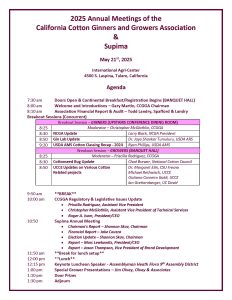
Registration is Now Open! 2025 CCGGA & Supima Annual Meeting

It’s time for the California Cotton Ginners and Growers Association’s 2025 Annual Meeting! This year, Supima will join forces with CCGGA to showcase valuable industry updates. The meeting will be held on Wednesday, May 21st at the International Agri-Center in Tulare, California. Please complete and submit the registration form linked below. You can email the form to Michelle Franco at michelle@ccgga.org or fax it to our offices promptly at (559) 252-0551.

There is also an opportunity to sponsor the event. All sponsorships go toward offsetting the costs, which helps us deliver our message to the industry. If you’d like to sponsor, you may do so by clicking the sponsorship link.

The cost of the event is free, but we encourage you to consider making a donation of at least $25 to the CCGGA Federal PAC or CCGGA State PAC to help protect California cotton at the state and federal levels. The CCGGA Federal PAC can only accept personal checks. Any corporate contributions must be made to the CCGGA State PAC.

Loan Deficiency Payments Now Available for Cotton Producers in California

Cotton producers in California may be eligible for Loan Deficiency Payments (LDP) from the U.S. Department of Agriculture (USDA) Farm Service Agency (FSA). LDPs are payments made to producers who, although eligible to obtain a Marketing Assistance Loan, agree to forgo the loan in return for a payment on the eligible commodity. The deadline to apply for an LDP on 2024 crop-year cotton is May 31, 2025.

For more information, click this link.

Federal EPA to Revisit PM2.5 Standard

Today, the U.S. Environmental Protection Agency (EPA) Administrator Lee Zeldin announced the agency is revisiting the Biden PM2.5 National Ambient Air Quality Standards (NAAQS), which has raised serious concerns from states across the country and served as a major obstacle to permitting.  “All Americans deserve to breathe clean air while pursuing the American dream. Under President Trump, we will ensure air quality standards for particulate matter are protective of human health and the environment while we unleash the Golden Age of American prosperity,” said EPA Administrator Zeldin.  EPA is also announcing that it will soon release guidance to increase flexibility on NAAQS implementation, reforms to New Source Review, and direction on permitting obligations. This suite of actions advances cooperative federalism and begins to undo red tape holding back American exceptionalism. The U.S. has some of the lowest fine particulate matter levels in the world. Between 2000 and 2023, average PM2.5 concentrations in the U.S. fell by 37 percent and average PM10 concentrations similarly fell by 36 percent. This action is significant for California where at least seven areas were deemed non-attainment for the new 9 ug/m3 PM2.5 standard and would have had a very difficult time meeting this new standard. 

Isom Guest Lectures At Fresno State

The Association’s President/CEO Roger Isom was a guest lecturer this past week for two (2) Ag Business 150 Classes at CSU Fresno.  Isom presented on port issues, impacts of retaliatory tariffs and the Sustainable Groundwater Management Act (SGMA).  Isom stated “these students are the next generation of agricultural leaders in our community, and it is important to make sure they are knowledgeable on critical issues impacting agriculture.  I cherish this opportunity to contribute to their education and knowledge base.”

USDA FSA Hosting Disaster & Farm Loans Webinar

U.S. Department of Agriculture’s (USDA) Farm Service Agency (FSA) will be hosting a webinar on Thursday, March 27th at 10 A.M. PST to discuss the agencies’ available Disaster Program funding and other support programs for producers.  The webinar will cover a wide variety of resource programs made available, such as direct farm operating loans, loan assistance tools, and programs available specifically for new farmers and ranchers.


If you are interested in attending, please follow the instructions on the link here: USDA FSA Webinar – Registration

Bureau Announces Initial Allocation of 35% for South of Delta

Today, the Bureau of Reclamation announced major steps to improve California water supply.  The initial allocation to be provided to California farmers on the west side of the Central Valley south of the Sacramento-San Joaquin Bay-Delta is initially set at 35% and more than twice what the initial allocation was in 2024, a year with similar hydrology.  In addition, the Trump administration is investing more than $315.5 million to create new water storage at the future Sites Reservoir and at the existing San Luis Reservoir.   Reclamation, as directed through President Trump’s Executive Order 14181, has worked to maximize water supply, particularly for south-of-Delta contracts.  Reclamation continues its dedicated efforts to deliver more water and produce more hydropower as a commitment to California farmers and communities.  Water supply allocations are based on an estimate of water available for delivery and reflect current reservoir storage, precipitation, and snowpack in the Sierra Nevada, as well as contractor-rescheduled water from the last water year.  “Recent atmospheric rivers and the good condition of most of our reservoirs going into this water year have benefited our water supply outlook; however, the San Joaquin Basin has experienced critically dry conditions this winter,” said California-Great Basin Regional Director Karl Stock. “Initial allocations reflect this significant variation across the Sacramento and San Joaquin valleys.”   Based on current hydrology and forecasting, Reclamation is announcing the following initial Central Valley Project water supply allocations:


North-of-Delta Contractors

Sacramento River

  • Irrigation water service and repayment contractors north-of-Delta are allocated 100% of their contract total. 
  • Municipal and industrial water service and repayment contractors north-of-Delta are allocated 100% of their contract total. 
  • Sacramento River Settlement Contractors’ water supply is based upon settlement of claimed senior water rights. The 2025 water year is determined as non-critical, as defined in their Settlement Contracts, which allows for 100% of their contract water supply.


American River

  • M&I water service and repayment contractors north-of-Delta who are serviced by Folsom Reservoir on the American River are allocated 100% of their contract total. 


In-Delta Contractors

  • M&I water service and repayment contractors who are serviced directly from the Delta are allocated 100% of their contract total. 


South-of-Delta Contractors

  • Irrigation water service and repayment contractors south-of-Delta are allocated 35% of their contract total.
  • M&I water service and repayment contractors south-of-Delta are allocated 75% of their historical use, or public health and safety needs, whichever is greater.
  • San Joaquin River Settlement Contractors and San Joaquin Exchange Contractors’ water supply is based upon settlement/exchange of claimed senior water rights. The 2025 water year is determined as non-critical, as defined in their contracts, which allows for 100% of their contract supply.
  • In addition to this allocation, CVP contractors south-of-Delta are expected to reschedule approximately 180,000 acre-feet of unused allocated water from 2024 for use in 2025. 


Friant Division Contractors

  • Friant Division contractors’ water supply is delivered from Millerton Reservoir on the upper San Joaquin River via the Madera and Friant-Kern canals. The first 800,000 acre-feet of available water supply is considered Class 1; Class 2 is considered the next amount of available water supply up to 1.4 million acre-feet. The Friant Division water supply allocation is 45% of Class 1 and 0% of Class 2. 


Wildlife Refuges

  • The 2025 water year is determined as non-critical, as defined in their contracts, which allows for 100% of contract supply for wildlife refuges (Level 2), both north- and south-of-Delta.