Author Archives: ccgga

CalOSHA Issues Proposed “Walkaround Rule”

Almost two years ago, Federal OSHA issued a final rule addressing the workplace inspection process. Accordingly, CalOSHA is now proposing to adopt and implement those same requirements at the state level. Essentially, the regulation will allow a representative of the employer and a representative authorized by the employees shall be given the opportunity to accompany the Division’s inspector during an inspection. The proposal clarifies who may be considered a representative authorized by the employees when that representative is not an employee of the employer subject to the inspection. Under the amended rule, a third party may be deemed a representative authorized by employees when, in the judgment of the Compliance Safety and Health Officer, good cause has been shown why their presence is reasonably necessary for an effective and thorough inspection. The rule describes that a third party’s presence may be reasonably necessary based on their “relevant knowledge, skills, or experience with hazards or conditions in the workplace or similar workplaces, or language or communication skills.”


The proposed rule contains four primary provisions. The first provision is added, to allow both a representative of the employer and a representative authorized by employees to accompany the Cal/OSHA inspector during the inspection of the worksite.  It also  authorizes the Cal/OSHA inspector to allow multiple representatives for employer and employee and authorizes the inspector to resolve any disputes as to who the representatives are. The employer or employee representative may object to someone’s participation in the workplace inspection, and the inspector is authorized to make a final and immediate decision to avoid delays or interference with the inspection process. 


The second provision establishes who may be designated as the representative authorized by employees for purposes of accompanying the inspection. Where the employee representative is an employee of the company or the collective bargaining (union) representative, they will be allowed to accompany the inspector. If the authorized representative of employees is someone other than an employee or collective bargaining representative, it must be shown that their accompaniment is reasonably necessary for an effective and thorough inspection. There may be various reasons why the third-party representative’s participation may be reasonably necessary, including their knowledge of the workplace, the industry, the hazards involved, or their ability to communicate with hard-to-reach employees in the workplace. The inspector will make the determination as to whether the third-party representative may accompany the inspection. 


The third provision is added to establish the inspector’s authority to lead the inspection and make sure that the conduct of the representatives who participate does not interfere with the effectiveness of the workplace inspection. This subsection allows the inspector to limit the representative’s interactions, such as arguments, with each other, and even to remove a representative from the inspection process if their conduct interviews with the inspection. 


The final provision is added to allow the employer to protect trade secrets, by requiring that any employee representative in an area containing trade secrets be an employee of the company. If this requirement results in excluding the only available employee representative, then the inspector will be required to interview employees who work in the area as part of the inspection.


A hearing will be held on April 1, and the Association will be weighing in.

Cal/OSHA Form 300A Annual Summary of Work-Related Injuries and Illness

Beginning February 1, employers are required to post their Cal/OSHA Form 300A Annual Summary of Work-Related Injuries and Illness for the prior year.

Posting Requirements:

  • Must be posted from February 1- April 30
    • Posted in a visible location, such as an employees bulletin board
  • Employers are required to post the form even if no injuries or illnesses occurred.

Recordable work-related injuries and illness include:

  • Death
  • Days away from work
  • Medical treatment beyond first aid
  • Significant injury or illness diagnosis by a physician or other licensed healthcare professional

Electronic submission requirement

  • Employers required to electronically report must submit 2025 Form 300A data no later than March 2, 2026.
  • Electronic submission is completed through the Federal OSHA Injury Tracking Application (ITA).

For additional information and step-by-step instructions, visit:
https://www.osha.gov/injuryreporting/ita/

CARB Won’t Give In…Now Pushing “Tier 5 Engines”

Ignoring Federal EPA, the California Air Resources Board (CARB) staff has posted a draft potential Tier 5 Regulation Order, which will be discussed at a February 27, 2026, public workshop. Staff has made substantial updates to the previous draft of the potential Tier 5 Regulation Order, including changes to the potential Tier 5 standards for criteria pollutants and greenhouse gases, implementation timelines, the Off-Road In-Use Testing program, zero-emission credits, durability demonstrations, and potential requirements for hydrogen-fueled internal combustion engines.


CARB staff is considering cleaner exhaust emission standards for NOx (up to 90% cleaner than today’s Tier 4 standards) and PM (up to 75% cleaner than today’s Tier 4 standards). Other elements include enhanced in-use compliance testing, more representative useful life periods, OBD requirements (applicable for the first time to this category), and a new low-load test cycle. This workshop is the tenth public event in CARB’s development of potential Tier 5 regulations. CARB staff invites industry, fleet owners, trade associations, representatives of non-governmental organizations, environmental groups, air districts, members of the community, and other interested stakeholders to participate and provide feedback on the draft Regulation Order and draft Test Procedures for the Tier 5 rulemaking.  The Association continues to oppose further regulations and restrictions, as California farmers already face the toughest air quality regulations in the country, if not the world.

EPA Strikes Down Part of Heavy-Duty Truck Inspection Program

Last week, the U.S. Environmental Protection Agency (EPA) gave partial approval and partial disapproval on the state of California’s aggressive Clean Truck Check Program (CTC).  EPA approved the portion of the rule that applies to heavy-duty on-road trucks registered in California, and the agency disapproved the applicability of the rule to out-of-state and foreign country registered trucks. In the finding, EPA noted that the California Air Resources Board (CARB) failed to meet legal requirements to apply the rule so broadly under the Clean Air Act, additionally noting that there were concerns over the rule’s potential violation of the U.S. Constitution’s Commerce Clause. 
 
The CTC rule requires that heavy-duty trucks operating on California roads must undergo periodic smoke inspection tests to show that the equipment’s emission control systems are functioning properly. The regulatory timeline increases frequency of the testing requirements, all the way up to 4 tests per year for drayage and long-haul trucks operating in the state.  Heavy-duty equipment operating within the agricultural industry are only required to test once per year. The testing is directly tied into your vehicles DMV registration process, and failure of an annual emissions test will put a temporary hold on the registration process for the vehicle.  CARB has already announced that they still intend to enforce the regulation to out-of-state and foreign vehicles, but without the approval from EPA, there will be no credit for the reductions that result from enforcement of the rule. 

U.S. EPA Designates San Joaquin Valley in Attainment for 1997 Air Quality Standard

Late last month, the U.S. Environmental Protection Agency (EPA) released their Federal Register notice that the San Joaquin Valley Air Pollution Control District (Air District) had met the attainment requirements for the 1997 24-hour PM 2.5 Standard.  The standard established that regions must meet a monitor limitation of 65 micrograms per cubic meter in a 24-hour period, over 3 years of continuous monitoring. Between 2022 and 2024, the Valley Air District met the PM 2.5 concentration requirement, validated through continuous air monitoring system.

This achievement is a result of the numerous incentive programs, and rules on stationary sources, that have been implemented on Valley businesses in order to reduce their emissions footprint. Incentive programs such as the AG-ICE pump engine replacement program, the FARMER program which provides incentives for growers replacing existing tractors with lower emitting technology, as well as the Alternatives to Ag Burn program which incentivized growers to chip and incorporate orchard and vineyard material have helped lower the emissions associated with agricultural operations. While this accomplishment should be celebrated, it demonstrates the difficulties in achieving tightening standards. For context, a new PM 2.5 standard was established in 2024, setting a new target for the 24-hour PM 2.5 standard at 9 micrograms per cubic meter. While there is still progress to be made, this is a significant achievement in air quality in the Valley.

2026 Regional Training Workshops – Updated Flyer

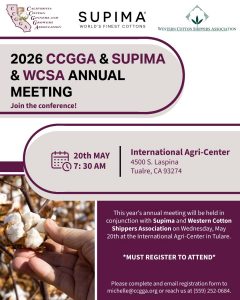
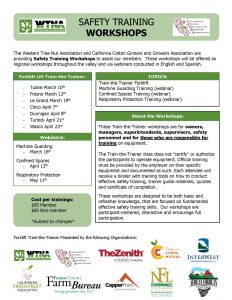
Our first regional training will be held in Tulare on March 10th! This year, the California Cotton Ginners and Growers AssociationThe ZenithFresno County Farm BureauNisei Farmers LeagueCalifornia Fresh Fruit AssociationCalifornia Citrus MutualInterWest Insurance ServicesCopperPoint Insurance CompaniesAfrican American Farmers of California, and the Western Tree Nut Association are partnering to provide Forklift Safety Train- the-Trainer workshops. 
 
As an update to our previous flyer news, the Forklift Train-the-Trainer workhops will be held in the following locations: Fresno, Tulare, Wasco, Le Grand, Turlock, and two additional locations in Dunnigan and Chico.
 
These workshops are designed for owners, managers, supervisors, safety personnel, and individuals responsible for employee training. Each participant will receive a comprehensive binder with the materials needed to understand applicable rules and regulations and to conduct effective forklift safety training. Attendees who complete the full class will also receive a certificate of completion.

In addition to the in-person workshops, the Association will host Machine Guarding, Confined Spaces, and Respiratory Protection webinars later this spring.

Training Cost:
·       $65 per person (members)
·       $85 per person (non-members)

For registration details and additional information about the workshops and webinars, please refer to the event flyer below.

2026 Regional Training Workshops

It’s that time of the year again! The Association is gearing up for the 2026 regional Train-the -Trainer workshops.
 
This year the California Cotton Growers AssociationThe ZenithFresno County Farm BureauNisei Farmers LeagueCalifornia Fresh Fruit AssociationCalifornia Citrus MutualInterWest Insurance ServicesCopperPoint Insurance CompaniesAfrican American Farmers of California, and the Western Tree Nut Association are partnering to provide Forklift Safety Train- the-Trainer workshops.

Beginning in March, these bilingual (English and Spanish) trainings will include seven in-person Forklift Train-the-Trainer workshops held in the following locations: Fresno, Tulare, Wasco, Le Grand, Turlock, and two additional locations in Zamora and Chico (these two locations TBD).

These workshops are designed for owners, managers, supervisors, safety personnel, and individuals responsible for employee training. Each participant will receive a comprehensive binder with the materials needed to understand applicable rules and regulations and to conduct effective forklift safety training. Attendees who complete the full class will also receive a certificate of completion.

In addition to the in-person workshops, the Association will host Machine Guarding, Confined Spaces, and Respiratory Protection webinars later this spring.

Training Cost:

  • $65 per person (members)
  • $85 per person (non-members)

For registration details and additional information about the workshops and webinars, please refer to the event flyer or visit https://ccgga.org/.

Association Highlight Value of California Agricultural Leadership Program as Applications Open for Class 56

Applications are now open for Class 56 of the California Agricultural Leadership Program (CALP), a premier leadership development experience for mid-career professionals shaping the future of California agriculture.
 
Led by the California Agricultural Leadership Foundation (CALF), the program has developed more than 1,500 leaders over the past five decades, many of whom now serve in influential roles across agriculture, business, government, and their communities.

Our Association is proud to count Assistant Vice President Priscilla Rodriguez (Class 50) and Assistant Vice President of Technical Services Christopher McGlothin (Class 52) among Ag Leadership alumni. Both credit the intensive 18-month program with strengthening their leadership skills and expanding their impact within the agricultural industry and beyond.
 
Association member Jake Barcellos (Class 54), a fourth-generation farmer with A-Bar Ag Enterprises, described the program as transformational: “Ag Leadership pushed me to look inward and grow not just as a better farmer, but as a more intentional leader grounded in purpose. It shaped how I show up for my community and my family.”
 
Rodriguez emphasized the broader ripple effect of the experience: “The skills I gained—especially in communication, emotional intelligence, and critical thinking—have strengthened not only my professional effectiveness, but also how I support colleagues, members, and my community.”
 
McGlothin highlighted the program’s lasting influence: “The California Agricultural Leadership Program transformed and emboldened me beyond just my professional capabilities. I have used lessons from board rooms to the family dinner table, and I credit CALF with helping me develop the skills necessary to be a leader in agriculture today.”
 
The highly selective program includes leadership development, individualized coaching, and national and international travel seminars designed to broaden perspective and prepare fellows to lead in a complex, evolving industry. The Association strongly encourages members and industry professionals seeking to grow as leaders to apply.
 
Phase one applications for Class 56 are due March 27, 2026. More information is available at www.agleaders.org/class56apply.

Another Milestone for Sites Reservoir

The Department of the Interior today approved the Record of Decision for the Sites Reservoir Project, a major off-stream storage project in Northern California. The decision authorizes the Bureau of Reclamation to provide up to 25 percent of the total cost for the 1.5 million acre-foot off-stream reservoir, which will be located west of the Sacramento River near Maxwell. Designed to capture and store water during wet periods for use in dry years, the project will strengthen reliability for communities, agriculture and the environment across the state. The action reflects the Trump administration’s priority to expand water supply, enhance system resilience and reduce regulatory delays through the direction established in Executive Order 14181. The order has driven operational improvements that delivered more than 200,000 acre-feet of additional water to the Central Valley Project, enough to supply more than 500,000 people for a year by streamlining operations and capturing storm flows that historically could not be stored. 

“President Trump made clear that federal water projects must deliver real results for American families,” said Secretary of the Interior Doug Burgum. “This administration is getting it done in record time. The Sites Reservoir Project and the gains achieved over the past year demonstrate how a disciplined, mission-focused approach can expand water reliability for communities, agriculture and the economy.” Sites Reservoir would further boost that supply. “Signing the Sites Reservoir Record of Decision represents a federal commitment to move a long-studied water storage project forward,” said Assistant Secretary for Water and Science Andrea Travnicek. “This decision reflects years of analysis, public engagement and coordination, and establishes the foundation for construction through sound partnerships that will ultimately result in additional water supplies for California.”