The California Department of Food and Agriculture (CDFA) has just issued a “pest exclusion advisory” for the “cotton jassid (Amrasca biguttula)”. The cotton jassid is a plant-sucking leafhopper that was recently discovered in the Southeastern US, specifically Florida back in January. From there, it has quickly spread to several states in the southeast. It feeds on juices in the plant leaves and creates a condition known as “hopperburn”, which stunts the plan and is characterized by yellowing, browning, curling and eventual loss of the leaves and abortion of the flowers/fruits. It is known to be pest of several plant families including cotton, grapevine, tomato, okra, eggplant, sunflower and hibiscus. It is not a strong flier and is most likely spread by wind or through movement of infected plants, particularly hibiscus. See the full advisory here.

Author Archives: ccgga
Association Attends Important Rodent Meeting at CDFA
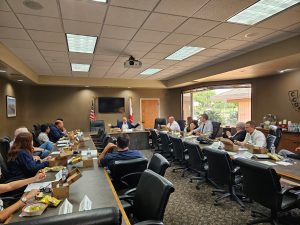
This week the Association participated in an important meeting held at the California Department of Food and Agriculture (CDFA) to discuss the ongoing rodent crisis, especially rats and squirrels. The Associations’ President/CEO Roger A. Isom kicked off the meeting by stating “the rat crisis in the San Joaquin Valley is destructive and ongoing. It is costing our growers thousands in irrigation system replacement, and we are looking to this meeting to help develop a strategy on how we are going to tackle this issue.” In addition to CDFA, other state and local agencies participating in the meeting included the California Department of Public Health (CDPH), California Department of Pesticide Regulation (CDPR), UC Cooperative Extension, and the Ag Commissioners from Fresno and Kings Counties. Industry was well represented with attendees including the California Farm Bureau, Almond Alliance of California, Almond Board of California, California Association of Pest Control Advisors, and California Citrus Mutual. Representing the California Cotton Ginners and Growers Association and the Western Tree Nut Association were Assistant Vice President Priscilla Rodriguez, and President/CEO Roger A. Isom. Isom closed the meeting by asking the participants “…to have a sense of urgency. We have a grower who has replaced his entire irrigation system three times. We have another grower who went from a yield of 4,000 pounds of almonds per acre in 2023 to only 900 pounds per acre in 2024. This cannot be sustained, and we need every tool we can get to fight this issue.”
Association Hosts Gubernatorial Candidate Steve Hilton
In partnership with the Nisei Farmers League, the Association co-hosted Republican Gubernatorial Candidate Steve Hilton for a sit down with agricultural stakeholders at the CCGGA office. With his prior experience working as a Senior Policy and Strategy Advisor within the British Conservative Party, and hosting a weekly show on Fox News in the United States, Hilton has become a more recognizable face within the crowded Governor’s race.
Hilton opened the discussion by acknowledging the difficulties of having an “R” next to the name on the ballot in California, but detailed his perspective on the frustration with the current administration’s priorities. Citing affordability for everyday Californians, energy unreliability, the limitation to develop any substantial project under the California Environmental Quality Act (CEQA), as well as the mountain of regulatory requirements levied on business, Hilton envisions that a large percentage of the state is fed up. Hilton then opened up the discussion to understand the big issues in agriculture.
Hilton heard perspective from several commodity organizations such as the Western Tree Nut Association, California Citrus Mutual, the Nisei Farmers League, California Avocado Commission, American Pistachio Growers, California Apple Commission, California Blueberry Commission, California Olive Committee as well as several business owners and operational managers. Hilton has some prior understanding of the significant issues agriculture faces such, as water availability, and increasing energy rates, and the current Federal Administration’s ongoing immigration policy, but took the time to hear from each representative on their big-ticket items.
California Water Commission Awards $10.9 Million in Early Funding for Sites Reservoir Project
The California Water Commission has approved $10.9 million in early funding for the Sites Reservoir Project through the Proposition 1 Water Storage Investment Program (WSIP). The funding will support permitting and environmental review efforts as the project advances toward construction. “This additional funding will help the Authority secure key federal and state permits that will advance Sites Reservoir closer to construction,” said Fritz Durst, Chair of the Sites Project Authority Board of Directors.
The Sites Reservoir, is designed to add 1.5 million acre-feet of storage capacity to California’s system. Once completed, the project will improve the state’s ability to capture and store water during wet years for use during droughts, while also providing dedicated supplies to protect fish and wildlife habitats.
Last month, Commissioners also recently adjusted the project’s Maximum Conditional Eligibility Determination (MCED) for inflation, increasing its potential to secure additional early funding. Project leaders say this investment reflects growing recognition of the reservoir’s role in delivering long-term reliability, flexibility, and resiliency to California’s water supply. You can see the full news release here.
Immigration Reform Discussions Continue
This week the Association attended a townhall roundtable discussion with Congressman David Valadao (22nd) and Congressman Jim Costa (21st) in Fresno, hosted by the Nisei Farmers League and the Fresno County Farm Bureau. More than 60 attendees participated in the townhall representing the agricultural, restaurant and hospitality and the construction industries. Discussion centered on the status of legislation including the Dignity Act, the Farmworker Modernization Act, and the DREAM Act. The congressman encouraged industry to get together and be united and to try and convince the President to support the effort for immigration reform. Other suggestions included getting other states, especially Republican states to help support the push for reform. Representing the Association was President/CEO Roger A. Isom and Assistant Vice President of Technical Services Christopher McGlothlin.
AECA Energy Affordability Gains Erased as CPUC Approves Massive SoCal Edison Rate Hike
Late last week legislators passed energy legislation providing important, but modest, long-term energy cost savings. This week, the California Public Utilities Commission (CPUC) erased those important gains by granting SoCal Edison a massive rate hike — nearly 25% over the next three years. Edison customers will pay over 9% more on their monthly bills, effective October 1st, and an additional ~5% each year compounded over the next three years. The total combined increase is roughly 25%, or about $2.5 billion more each year when fully implemented.
But that’s not all, consider:
- The CPUC has already awarded Edison a 1% increase to collect an additional $1.6 billion from ratepayers for their liability from the 2017 Thomas Fire in Santa Barbara County.
- Edison is seeking an additional 2% increase to cover $5.4 billion in damages from the 2018 Woolsey Fire.
- Edison is also seeking a 2.1% rate hike to increase shareholder profits following the deadly 2025 Eaton Fire.
- Since 2014, Edison rates have risen more than 80% — more than twice the rate of inflation.
- More than 860,000 Edison customers are already behind in paying their electricity bills.
- Despite spending billions on wildfire mitigation and prevention work, Edison’s equipment sparked 178 fires last year — up from 90 in 2023.
Association Co-Hosts Cotton Safety Training
Earlier this week, in partnership with Fresno County Farm Bureau and The Zenith, the Association co-hosted a pre-harvest safety training out at the Westside Research and Extension Center out in Five Points. Attendees were able to hear a presentations on equipment safety, and even get hands on with some tractors to learn how to stay safe. We would like the thank the Fresno County Farm Bureau and The Zenith for their partnership to keep workers safe during the upcoming season.
NRCS California’s Conservation Funding Assistance Deadline for Producers
The USDA Natural Resources Conservation Service (NRCS) in California has announced Fiscal Year 2026 (October 1, 2025 through September 30, 2026) federal assistance opportunities for agricultural producers, including through the Environmental Quality Incentives Program (EQIP), the Conservation Stewardship Program (CSP), and the Agricultural Conservation Easement Program(ACEP). While NRCS accepts applications for these programs year-round, interested applicants should apply no later than November 21, 2025, for the application cutoff period. “EQIP, CSP, and ACEP are amazing tools that empower our producers to turn their conservation plans into action to protect our land and natural resources. They are how NRCS partners with producers to Keep Farmers Farming,” said California State Conservationist Carlos Suarez. Application cutoff periods allow NRCS to screen and rank applications for those with the highest conservation benefits across California’s landscapes, including cropland, ranchlands, and private non-industrial forestlands. Additional signups may be announced at later dates.
CARB Chair Departs – New Chair Appointed
Governor Gavin Newsom has abruptly announced that California Air Resources Board (CARB) Chair Liane Randolph will be retiring from state service effective September 30, 2025, and named Senior Advisor to the Governor for Climate Lauren Sanchez to serve as the next CARB Chair. Randoph departs the Board after five years of service as Chair. What can we expect from the new Chair? This is what the Governor had to say about Sanchez: “Lauren has been my most trusted climate advisor and the chief architect of California’s bold climate agenda — helping deliver billions in new investments and cementing our state’s role as the global leader in the fight for a clean, healthy, job-creating future.
Sanchez has been Senior Advisor for Climate in the Office of Governor Gavin Newsom since 2021. She was Senior Advisor for the Special Presidential Envoy for Climate in the Biden-Harris Administration in 2021. Sanchez was Deputy Secretary for Climate Policy and Intergovernmental Relations at the California Environmental Protection Agency from 2019 to 2021. She was International Policy Director at the California Air Resources Board from 2018 to 2019. Sanchez was a Climate Negotiator at the United States Department of State from 2015 to 2017. Sanchez earned a Master of Science degree in Environmental Management from Yale University and a Bachelor of Arts degree in Environmental Studies and Biology from Middlebury College. Sanchez will begin her term on October 1, but the position does require Senate Confirmation.
Court Upholds Pesticide Use Permit Authority in Monterey
In a significant victory for agriculture, the Monterey County Superior Court decided in favor of California Department of Pesticide Regulation (DPR) and County Ag Commissioner’s authority to issue restricted material’s permits for fumigant use in Monterey County. Petitioners from 4 local teachers unions had challenged the existing authority for the government agencies to approve the use of restricted materials of chloropicrin and 1, 3-dichloropropene to fumigate fields intended to be planted in strawberries for applications proposed during the 2023 season.
The Court rejected Petitioners’ arguments. The administrative record could not be expanded beyond what was presented to both CAC and Director. The “post hoc rationalization” theory failed because CAC inspectors performed their evaluations before issuance, and written explanations are only required when review is requested. The claim that CACs have authority to stay permits was forfeited and contrary to the statute, which grants stay authority only to the Director. Finally, Petitioners’ “pattern and practice” claim could not stand once the core CEQA-based challenges failed.
This is a huge win for the industry, while also affirming DPR and the Ag Commissioner’s authority to issue restricted material permits.