At last week’s California Occupational Safety and Health Standards Board public hearing, the Board heard recommendations for revisions to the proposed First Aid kit Standard, particularly the inclusion of naloxone (Narcan) and the removal of detailed kit content tables from regulation.
During public testimony the Association’s Assistant Vice President Priscilla Rodriguez addressed the Board regarding the practical challenges of requiring naloxone, commonly known as Narcan, in first aid kits. Rodriguez explained that naloxone must be stored in a cool temperature to maintain stability, a requirement that would be extremely difficult to meet in farming and agricultural operations. She noted that first aid kits are commonly stored in supervisors’ vehicles or in shaded area environments that routinely exceed recommended storage temperatures. As a result, compliance could prove nearly impossible.
Rodriguez also opposed the proposal to remove the table listing required first aid kit contents and instead rely solely on reference to the ANSI first aid kit standard. She emphasized that eliminating the detailed list from the regulation would require employers to purchase the ANSI standard to determine what is required for compliance. “Workplace safety regulations should be accessible to all employers,” she testified, noting that regulated parties should not have to buy a private standard in order to understand legal requirements.
The Associations formally opposed both the inclusion of naloxone in mandated first aid kits and the removal of explicit kit content language from the regulation. The Standards Board will continue deliberations as part of its broader effort to revise California’s first aid kit standard.
Author Archives: ccgga
Isom Addresses AgSafe Activate on CalOSHA Serious Violations
Association President/CEO Roger A. Isom addressed the crowd at this past week’s Annual AgSafe Activate 2026 meeting in Monterey, California. Isom reported on the recent changes in CalOSHA Appeals with regards to violations classified as serious. “You are no longer dealing with Division Managers” commented Isom. “You are dealing directly with legal counsel, who have less experience with equipment and plant operations, and see things in black and white, period!” Isom also reported that he has worked on serval cases in recent months and legal counsel is less inclined to negotiate and are working under a “Do not settle” mindset. Isom lamented “This is not your Daddy’s CalOSHA!” stating that if an employer challenges, then legal counsel is inclined to go directly to a hearing with little, if any, negotiation. With serious violations costing $18,000 each, this is a major development and should have the attention of every employer. Isom encouraged attendees to be as proactive as possible, stating “Every employer needs to have a disciplinary program for failure to follow safety rules, and you must enforce it.” Failure to do so, not only exposes the employer to more potential accidents, but it also severely limits your ability to fight them down the road.
2026 Regional Training Workshops
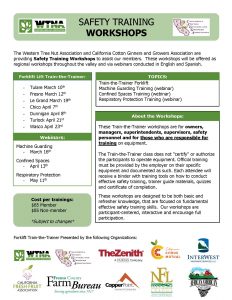
Our first regional training will be held in Tulare on March 10th! This year, the California Cotton Ginners and Growers Association, The Zenith, Fresno County Farm Bureau, Nisei Farmers League, California Fresh Fruit Association, California Citrus Mutual, InterWest Insurance Services, CopperPoint Insurance Companies, African American Farmers of California, and the Western Tree Nut Association are partnering to provide Forklift Safety Train- the-Trainer workshops.
Beginning in March, the Forklift Train-the-Trainer workshops will be held in the following locations: Fresno, Tulare, Wasco, Le Grand, Turlock, and two additional locations in Dunnigan and Chico.
These workshops are designed for owners, managers, supervisors, safety personnel, and individuals responsible for employee training. Each participant will receive a comprehensive binder with the materials needed to understand applicable rules and regulations and to conduct effective forklift safety training. Attendees who complete the full class will also receive a certificate of completion.
In addition to the in-person workshops, the Association will host Machine Guarding, Confined Spaces, and Respiratory Protection webinars later this spring.
Training Cost:
· $65 per person (members)
· $85 per person (non-members)
For registration details and additional information about the workshops and webinars, please click here.
USDA Opens Signup for Farmer Bridge Assistance
The U.S. Department of Agriculture (USDA) announced that enrollment is now open for the Farmer Bridge Assistance (FBA) program, providing direct financial support to eligible producers based on 2025 planted acreage. Cotton growers will receive the second-highest payment rate under the program at $117.35 per acre.
Producers with a Login.gov account can access and submit their pre-filled FBA applications online. Growers who do not have a Login.gov account may obtain and complete their pre-filled application by visiting their local Farm Service Agency (FSA) office.
The deadline to submit FBA applications is April 17, 2026. Payments will be calculated based on 2025 planted acres as reported to FSA on Form FSA-578. According to USDA, payments are expected to begin hitting producers’ bank accounts as early as February 28.
Cotton’s payment rate of $117.35 per acre reflects its continued importance in U.S. agriculture and the financial pressures facing producers. Payment rates for all eligible commodities are available through USDA.
State Increases Water Allocation for State Water Project
The Department of Water Resources (DWR) has announced an increase to the State Water Project (SWP) allocation for 2026. The allocation is now 30 percent of requested supplies, up from the initial allocation of 10 percent on December 1. Storms in mid-December have made it possible for the SWP to increase the expected amount of water deliveries this year to the 29 public water agencies served by the SWP, which provides water to 27 million Californians and 750,000 acres of farmland. SWP allocations are based on a number of factors including hydrological conditions, existing reservoir storage, and an assumption of dry conditions through the rest of the year. The assumption of dry conditions is increasingly important given the shrinking and warming of California’s traditional precipitation season. In December, all of California benefited from winter storms. However, January has been unseasonably dry and warm and, as a result, snowpack and precipitation are below average for this time of year. Despite the dry January, California’s reservoirs remain above average at 125 percent statewide. Lake Oroville, the SWP’s largest reservoir, is at 138 percent of average for this time of year. In December, the SWP received approval from the California Department of Fish and Wildlife for an amendment to their Incidental Take Permit (ITP) that helps guide operations of the SWP. This amendment allows for flexibility in decision-making around fish protection actions, including for a pumping reduction known as a “first flush” action. First flush is triggered when early winter storms swell river flows. DWR analysis shows that the rules triggering these actions can sometimes be relaxed without impacts to listed species. That flexibility allowed the SWP to capture 15,000 acre-feet of additional water supply in December and January, enough to support 45,000 homes for a year. The SWP will continue utilizing real-time operational flexibility to benefit water users and the environment.
Registration Now Open for 2026 NCGA Gin School
The National Cotton Ginners Association (NCGA) announced the opening of registration for the 2026 Gin School circuit. The registration website has been updated, and the process is easier than ever. Interested parties can now register multiple attendees in one page, and can select multiple gin schools if interested in attending the regional events. Each of the locations will provide attendees with Level 1, 2, 3 and Continuing Education offerings for those interested. The dates for the schools are as follows:
- April 4th – 6th, Southwest Ginners School, Lubbock, TX
- May 5th – 7th, Western Ginners School, Mesilla Park, NM
- June 2nd – 4th, Stoneville Ginners School, Stoneville, MS
If interested, please follow the link to register for the school(s) and levels you are interested in attending. https://ncga.cotton.org/ginschool/
Association Hosts Assemblyman David Tangipa
This week, the California Cotton Ginners & Growers Association was happy to welcome Assemblyman David Tangipa (AD 08) for a tour of Fresno County agriculture. Enduring a break in the rain, the Assemblyman grew a couple inches taller maneuvering through the muddy conditions in the gin yard at Pacific Ginning Company in Cantua Creek. Gin manager, and CCGGA Board Member, Matt Toste showed the Assemblyman the detailed ginning process from module to finished bale. After the gin tour, the Assemblyman was then taken to Errotabere Ranch to meet with CCGGA member Dan Errotabere for lunch. The group spent time talking about impactful regulations on the agricultural industry, what the updated water allocations mean for ag, and the current difficulties with ag labor in the post ag-overtime world.
The Association would like to thank Assemblyman Tangipa and his District Director, Austin Gilbert, for taking the time to visit with CCGGA Members.

California Farmworker Foundation 2026 Nueva Generación Scholarship Program
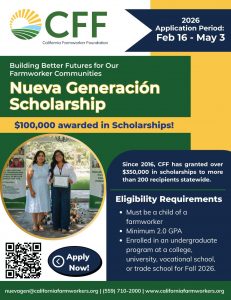
The California Farmworker Foundation (CFF) is excited to share that their 6th Annual Nueva Generación Scholarship Program is now open for applications from February 16th – May 3rd. The Nueva Generación Scholarship Program was designed to assist students from farmworker families pursuing higher education. Please see the attached PDF flyer for all important details. Students can apply by scanning the QR code on the flyer, which will take them directly to the Google form.
CalOSHA Issues Proposed “Walkaround Rule”
Almost two years ago, Federal OSHA issued a final rule addressing the workplace inspection process. Accordingly, CalOSHA is now proposing to adopt and implement those same requirements at the state level. Essentially, the regulation will allow a representative of the employer and a representative authorized by the employees shall be given the opportunity to accompany the Division’s inspector during an inspection. The proposal clarifies who may be considered a representative authorized by the employees when that representative is not an employee of the employer subject to the inspection. Under the amended rule, a third party may be deemed a representative authorized by employees when, in the judgment of the Compliance Safety and Health Officer, good cause has been shown why their presence is reasonably necessary for an effective and thorough inspection. The rule describes that a third party’s presence may be reasonably necessary based on their “relevant knowledge, skills, or experience with hazards or conditions in the workplace or similar workplaces, or language or communication skills.”
The proposed rule contains four primary provisions. The first provision is added, to allow both a representative of the employer and a representative authorized by employees to accompany the Cal/OSHA inspector during the inspection of the worksite. It also authorizes the Cal/OSHA inspector to allow multiple representatives for employer and employee and authorizes the inspector to resolve any disputes as to who the representatives are. The employer or employee representative may object to someone’s participation in the workplace inspection, and the inspector is authorized to make a final and immediate decision to avoid delays or interference with the inspection process.
The second provision establishes who may be designated as the representative authorized by employees for purposes of accompanying the inspection. Where the employee representative is an employee of the company or the collective bargaining (union) representative, they will be allowed to accompany the inspector. If the authorized representative of employees is someone other than an employee or collective bargaining representative, it must be shown that their accompaniment is reasonably necessary for an effective and thorough inspection. There may be various reasons why the third-party representative’s participation may be reasonably necessary, including their knowledge of the workplace, the industry, the hazards involved, or their ability to communicate with hard-to-reach employees in the workplace. The inspector will make the determination as to whether the third-party representative may accompany the inspection.
The third provision is added to establish the inspector’s authority to lead the inspection and make sure that the conduct of the representatives who participate does not interfere with the effectiveness of the workplace inspection. This subsection allows the inspector to limit the representative’s interactions, such as arguments, with each other, and even to remove a representative from the inspection process if their conduct interviews with the inspection.
The final provision is added to allow the employer to protect trade secrets, by requiring that any employee representative in an area containing trade secrets be an employee of the company. If this requirement results in excluding the only available employee representative, then the inspector will be required to interview employees who work in the area as part of the inspection.
A hearing will be held on April 1, and the Association will be weighing in.
Cotton & Coffee is Next Week – Tuesday, February 17th, at 7:30 a.m. Central

Cotton & Coffee is Next Week – Tuesday, February 17th, at 7:30 a.m. Central.
We hope you’ll join us next week to learn how Cotton Incorporated works to keep cotton competitive, through innovation, in the apparel and home textile markets. You don’t want to miss it!
To register, click here.
Meeting ID: 816 8722 3277
Passcode: Cotton1